

Calendar
The following calendar includes all important dates and deadlines to help you with planning for your upcoming programme. You will receive an email with log-in details for the learning platform and connection details for the kick-off call one week before the programme starts.
Note: Dates or times may be subject to change. Once the programme begins, consult the learning platform for the final version of the programme calendar.
| Event/deadline | Date |
| Programme Launch and Kick-off Call | 23 February - 1:00 pm - 2:00 pm CET |
| Live Call #1 with Faculty | 18 March - 2:00 pm - 3:30 pm CET |
| Live Call #2 with Faculty | 9 April - 2:00 pm - 3:00 pm CEST |
| Final Assignment due | 20 April |
| Final Assignment Review due and close of programme | 29 April |
| Learning Platform access ends | 26 August |
| Premium Journey participants will have access to the course content for 12 months from the programme start date. | |
Attendance to the Kick-off and Live Call sessions is highly recommended but not mandatory. For those unable to join, the session will be recorded and made available on the platform.
| Event/deadline | Date |
| Programme Launch and Kick-off Call | 11 May - 1:00 pm - 2:00 pm CEST |
| Live Call #1 with Faculty | 4 June - 2:00 pm - 3:30 pm CEST |
| Live Call #2 with Faculty | 25 June - 2:00 pm - 3:00 pm CEST |
| Final Assignment due | 6 July |
| Final Assignment Review due and close of programme | 15 July |
| Learning Platform access ends | 11 November |
| Premium Journey participants will have access to the course content for 12 months from the programme start date. | |
Attendance to the Kick-off and Live Call sessions is highly recommended but not mandatory. For those unable to join, the session will be recorded and made available on the platform.
Faculty

Professor of Strategy
Syllabus
Programme Overview
Today, powerful and interconnected technologies mean any businesses going through a digital transformation journey will be handed lucrative opportunities but will also have to face dramatic threats.
At its base, inexpensive bandwidth and versatile smartphones make digital a ubiquitous part of modern life. The cloud now conveniently and inexpensively packages incredible processing power and digital storage.
Data and Artificial Intelligence has turned traditional computer programming upside down. We can leverage this technology to target consumers on an unprecedented scale increasing the possibilities for new products, services and business models in almost every sector of the economy even those where digital has already brought important changes.
And yet, although the long-term impacts of digital promise to be deep and far reaching, the path to this future for industries, companies and consumers is proving far from linear or predictable. Often claims of impending disruptions do not materialise, at least in the time frame or manner predicted.
A carefully considered, strategic response is invaluable in approaching digital transformation so that your business remains sustainable and agile in the ever-changing environment.
This programme provides the strategic tools, concepts and perspectives that will help you to develop a strategic response and to then align your organisation for effective strategy execution.
It will support you in becoming more proactive in the digital domain, help you turn digital threats into opportunities, and allow you to leverage digital to create competitive advantage and enhanced performance.
Programme Learning Objectives:
- Demonstrate how digital is transforming the industry value chain, patterns of demand and competitive pressures that impact your industry and equip you with the tools and frameworks to formulate a strategic response.
- Leverage digital to develop compelling value propositions that help you to turn a threat into an opportunity.
- Execute on digital strategies by aligning key activities across your organisation with new value propositions and by balancing strategic agility for a digital world with the longer-term sustainability required to build key resources.
Please note: In this course, you will engage with AI-powered tools designed to enhance your learning experience, enabling more practical, personalised, and immersive exploration of the concepts covered. The use of Vstrat is completely optional and is not required to complete the programme or assignments.
Important: AI tools can make mistakes and be inaccurate. Please fact-check outputs and ensure that any information you disclose complies with applicable confidentiality obligations and your organisation’s policies.
-
Launch Week
-
This week is laying foundations for the overall programme, starting with the exploration of how technology is shaping the world around us. It continues with clarifying what is meant by digital industrial revolution and explaining why digital is driving ever-greater interest. It also explores the links to the original industrial revolution.
Finally Professor Zemsky shares a personal example of coming up with a digital response to changing environment.In Launch Week, you will also find guidance on how to make the most of the course, information on course completion and certification requirements, and an overview of the journey you will take over the next 8 weeks. You will learn how to navigate the platform and about the different functionalities available.
You will also find out about the “Action Learning Project” (ALP). The ALP is an integral part of the online course. It offers you the opportunity to apply your learning to explore ways to apply programme concepts to come up with a digital strategy based on a winning value proposition. The objective of the ALP is to reinforce your learning and develop a tangible action plan for your project.Learning Objectives:
- Understand the challenges and opportunities of living in a digital world.
- Gain insight about Digital Industrial Revolution. Is it hype or reality?
- Learn some lessons from the original industrial revolution that still hold true today.
-
Week 1: Getting FIT for a Digital Age
-
This week introduces the overall strategic framework we will use to assess potential digital opportunities and to shape strategy formulation and execution in response. We will find that it is important to not only clarify the meaning of digital disruption, but also of strategy itself. This week reviews complementary approaches to strategy: (i) assuring fit between the company and its changing environment and (ii) resource allocation to achieve well-defined objectives. We will consider how digital can shift the set of activities and players in an industry value chain.
This week we will also start forming an understanding of AI and explore to what extent deep knowledge of technology is necessary to derive value from it.
Finally, we will discuss the most important aspects of digital transformation and why some companies struggle more than others.Learning Objectives:
- Review key approaches to business strategy and understand how they are useful in meeting the challenge of digital disruption.
- Get introduced to the overarching FIT framework that will be developed throughout the programme to analyse environment, value proposition and organisations’ readiness in digital context.
- Become familiar with the industry value chain to map the set of activities and players in your external environment and the ways they are shifting with new digital technologies.
- Understand the basics of AI from business perspective and learn what it means to be tech savvy.
- Learn about five focus areas of digital transformation.
-
Week 2: Follow the Value
-
A focus on value provides a powerful compass for navigating the changes created by digital. The second week of the programme introduces the key concepts of value creation, willingness-to-pay (WTP) and resource costs, and then illustrates how to use them to assess the impact of new products and technologies. We will leverage the value approach to deepen our analysis of the external changes impacting your business.
This week also explores the concept of social value and how the shifting attitudes towards technology can impact perceived value creation.Learning Objectives:
- Learn how to assess new digital possibilities.
- Get introduced to the value approach to digital strategy, including the definition of value creation and its drivers.
- Gain the ability to apply the concept of willingness-to-pay in both B2C and B2B settings, with a particular focus on new and emerging products and technologies.
- Develop an understanding of social value and importance of sustainability in digital strategy.
-
Week 3: Competing with Value
-
Week 3 continues our focus on how digital can transform the industry landscape, with a shift in focus from value creation to value capture. How can you ensure that you have a robust business model that not only creates value for society, but also positions you to capture a significant share? Digital can both fuel intense competition and lead to winner-take-all dynamics.
Learning Objectives:
- Understand how value capture depends on the competitive dynamics among the players that collaborate in value creation.
- Recognize the critical role of positive feedback in allowing digital to not only increase competitive pressures, but also create highly profitable positions within the industry value chain. See how data can increase the chance of creating positive feedback scenarios.
- Apply the concept of added value to understand competitive advantage.
-
Week 4: Executing on Digital
-
How to execute on a digital strategy? This week focuses on the tension between the need for greater strategic agility in a digital world and the traditional need for a longer-term orientation. With ever-greater industry ‘clock speed’, strategy analysis and formulation needs to become an ongoing process informed by the learning from strategy execution. At the same time, success still depends critically on having the longer term perspective required to develop a coherent strategy, where the value proposition, organisational activities and underlying resources are aligned.
This week will also explore what it takes to create a data culture in an organisation to deliver on digital strategies. We will also discuss some myths and truths around executing on AI strategies.
Learning Objectives:
- See how agility is critically important in a digital world and that more than ever strategy needs to be an ongoing process integrating execution with formulation and analysis.
- Develop your ability to identify the key resources built over time that are required for strategy execution and to anticipate how digital may be shifting the nature of key resources.
- Learn how to foster a data culture in your organisation.
- Gain insight on what to consider when executing on AI strategies.
-
Week 5: Seeing the Big Picture
-
In this final week of the course we will take a holistic view on crafting and executing digital strategy. With the help of a new strategic tool – the company value chain – you will discover how key organizational activities are critical to delivering new digital value propositions, as well as how those activities themselves can be transformed by digital. We will also explore strategic partnerships which offer an important route in a digital world for achieving agility given current resource constraints, while also allowing you to build new resources needed for the future..
Learning Objectives:
- Develop a big picture understanding of how different elements come together in execution on digital strategy.
- Understand the role of partnerships to enhance strategic agility by filling resource gaps, while also providing opportunities to develop new resources.
- Use the company value chain to ensure activities within the organisation across key functions and competencies are aligned with the value proposition.
- Learn about potential AI traps and pitfalls.
-
Final Assignment and Review
-
The final weeks are for you to synthesise your learning from the programme into a compelling Final ALP Assignment submission. You will also have the opportunity to exchange feedback on the Final ALP Assignment with your peers. No new course content will be released in these weeks.
Learning Journey
This overview outlines the learning journey you will follow from the programme launch (kick-off session) to certification upon completion of the programme. It will be covered in more detail during the kick-off call.
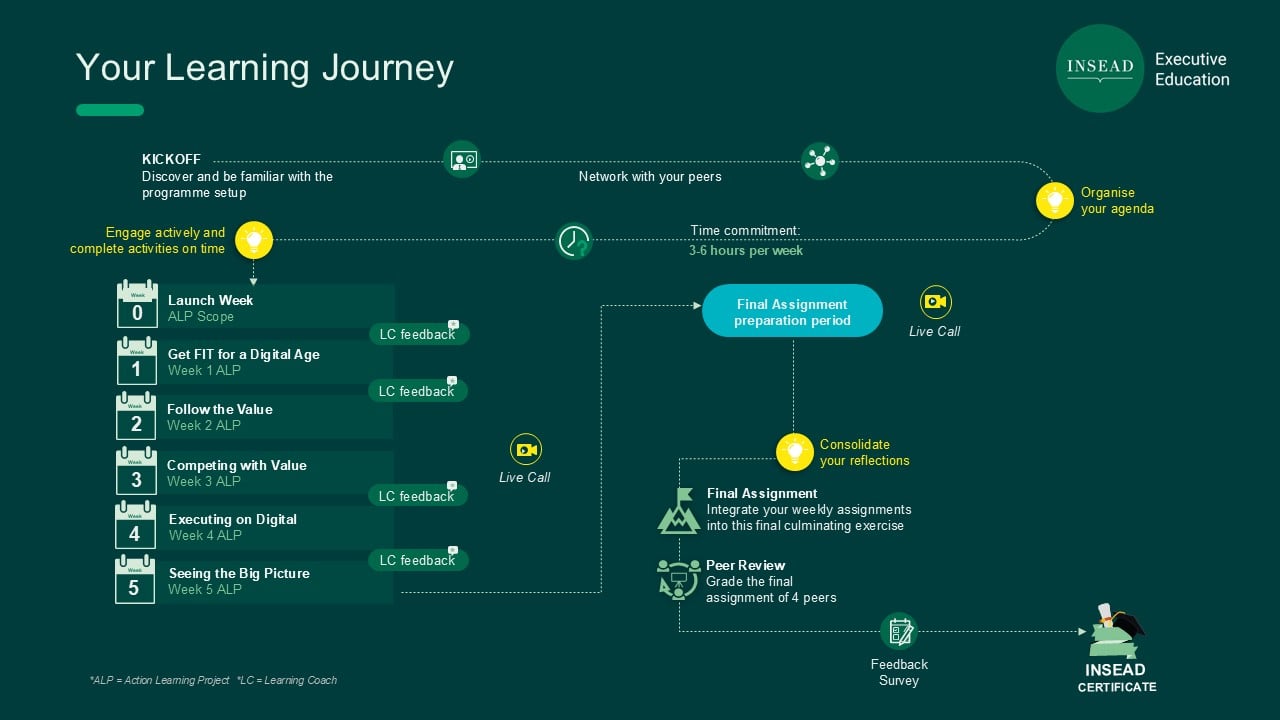
For specific dates, see calendar above.
Action Learning Project
Introduction
This Action Learning Project (ALP) is designed to help you come up with a concrete strategy plan in the face of digital disruption in your industry. You might already have a clear view on how digital is impacting your industry but do not have a strategy to tackle it, or you might still be debating whether and how digital disruption will play out in your industry, or you might already have existing initiatives – or at least rough plans – for how to respond to the disruption.
You want to wrap your head around the digital threats and opportunities facing your industry and your organization, and then explore how best to respond to these changes by leveraging digital to enhance the competitive position of your organization. This could be in the form of a new strategy or it could build on your current thinking and existing strategy.
In this ALP you will:
- Systematically analyze the nature of digital disruption facing your industry and challenge your current assumptions, if any.
- Formulate a strategic response from scratch or review and revise your existing strategy by leveraging digital to enhance your value proposition.
- Prepare and adapt for strategy execution by mapping your chosen value proposition into organizational activities and resources, assuring strategic agility through the use of pilots and experiments
Please start thinking about the strategy problem you want to work on, so that you have a specific project in mind when the programme launches.
You can work individually or, when applicable, together with other members of your organisation who are also taking the course to deliver your ALP (if you are attending the programme as a group from one organisation, you may work together on the same project in small groups of maximum 4–5 members).
What to Expect for the Final Assignment
For the final assignment, you need to present your digital strategy plan. Be sure to highlight the links between each area:
- Why have you chosen your selected technology, use case and target customer segment?
- What are the essential elements of your value proposition?
- What are the keys to executing on your value proposition? How can you deal with uncertainties?
Conclude yoru final assignment with an immediate action plan. What are the next steps you would need to focus on to take your strategy formulation and execution forward?
Your final deliverable will be a high-level written final presentation based on your weekly ALP submissions and outlining your digital strategy plan.
Coaching Touchpoints
INSEAD's learning coaches are accomplished business professionals who will guide you through your learning journey. Your coach will be assigned to you in Week 1 of the programme.
Learning Coach Intervention Rhythm
Your coach will spend, on average, 2 hours in total during the programme on your Action Learning Project (ALP), whether you are working on it individually or in a company group with your colleagues.
You will have 4 touchpoints with your Learning Coach:
- Touchpoint #1: Before Week 1 ends, to discuss the scope of your ALP
- Touchpoint #2: After Week 1 closes, for feedback on Week 1 ALP assignment submission
- Touchpoint #3: After Week 3 closes, for feedback on Weeks 2 & 3 submissions
- Touchpoint #4: Choose between Option A or B
- Option A: After Week 4 closes, for feedback on Week 4 submission, combined with guidance on Week 5 Reflections and Final Assignment.
Or - Option B: Feedback on the draft of your Final Assignment only. In this case, your Learning coach will focus the feedback on how to improve your Final Assignment (drawing from your ALP journey so far) and NOT on how to pass the course. Coaches will not give indications or recommendations on grading
- Option A: After Week 4 closes, for feedback on Week 4 submission, combined with guidance on Week 5 Reflections and Final Assignment.
You should work closely with your Learning Coach to plan the best schedule for your submissions and feedback. Please note that you will only receive feedback (written or via call) once for each coaching touchpoint. You should reflect on the feedback you receive from your Coach and incorporate any updates in the following ALP assignments and/or the Final Assignment.
For Premium Journey participants, you will receive an additional 2 hours of ALP coaching on top of the standard allocation mentioned above. You have up to 1 month after the Final Assignment Review deadline to schedule your coaching sessions.
Certification Requirements
To successfully complete the programme and earn certification, you are required to meet all of the following criteria:
- Earn a minimum of 80% of available points from in-platform activities by the Final Assignment deadline
- Earn a minimum of 60% of available points from your Final ALP assignment submission and review by the Final Assignment Review deadline
More information will be provided in the learning platform.
Programme Brochure
For a copy of the online programme brochure, visit the dedicated Executive Education page.
