

Calendar
The following calendar includes all important dates and deadlines to help you with planning for your upcoming programme. You will receive an email with log-in details for the learning platform and connection details for the kick-off call one week before the programme starts.
Note: Dates or times may be subject to change. Once the programme begins, consult the learning platform for the final version of the programme calendar.
| Event/deadline | Date |
| Programme Launch and Kick-off Call | 9 February - 1:00 pm -2:00 pm CET |
| Negotiations Preferences Assessment (NPA) | 16 February |
| Live Call #1 with Faculty | 6 March - 11:00 am - 12:00 pm CET |
| Live Call #2 with Faculty | 18 March - 11:00 am - 12:00 pm CET |
| Final Assignment due | 7 April |
| Final Assignment Review due and close of programme | 15 April |
| Learning Platform access ends | 9 August |
Attendance to the Kick-off and Live Call sessions is highly recommended but not mandatory. For those unable to join, the session will be recorded and made available on the platform.
| Event/deadline | Date |
| Programme Launch and Kick-off Call | 28 September - 1:00 pm -2:00 pm CEST |
| Negotiations Preferences Assessment (NPA) | 5 October |
| Live Call #1 with Faculty | 23 October - 11:00 am - 12:00 pm CEST |
| Live Call #2 with Faculty | 4 November - 11:00 am - 12:00 pm CET |
| Final Assignment due | 23 November |
| Final Assignment Review due and close of programme | 2 December |
| Learning Platform access ends | 28 March 2027 |
Attendance to the Kick-off and Live Call sessions is highly recommended but not mandatory. For those unable to join, the session will be recorded and made available on the platform.
| Event/deadline | Date |
| Programme Launch and Kick-off Call | 1 February - 1:00 pm -2:00 pm CEST |
| Negotiations Preferences Assessment (NPA) | 8 February |
| Live Call #1 with Faculty | 24 February - 11:00 am - 12:00 pm CET |
| Live Call #2 with Faculty | 10 March - 11:00 am - 12:00 pm CET |
| Final Assignment due | 30 March |
| Final Assignment Review due and close of programme | 7 April |
| Learning Platform access ends | 1 August 2027 |
Attendance to the Kick-off and Live Call sessions is highly recommended but not mandatory. For those unable to join, the session will be recorded and made available on the platform.
Faculty

Professor of Management Practice of Decision Sciences
Syllabus
Programme Overview
All of us negotiate all the time. Whether it is buying or selling, managing or working for others, dealing with friends, family, colleagues or workplace hierarchies, negotiation informs everything we do, every day. But how successful we are can vary, and forging agreement among people with diverse interests, perceptions or values can be challenging, whatever the context.
Strategic Negotiations introduces you to the INSEAD Value Negotiation (VN) system. Developed using faculty research, the VN system deploys evidence-based and practice-tested tools and frameworks that accelerate your understanding of win-lose and win-win strategies. The VN system enhances any negotiator’s sophistication by introducing the strategic dimension to negotiation, while also consistently expanding its diagnostic and implementation dimensions.
You explore how to choose between win-lose or win-win, when each strategy is most likely to be effective, and how strategic negotiation can drive effective, long-term outcomes.
You emerge with the insight and the real-world skills to make superior strategic evaluations and implementation choices, and maximise sustainable impact and value.
Programme Learning Objectives:
- Expand your ability to address negotiation challenges with a strategic mindset.
- Learn how to embrace a versatile approach to succeed in any negotiation.
- Become able to diagnose and embrace a probabilistic approach to maximise value and reduce risks in every type of negotiation.
- Accelerate your efficiency, build better relationships with fewer conflicts, drive more engagement and gain more confidence to deliver superior outcomes.
- Leverage hands-on practice to address weak points and optimise strengths back in the workplace.
-
Launch Week
-
In the Launch Week, you will find guidance on how to make the most of the programme, information on certification requirements, and an overview of the learning journey. You will learn how to navigate the platform, get to know your faculty and peers.
You will find information on how to organise your negotiation role play exercises, your coaching sessions and how to complete the Negotiation Preferences Assessment (NPA).
You will also find out about the “Action Learning Project” (ALP). The ALP is an integral part of the online course. It offers you the opportunity to apply your learning and to prepare for an upcoming negotiation. The objective is for you to synthesize your strategic analysis and recommendations on how best to approach it.
Note: In order to successfully pass this programme, you must complete your ALP to a high standard.
-
Week 1: Value Negotiation Principles
-
To start, we will look at some of the foundations of the Value Negotiation (VN) system. The VN system has been developed at INSEAD by Prof. Falcao. It builds on several negotiation systems, to create a coherent, effective, strategic, and international negotiation system. Ultimately, the VN system aims to help negotiators maximize rewards at minimum risk in the widest range of situations.
Learning Objectives:
- Define negotiation, win-win, win-lose, value and power correctly as fundamental concepts.
- Identify the risk and reward of different negotiation choices.
- Apply the best communication strategies right from the start of a negotiation.
- Practice substituting crippling assumptions for empowering ones.
-
Week 2: Start from the End: Defining Success
-
During week 2 we cover VN’s main framework: the 7 elements. This framework helps us become more disciplined in our views of negotiation, more precise and thus efficient with our language, and overall better negotiators. We apply the 7 elements as a structure to the several steps in a negotiation, from preparing, to defining your mandate and your preferred outcome (your vision of success), to diagnosing the different challenges and opportunities, to negotiating with confidence and clarity, to debriefing and learning from your experience, all the way to successfully reporting your outcome back to your constituents.
Learning Objectives:
- Define what success means in a negotiation.
- Identify ways to define success that can make your negotiation easier or harder to succeed.
- Apply a 7 element framework to create a clear yet flexible vision of success.
- Practice thinking, talking and diagnosing the 7 elements.
-
Week 3: Strategy for Negotiation: Best Practices
-
In week 3, we dive into the more strategic nature of the VN system and introduce its 2nd main framework: the 3 negotiations. The 3 negotiations framework improves our ability to align our moves and diagnose our counterparty patterns according to win-win or win-lose strategies. Being consistent and understanding our trade-offs is paramount to choosing moves that build of each other and improve our odds of reaching our desired outcome.
Learning Objectives:
- Define the three negotiations, and their respective win-lose and win-win strategies.
- Learn how to strategically frame negotiations before you reach the table.
- Understand; the connection, opportunities, and traps between the 3 negotiations.
- Lead and balance all strategic aspects of your negotiation and minimise last minute surprises.
-
Week 4: Relationship Building and Trust
-
Many argue that negotiations require trust, especially when negotiating win-win. While that statement is not true, and a skilled negotiator can negotiate win-win successfully without trust, trust does make negotiation and win-win strategies significantly easier to implement. As such, relationship and trust building are great assets for any negotiator’s toolbox. During this week, we will breakdown relationship and trust building into small, replicable, and detailed moves that any learned negotiator can implement independently of their previous ability.
Learning Objectives:
- Defining trust and what a good relationship really means.
- Recognise relationship building mistakes in negotiation that cost money or fail to build trust.
- Learn efficient and positive short and long-term relationship building strategies.
- Practice how to counter aggressive or manipulative moves.
-
Week 5: Navigating the Value Tension: Balancing Value Creation and Claiming
-
Every negotiation presents the value tension as one of its main challenges: do I help create value, but in the process share information that risks helping my counterparty claim more value at my expense; or do I skip value creation, but in doing so have a smaller pie to claim from? It seems like a Catch 22, where you are doomed if you do or doomed if you don’t. In week 5, we cover how you can negotiate that tension so that you can maximize value creation and still position yourself for a successful value claiming exercise, thus allowing you to claim your fair share from a bigger pie for a superior outcome.
Learning Objectives:
- Understand the tension between value creation & claiming, and how to minimise it.
- Learn advanced value creation and claiming techniques.
- Prepare to overcome the main value creation enemies or obstacles within and surrounding your negotiation.
- Learn how to claim value consistently with a win-win process and without bargaining.
-
Final Assignment and Review
-
The last two weeks are for you to synthesise your learning from the programme into a compelling Final ALP submission, building on your reflections from your weekly ALPs. Throughout the programme, you will have the opportunity to receive guidance from your coach, and draw from that feedback and experience to develop and fine tune your execution plan.
-
Role Plays
-
This programme includes 5 one-on-one role-play exercises. These simulated negotiations will offer you an opportunity to practice various tactics in a low-risk setting that not only helps improve your skills, but also boosts your confidence, a key ingredient to negotiation success. You will also have the opportunity to observe recordings of negotiations with the expert commentary of Professor Falcao. Each case is designed to help you focus on the key concepts covered in the corresponding week. Please note that these role-plays are mandatory for your programme completion. More details will be provided during the kick-off call.
Learning Journey
This overview outlines the learning journey you will follow from the programme launch (kick-off session) to certification upon completion of the programme. It will be covered in more detail during the kick-off call.
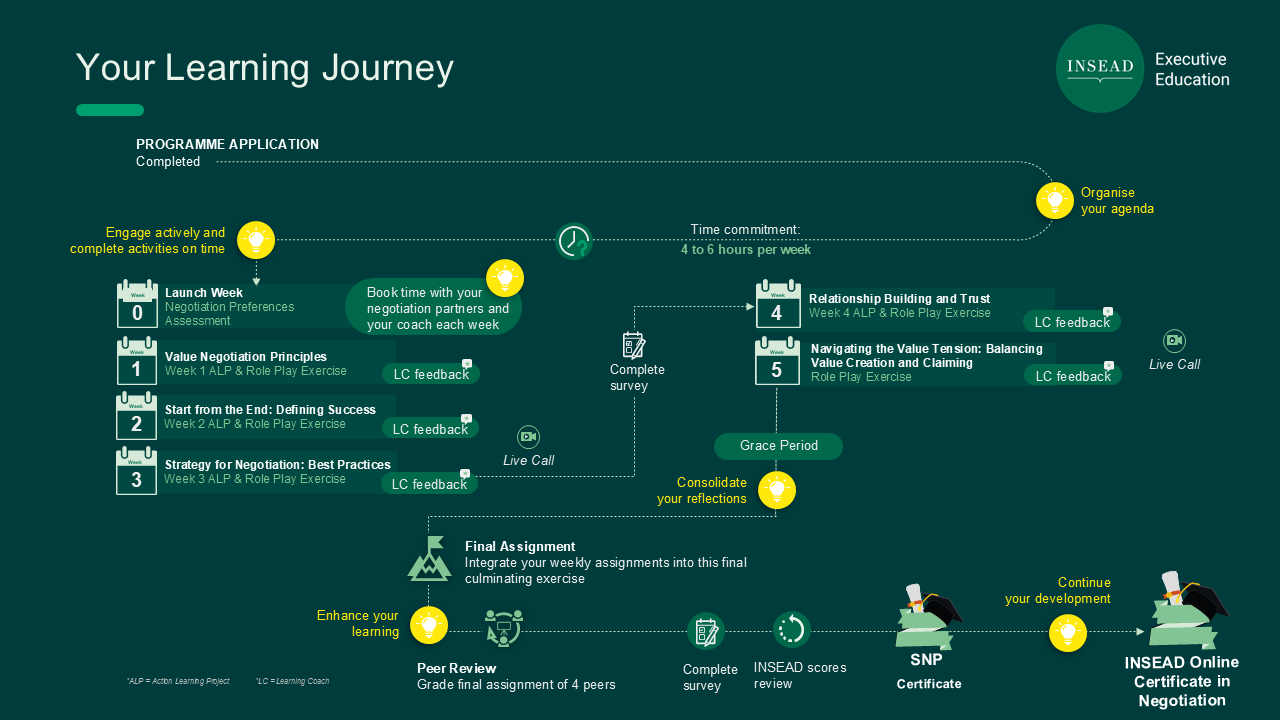
For specific dates, see calendar above.
Action Learning Project
Introduction
The Action Learning Project (ALP) is designed to help you prepare for an upcoming negotiation, submit a strategic analysis and recommendations on how best to approach it.
The negotiation should be based on your own context and it is not related to the role play cases.
Week-on-week, you will conduct a diagnosis and prepare your Negotiation Plan. You will use the concepts and techniques from the programme – 7 Elements prep sheet, Three Negotiations, building trust – to set you up for success in your negotiation practice and create maximum value for you and your counterpart.
Please start thinking about an upcoming negotiation and previous negotiation experience, so that you have a specific project in mind when the programme launches.
What to Expect for the Final Assignment
For the Final Assignment, you will continue your reflection from your weekly ALP assignments to submit your Negotiation Plan. Ultimately, you will be asked to create a negotiation plan that helps both parties realise the most value and achieve a great deal.
You will use the 7 Elements prep sheet that you will fill in in weeks 2 and 3 as a basis of your diagnosis.
Your Negotiation Plan should cover:
- Your negotiation counterpart, who they are, your knowledge of them, your negotiation history and whether you have any crippling or empowering assumptions going into the negotiation
- Diagnosis of the 7 Elements
- Techniques to use to improve all 3 Negotiation layers and increase value creation
- Building trust with your counterpart
Remember to draw also from your weekly reflections and the feedback you have received on your negotiation role play exercises.
Your final deliverable will be a high-level written final presentation based on your weekly ALP submissions and outlining your Negotiation Plan.
Coaching Touchpoints
INSEAD's learning coaches are accomplished business professionals who will guide you through your learning journey. Your coach will be assigned to you in Week 1 of the programme.
Learning Coach Intervention Rhythm
Your coach will spend, on average, 2.5 hours in total during the programme, to share their feedback.
In total, you will have 5 touchpoints. Do note that you will only receive feedback (via call) once at each coaching touchpoint.
- Touchpoint #1: Before Week 1 ends, to discuss feedback on your NPT assessment report
- Touchpoint #2: Before Week 2 ends, to discuss feedback on the Shooting Star Case exercise
- Touchpoint #3: Before Week 3 ends, to discuss feedback on your ALP (Week 1-3 submissions)
- Touchpoint #4: Before Week 4 ends, to discuss feedback on the Oxipouco, PrimeGeo or Indonesia Strategy Case exercise (choose one of these)
- Touchpoint #5: Before Final Assignment deadline, to discuss feedback on your draft of Final Assignment
The coaching timeline and specific session dates are to be agreed directly with your coach. The sequence of the touchpoints must be followed but the timeline can be adjusted in agreement with your coach.
All coaching touchpoints are to be completed prior to programme close.
For Premium Journey participants, you will receive an additional 2 hours of ALP coaching on top of the standard allocation mentioned above. You have up to 1 month after the Final Assignment Review deadline to schedule your coaching sessions.
Certification Requirements
To successfully complete the programme and earn certification, you are required to meet all of the following criteria:
- Earn a minimum of 80% of available points from in-platform activities by the Final Assignment deadline
- Earn 5 badges for submitting 5 Feedback Forms (following the completion of 5 negotiation role plays)
- Earn a minimum of 60% of available points from your Final ALP assignment submission and review by the Final Assignment Review deadline
More information will be provided in the learning platform.
Programme Brochure
For a copy of the online programme brochure, visit the dedicated Executive Education page.
