

Calendar
The following calendar includes all important dates and deadlines to help you with planning for your upcoming programme. You will receive an email with log-in details for the learning platform and connection details for the kick-off call one week before the programme starts.
Note: Dates or times may be subject to change. Once the programme begins, consult the learning platform for the final version of the programme calendar.
| Event/deadline | Date |
| Programme Launch and Kick-off Call | 14 September - 1:00 pm - 2:00 pm CEST |
| Live Call #1 with Faculty | 1 October - 11:30 am - 1:00 pm CEST |
| Live Call #2 with Faculty | 19 October - 11:30 am - 1:00 pm CEST |
| Live Call #3 with Faculty | 3 November - 11:30 am - 1:00 pm CET |
| Final Assignment due | 9 November |
| Final Assignment Review due and close of programme | 18 November |
| Learning Platform access ends | 14 March 2027 |
Attendance to the Kick-off and Live Call sessions is highly recommended but not mandatory. For those unable to join, the session will be recorded and made available on the platform.
Faculty

Professor of Accounting and Control

Professor of Accounting and Control

Professor of Accounting and Control
Syllabus
Programme Overview
Progressing towards greater leadership positions means learning to cut through greater complexity. It means broadening your understanding of the entire business, in order to make the most effective strategic and tactical decisions. Finance is one of the core pillars of any business organisation. Building financial understanding into your decision-making is critical as you advance. So too is developing the financial literacy to communicating your decision both inside and outside of your organisation.
Financial Analysis for Non-Financial Managers accelerates your understanding of the core financial dimensions of business. The programme empowers you with a robust valuation framework to make strategic decisions on future investments – and to assess the impact of past decisions you and your business have taken.
The programme will explore decision-making frameworks within the firm, using evaluation tools to evaluate the impact and efficacy of different projects. It will take a deep dive into valuation at the firm level, getting to grips with new techniques and mechanisms to estimate the value of an enterprise.
You will emerge from the programme with the understanding, the knowledge and the skills to make solid financial forecasts and better strategic decisions. You benefit from enhanced ability to execute your decisions, while accurately monitoring past investments. And you will build the expertise and the confidence to communicate your plans and results to both financial and nonfinancial audiences.
Programme Learning Objectives:
- Enhance your literacy of financial statements and terminology
- Improve your understanding of how strategic decisions impact financial metrics
- Gain insights into how revenues, costs and profits are allocated to products, customers, and divisions
- Learn methodologies of financial decision making based on rigorous, but intuitive, frameworks including net present value (NPV), Internal Rate of Return (IRR), and Economic Value Added (EVA).
-
Launch Week
-
In Launch Week, you will find guidance on how to make the most of the course, information on course completion and certification requirements, and an overview of the journey you will take over the next weeks. You will learn how to navigate the platform and about the different functionalities available.
You will also find out about your “Action Learning Project” (ALP). Your ALP is a unique opportunity to apply your learning to your own business context. The ALP will take you on a step-by-step journey to develop a financial perspective on a current business decision you are facing. You will identify a specific strategic opportunity and then quantify the predicted financial effects of various possible outcomes following a recommended action. During Launch Week, you will need to start thinking about the scope of your ALP and finalise it with your learning coach.
Note: In order to successfully pass this course, you must complete your ALP to a high standard. This is one of the most important components of the course.
-
Week 1: Financial Acumen
-
Financial reports provide information about how a company allocates its resources and how well it uses those resources to execute its strategy. Hence, financial acumen is a key part of successful strategic thinking. With this in mind, we begin by discussing the balance sheet and income statement, which are the two key financial statements. We discuss why these statements are presented to investors and the information they convey. We then deepen our understanding of financial reports and discuss how to use them to evaluate a company’s strategy execution. We discuss key financial reporting issues including the difference between cash and accrual accounting, capitalising versus expensing costs, and subsequently move on to studying the cash flow statements to understand the sources and uses of cash.
Learning Objectives:
- Build What information is contained in the Balance Sheet, Income Statement and Statement of Cash Flows?
- What information is missing from these statements?
- How are these statements connected to each other?
- How can I use these statements when making strategic decisions?
-
Week 2: Decision Making: Information Needs
-
Financial information about the firm’s products, services, processes, assets, and customers provides managers with key inputs to understand the firm’s current performance and support value-based decision making. In Week 2, our main objective is to equip you with the ability to understand and evaluate profitability information from the perspective of a manager inside the organization. We begin by considering cost and profit behaviour and how profitability is determined. We then apply this analysis to any unit within the organization: company, division, product, and even to individual customers. This week will give participants a deeper understanding of the financial information they receive as managers, how to interpret and use it, and insight as to what questions to ask.
Learning Objectives:
- Why is it necessary to understand cost behaviour?
- How do costs behave?
- What financial information should I focus on – and what should I ignore when making strategic decisions?
- How can I effectively measure profitability?
-
Week 3: Financial Statement Analysis
-
In Week 3, you will gain a comprehensive understanding of key financial performance measures and their implications for organisational success. We will start by defining two vital performance measures, Return on Equity (ROE) and Return on Invested Capital (ROIC), and explore their significance in evaluating financial performance. We also discuss how these measures improve upon the ROA metric defined in Week 1. Additionally, you will learn how to evaluate management's effectiveness in converting sales into profits and utilising resources to generate sales. Furthermore, we will delve into other solvency financial statistics that provide insights into an organisation's financial health.
Learning Objectives:
- Define two key performance measures: Return on Equity (ROE) and Return on Invested Capital (ROIC)
- Evaluate how management converts sales into profits
- Evaluate how management uses resources to generate sales
- Understand other solvency financial statistics that measure financial health
-
Week 4: Forecasting and Valuation
-
In Week 4, we will explore the topic of financial decision-making and prospective analysis. We will delve into the process of making informed decisions based on forecasts, considering the company's past performance and various future factors such as new product launches, market expansions, and workforce expansions. You will learn how to effectively evaluate and anticipate the company's future performance by incorporating all available information. Additionally, we will discuss the concept of valuation, equipping you with the knowledge and tools to assess the intrinsic value of a company. By the end of this week, you will have a comprehensive understanding of financial decision-making, prospective analysis, and valuation, enabling you to make informed and strategic financial decisions in a dynamic business environment.
Learning Objectives:
- Forecast financial performance using historical data and analysis of the sustainability of current strategic choices
- Link forecast to the generation of cash flow
- Understand time value of money and how to make an informed choice between different projects
- Link cash flow to sustainable value
-
Week 5: Performance Evaluation
-
So far, we have learned how successful managers use financial information to make value enhancing decisions. In our final week we discuss how best to evaluate the personnel who make decisions throughout the organization. We will develop tools to evaluate the performance of managers and their divisions’ performance. We introduce and evaluate some commonly used financial performance metrics and consider their benefits and potential weaknesses for performance evaluation. We then consider how to link strategy to both financial and non-financial performance metrics to achieve organisational objectives, as well as the strengths and weaknesses of using performance measures to explicitly incentivize employees.
Learning Objectives:
- What are the commonly used measures of performance evaluation?
- Under what conditions are these measures consistent with long-term value creation?
- When are these measures inconsistent with long-term value creation?
- How do you link financial and non-financial performance to your organisation’s strategy and objectives?
-
Final Assignment and Review
-
These two weeks are for you to synthesise your learning from the past few weeks into a compelling Final ALP Assignment submission. It will also offer an opportunity for you to give feedback to, and receive feedback from your peers for the Final ALP Assignment. No new course content will be released in these weeks.
Learning Journey
This overview outlines the learning journey you will follow from the programme launch (kick-off session) to certification upon completion of the programme. It will be covered in more detail during the kick-off call.
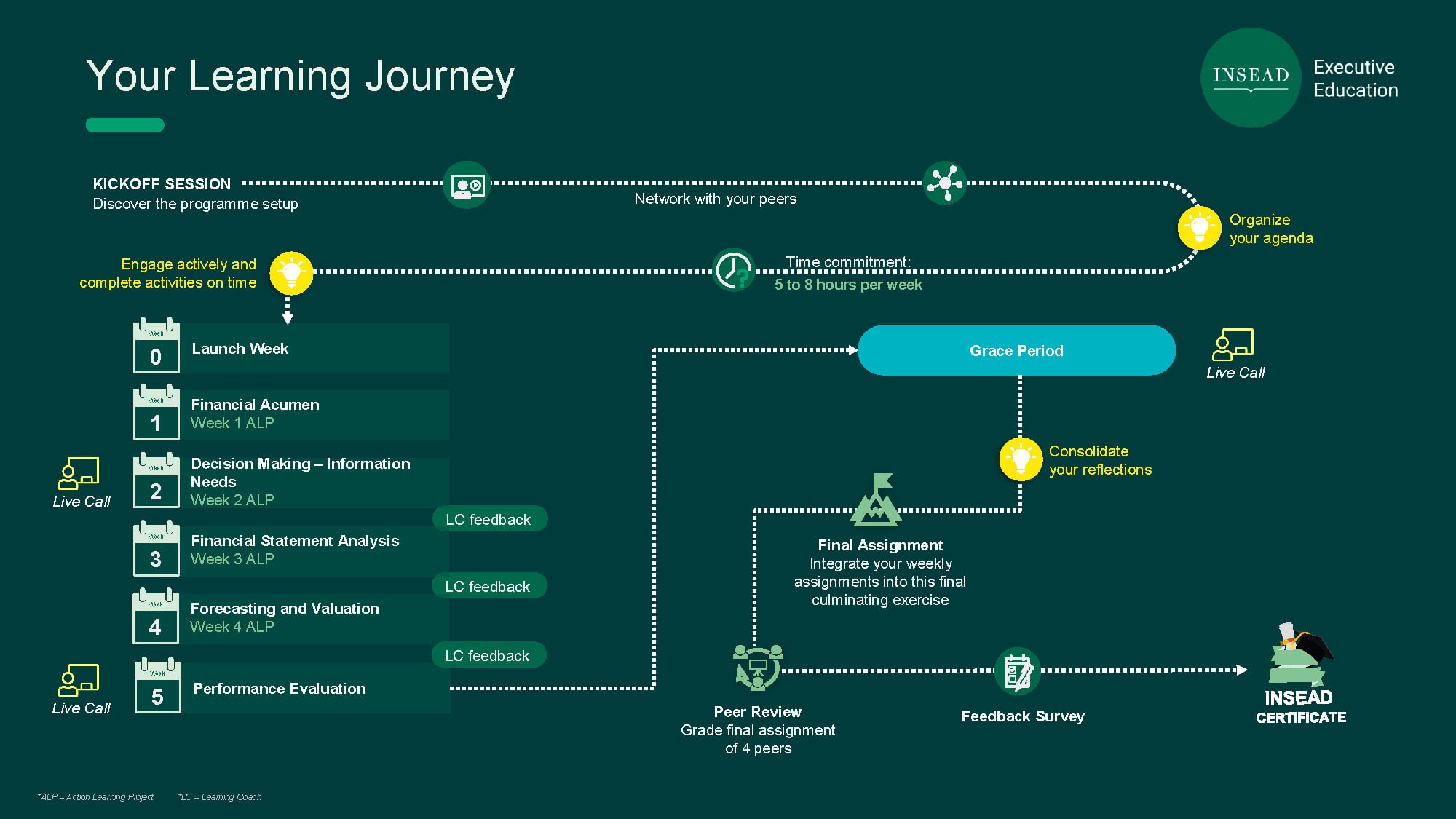
For specific dates, see calendar above.
Action Learning Project
Introduction
This Action Learning Project (ALP) is designed to help you come up with a concrete plan on how to apply the key financial and non-financial performance measures and further evaluate the proposed initiative within your organisation.
Regardless of whether your initiative is based on a current (implementation & planning phase) or future (entirely new) project, the ALP will provide you with a framework to think through the challenges and solutions in a systematic and strategic manner.
You might already have a clear view on the key challenges for your initiative but do not have a plan to tackle them, or you might still need to build the business case for change and then diagnose the challenges. Likewise, you might have some existing initiatives which you want to improve and add to. Whatever your starting point, the ALP will enable you to make a full diagnosis and build a comprehensive plan to improve on it.
The learning goal of the ALP is to practice the application of the tools being delivered within the course while also performing an assessment of the financial impact of your proposed project.
Please start thinking about an initiative or proposed project within your organisation so that you have a specific project in mind when the programme launches. Have your financial statements ready, as you will use this to perform an assessment of the financial impact of your project.
You can work individually or, when applicable, together with other members of your organisation who are also taking the course to deliver your ALP (if you are attending the programme as a group from one organisation, you may work together on the same project in small groups of maximum 4–5 members).
What to Expect for the Final Assignment
For the Final Assignment, you will synthesise the most relevant analyses from your weekly ALP assignments into a concise story for your project.
You will put together a summary proposal for your project that includes:
- A recommendation: invest or do not invest
- Key conclusions and insights from financial analysis to support your recommendation
- Impact that your initiative or project might have on your organisation’s performance evaluation system and a discussion of what other information you may need to make a more informed decision, including whether it is feasible to acquire such information at a reasonable cost.
Be honest in the recommendation! Do not alter assumptions to merely achieve the “right” outcome. Instead, recommend what actions can be taken to make the project a financial success.
Your final deliverable for the ALP should consist of:
- Executive Summary
- Business context
- Key conclusions from Financial Statement Analysis
- Key conclusions from ROIC analysis
- Key conclusions on how to evaluate performance
Coaching Touchpoints
INSEAD's learning coaches are accomplished business professionals who will guide you through your learning journey. Your coach will be assigned to you in Week 1 of the programme.
Learning Coach Intervention Rhythm
Your coach will spend, on average, 2 hours in total during the programme on your Action Learning Project (ALP), whether you are working on it individually or in a company group with your colleagues.
You will have 3 touchpoints with your Learning Coach:
- Touchpoint #1: After Week 1 closes, for feedback on Week 1 ALP assignment submission and to help finalise your ALP Scope
- Touchpoint #2: After Week 3 closes, for feedback on Weeks 2 & 3 submissions
- Touchpoint #3: Choose between Option A or B
- Option A: After Week 4 closes for feedback on Week 4 submission, combined with guidance on Week 5 Reflections and Final Assignment; OR
- Option B: Feedback on the draft of your Final Assignment only. In this case, your Learning coach will focus the feedback on how to improve your Final Assignment (drawing from your ALP journey so far) and NOT on how to pass the course. Coaches will not give indications or recommendations on grading.
You should work closely with your Learning Coach to plan the best schedule for your submissions and feedback. Please note that you will only receive feedback (written or via call) once for each coaching touchpoint. You should reflect on the feedback you receive from your Coach and incorporate any updates in the following ALP assignments and/or the Final Assignment.
For Premium Journey participants, you will receive an additional 2 hours of ALP coaching on top of the standard allocation mentioned above. You have up to 1 month after the Final Assignment Review deadline to schedule your coaching sessions.
Certification Requirements
To successfully complete the programme and earn certification, you are required to meet all of the following criteria:
- Earn a minimum of 80% of available points from in-platform activities by the Final Assignment deadline
- Earn a minimum of 60% of available points from your Final ALP assignment submission and review by the Final Assignment Review deadline
More information will be provided in the learning platform.
Programme Brochure
For a copy of the online programme brochure, visit the dedicated Executive Education page.
