

Calendar
The following calendar includes all important dates and deadlines to help you with planning for your upcoming programme. You will receive an email with log-in details for the learning platform and connection details for the kick-off call one week before the programme starts.
Note: Dates or times may be subject to change. Once the programme begins, consult the learning platform for the final version of the programme calendar.
| Event/deadline | Date |
| Programme Launch and Kick-off Call | 2 February - 1:00 pm - 2:00 pm CET |
| Live Call #1 with Faculty | 25 February - 12:00 pm - 1:00 pm CET |
| Live Call #2 with Faculty | 17 March - 12:00 pm - 1:00 pm CET |
| Live Call #3 with Faculty | 26 March - 12:00 pm - 1:00 pm CET |
| Final Assignment due | 13 April |
| Final Assignment Review due and close of programme | 22 April |
| Learning Platform access ends | 2 August |
Attendance to the Kick-off and Live Call sessions is highly recommended but not mandatory. For those unable to join, the session will be recorded and made available on the platform.
| Event/deadline | Date |
| Programme Launch and Kick-off Call | 7 September - 1:00 pm - 2:00 pm CEST |
| Live Call #1 with Faculty | 30 September - 12:00 pm - 1:00 pm CEST |
| Live Call #2 with Faculty | 13 October - 12:00 pm - 1:00 pm CEST |
| Live Call #3 with Faculty | 4 November - 11:00 am - 12:00 pm CET |
| Final Assignment due | 16 November |
| Final Assignment Review due and close of programme | 25 November |
| Learning Platform access ends | 7 March 2027 |
Attendance to the Kick-off and Live Call sessions is highly recommended but not mandatory. For those unable to join, the session will be recorded and made available on the platform.
Faculty

Professor of Strategy

Professor of Accounting and Control
Syllabus
Programme Overview
Business Strategy and Financial Performance is designed to give you the key tools and perspectives from strategy and finance to achieve these objectives. The programme will help you understand the evolving strategic agenda of a company and then leverage that understanding to identify concrete opportunities to elaborate the strategy, drive organizational alignment, and ultimately enhance financial performance.
Programme Learning Objectives:
- Develop your ability to think strategically and see the big picture so that you can align an organization’s internal resources and capabilities with its evolving external environment
- Learn to take a value approach to navigating business decisions and driving sustainable competitive advantage
- Understand the impact of management choices on company financials to develop a strategy execution plan for superior financial performance and sustainability
Please note: In this course, you will engage with AI-powered tools designed to enhance your learning experience, enabling more practical, personalised, and immersive exploration of the concepts covered. The use of Vstrat is completely optional and is not required to complete the programme or assignments.
Important: AI tools can make mistakes and be inaccurate. Please fact-check outputs and ensure that any information you disclose complies with applicable confidentiality obligations and your organisation’s policies.
-
Launch Week
-
In Launch Week, we establish why it is important for business professionals to understand and implement strategy to make timely, sustainable decisions for their organization. Using global examples from the beverage, pharmaceutical, and digital industries, you will be introduced to strategic principles and the relevance of using strategy in today’s turbulent times. We reflect on how data, devices, and detection can influence decision-making now and in the future, and how ESG, social values or other externalities also impact decision-making. This week will lay the groundwork for the remainder of the programme.
You will find also guidance on how to make the most of the course, information on course completion and certification requirements, and an overview of the journey you will take over the programme. You will learn how to navigate the platform and about the different functionalities available.
You will also find out about the “Action Learning Project” (ALP). The ALP is an integral part of the online course. It offers you the opportunity to apply your learning to explore ways to contribute to strategy design and execution in companies. The objective of the ALP is to reinforce your learning and develop a tangible action plan for strategy execution. During this week you must submit the scope of your ALP.
Note: In order to successfully pass this programme, you must complete your ALP to a high standard. This is one of the most important components of the programme.
-
Week 1: What is Strategy?
-
The week starts by exploring the question, what is strategy? You will focus on two complementary answers. The first is that strategy is about helping organizations fit into their external environment, often in the face of accelerating pressures for change. The second is that strategic thinking should enable companies to invest in such a way so as to drive superior performance. You will relate these ideas to a simple definition of strategy and the classic SWOT (Strengths, Weaknesses, Opportunities, and Threats) framework. You will also practice using the PESTLE framework to analyse the environment and industry around an organization. This week provides important foundations for the rest of the programme.
Learning Objectives:
- Understanding what strategy is really about
- Ensuring fit with a dynamic external environment
- Examining performance differences within and across sectors
- Analysing trends in the industry and the environment
- Meeting the challenge of market turbulence and disruption
-
Week 2: Follow the Value
-
A focus on value provides a powerful compass for navigating changes in an industry. The second week of the programme introduces the key concepts of value creation, value capture, willingness-to-pay (WTP) and resource costs and illustrates how to use them to assess the impact of new products and technologies. For example, how can you identify new opportunities based on the market demand for sustainable and environmentally-friendly products, such as electric vehicles? We shift our focus from the external environment to how you can formulate compelling new value propositions. The value-approach is used to deepen the analysis of the external changes impacting your business, developing a more structured approach to disruption and shifts in market size.
Learning Objectives:
- Understanding the challenge of creating and capturing value
- Driving competitive advantage through added value
- Balancing willingness-to-pay and resource costs
- Identifying willingness-to-pay drivers in B2B and B2C settings
- Understanding and anticipating shifts in market size
-
Week 3: Managing Your Value Network and Role of Financial Reporting
-
Week three continues our focus on how strategy can transform the industry landscape, with a shift in focus to added value, social value and willingness-to-supply (WTS). We will consider how external changes, competitive pressures, and positive feedback can shift the set of activities and players in an industry value chain. How can you assure that you have a robust business model that not only sustainably creates value for customers and society but also positions you to capture a significant share? You will also study the case of TripActions, a travel management scale-up, and how it responded strategically to significant disruptions due to the Covid-19 pandemic. This week, we also introduce you to the financial aspect of Strategy. We begin by examining the role and relevance of financial reporting in the context of an organization’s strategy.
Learning Objectives:
- Understanding the fundamental strategic question of who captures value and how much
- Identifying the industry value chain and using it to map shifting dynamics (activities and players) within the industry
- Analysing the impact of competition on value using the Five Forces framework
- Recognising the impact of a company strategy on its financials
- Understanding the basic financial statements and learning who uses these statements
-
Week 4: Measuring Investment and Strategic Performance
-
Financial reports provide information about how a company allocates its resources and how well it uses those resources to execute its strategy. Hence, financial acumen is a key part of successful strategic thinking. With this in mind, we begin the week by discussing the balance sheet and income statement, which are the two key financial statements. We discuss why these statements are presented to investors and the information they convey. We also discuss the challenges of reporting actions aimed at environmental sustainability, and obligations to stakeholders.
Learning Objectives:
- Understanding the Balance Sheet in the context of strategic initiatives and investments
- Reviewing the elements of the Income Statement and how to use it to measure performance
- Interpreting Revenues as the value delivered to the customer
- Examining Expenses from the perspective of what it takes to deliver value
-
Week 5: Management Choices and their Impact on Financials
-
During this week we deepen our understanding of financial reports and discuss how to use them to evaluate a company’s strategy execution. We discuss key financial reporting issues including the difference between cash and accrual accounting, capitalising versus expensing costs, and subsequently move on to studying the cash flow statements to understand the sources and uses of cash. We finish the week by introducing a key financial indicator: return on invested capital (ROIC). We discuss how to interpret ROIC, how to use the income statement and balance sheet to calculate it, and how ROIC is linked to financial sustainability.
Learning Objectives:
- Understanding the difference between cash flow and earnings
- Analysing the statement of cash flows to understand sources and uses of cash
- Understanding the concept of the Return on invested capital (ROIC) and its link to financial sustainability
- Differentiating between expensing versus capitalising cash flows and their effect on ROIC
- Learning about management choices that influence the numbers
-
Week 6: Aligning Activities
-
Strategy creates not only threats to current business but also opportunities to create whole new businesses as well as to enhance your position in existing markets. What does it take to seize these opportunities? With the help of a new strategic tool - the company value chain - you will discover how key activities within an organization are critical to delivering new value propositions and how those activities themselves can be transformed for enhanced value. Moreover, drilling competitive advantage down into the tissue of the organization is also critical for assuring the sustainability of your advantages. In addition to examining generic strategies for competitive advantage, you will explore how Blue Ocean Strategy, support function strategy and shifting from business to corporate strategy can enhance an organization’s value.
Learning Objectives:
- Crafting your value proposition to drive added value and competitive advantage
- Aligning your organizational activities with your value proposition
- Evaluating which opportunities to implement generic strategies, Blue Ocean Strategy or support function strategy
- Differentiating between business strategy and corporate strategy
-
Week 7: Agile Execution
-
How to effectively and systematically execute on a strategy? This week focuses on the tension between the need for greater strategic agility and the traditional need for a longer-term orientation to assure that the company builds the key resources required for success. With ever greater industry “clock speed,” strategy analysis and formulation needs to become an ongoing process driven by feedback from strategy execution. At the same time, success still depends critically on developing an integrated strategy over time where the value proposition, organizational activities and underlying resources are aligned. Strategic partnerships offer an important route for achieving agility given current resource constraints, while also allowing you to build the new resources needed for the future.
Learning Objectives:
- Aligning value, activities and resources to drive strategy execution
- Learning how to rethink the strategy process for agility
- Balancing strategic agility with the need for long-term stability
- Exploring how strategic partnerships can fuel growth while mitigating risks
-
Final Assignment and Review
-
The final weeks are for you to synthesise your learning from the programme into a compelling Final ALP Assignment submission. It will also offer an opportunity for you to give feedback to and receive feedback from your peers for the ALP Final Assignment. No new course content will be released in these weeks.
Learning Journey
This overview outlines the learning journey you will follow from the programme launch (kick-off session) to certification upon completion of the programme. It will be covered in more detail during the kick-off call.
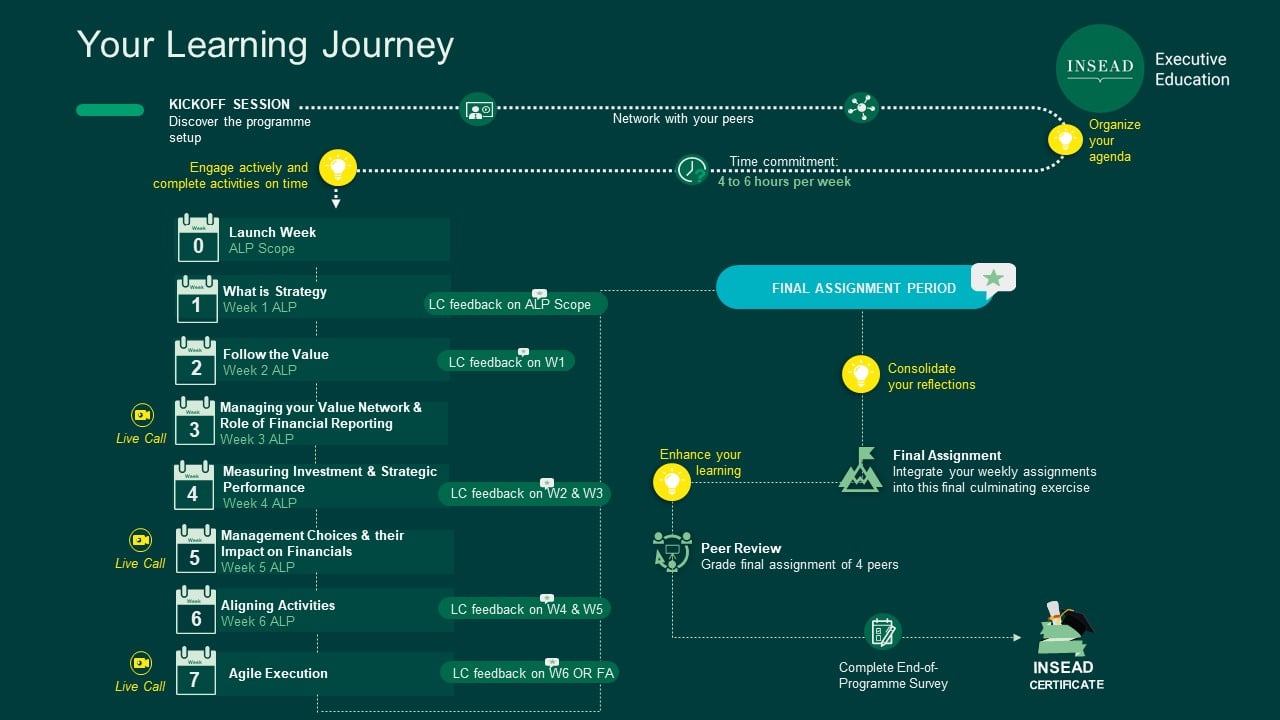
For specific dates, see calendar above.
Action Learning Project
Introduction
The Action Learning Project (ALP) gives you the opportunity to apply your learning directly to your own business context. You will need to decide on which Path to follow for your ALP. Below is a brief introduction to the 2 Paths.
Path 1: External - Strategic Partner:
The Strategic Partner Action Learning Project (ALP) is designed for those in B2B businesses and want to enhance their position as a trusted strategic partner to their clients. This ALP is especially relevant for those in B2B client relationship roles, but can also be relevant for those interested in leading B2B businesses.
Objectives:
- Understand your client’s strategic agenda and financials,
- Align your offerings as compelling value propositions for your client, and
- Elaborate on how these offerings can fit into the client’s overall plans for strategy execution.
Path 2: Internal - Strategic Initiative:
The Strategic Initiative Action Learning Project (ALP) is designed for those who want to more deeply understand their own organization’s strategic agenda, and to leverage that understanding to contribute to strategy execution and formulation.
Objectives
- Understand your organization’s strategic agenda and its financials,
- Elaborate a strategic initiative that fits with the overall organization strategy and drives value creation for your organization, and
- Propose a strategy execution plan for the initiative for a positive impact on the company financials
Please start thinking about the path you want to follow and a strategic initiative you want to work on so that you have a specific project in mind when the programme launches.
You can work individually or, when applicable, together with other members of your organization who are also taking the course to deliver your ALP (if you are attending the programme as a group from one organization, you may work together on the same project in small groups of maximum 4–5 members).
What to Expect for the Final Assignment
For the final assignment, you will prepare a presentation of your strategic initiative in the context of the overall strategy of your client’s business (External Path); or in the context of the overall strategy of your organization (Internal Path). You should combine the key insights from your weekly ALP submissions, while looking to create a coherent storyline that is easy to follow.
Your strategic presentation should cover the following aspects:
- Situation Analysis (Weeks 1, 2, 3 & 4)
- Strategic Recommendation (Weeks 2, 3 & 5)
- Strategy Execution (Weeks 5, 6 & 7)
Your final deliverable will be a high-level final presentation based on your weekly ALP submissions and outlining your Strategic Initiative Action Plan.
Coaching Touchpoints
INSEAD's learning coaches are accomplished business professionals who will guide you through your learning journey. Your coach will be assigned to you in Week 1 of the programme.
Learning Coach Intervention Rhythm
Your coach will spend, on average, 3 hours in total during the programme on your Action Learning Project (ALP), whether you are working on it individually or in a company group with your colleagues.
You will have 5 touchpoints with your Learning Coach:
- Touchpoint #1: Before Week 1 ends to discuss the scope of your ALP (Launch Week assignment)
- Touchpoint #2: After Week 1 closes for feedback on Week 1 ALP assignment submission
- Touchpoint #3: After Week 3 closes for feedback on Weeks 2 & 3 submissions
- Touchpoint #4: After Week 5 closes for feedback Weeks 4 & 5 submissions
- Touchpoint #5: Choose between Option A or B
- Option A: After Week 6 closes for feedback on Week 6 submission, combined with guidance on Week 7 Reflections and Final Assignment
Or - Option B: Feedback on the draft of your Final Assignment only. In this case, your Learning Coach will focus the feedback on how to improve your Final Assignment (drawing from your ALP journey so far) and NOT on how to pass the course. Coaches will not give indications or recommendations on grading
- Option A: After Week 6 closes for feedback on Week 6 submission, combined with guidance on Week 7 Reflections and Final Assignment
You should work closely with your Learning Coach to plan the best schedule for your submissions and feedback. Do note that you will only receive feedback (written or via call) once at each coaching touchpoint. You should reflect on the feedback you receive from your Coach and incorporate any updates in the following ALP assignments and/or the Final Assignment.
For Premium Journey participants, you will receive an additional 2 hours of ALP coaching on top of the standard allocation mentioned above. You have up to 1 month after the Final Assignment Review deadline to schedule your coaching sessions.
Certification Requirements
To successfully complete the programme and earn certification, you are required to meet all of the following criteria:
- Earn a minimum of 80% of available points from in-platform activities by the Final Assignment deadline
- Earn a minimum of 60% of available points from your Final ALP assignment submission and review by the Final Assignment Review deadline
More information will be provided in the learning platform.
Programme Brochure
For a copy of the online programme brochure, visit the dedicated Executive Education page.
