

Calendar
The following calendar includes all important dates and deadlines to help you with planning for your upcoming programme. You will receive an email with log-in details for the learning platform and connection details for the kick-off call one week before the programme starts.
Note: Dates or times may be subject to change. Once the programme begins, consult the learning platform for the final version of the programme calendar.
| Event/deadline | Date |
| Programme Launch and Kick-off Call | 2 March - 1:00 pm - 2:00 pm CET |
| Live Call #1 with Faculty | 24 March - 9:30 am - 11:00 am CET |
| Live Call #2 with Faculty | 13 April - 10:30 am - 12:00 pm CEST |
| Final Assignment due | 27 April |
| Final Assignment Review due and close of programme | 6 May |
| Learning Platform access ends | 2 September |
Attendance to the Kick-off and Live Call sessions is highly recommended but not mandatory. For those unable to join, the session will be recorded and made available on the platform.
| Event/deadline | Date |
| Programme Launch and Kick-off Call | 14 September - 1:00 pm - 2:00 pm CEST |
| Live Call #1 with Faculty | 7 October - 10:30 am - 12:00 pm CEST |
| Live Call #2 with Faculty | 22 October - 10:30 am - 12:00 pm CEST |
| Final Assignment due | 9 November |
| Final Assignment Review due and close of programme | 18 November |
| Learning Platform access ends | 14 March |
Attendance to the Kick-off and Live Call sessions is highly recommended but not mandatory. For those unable to join, the session will be recorded and made available on the platform.
Faculty

Associate Professor of Organisational Behaviour
Syllabus
Programme Overview
Leading teams and organisations effectively in today’s climate of endless uncertainty is contingent on your ability to inspire confidence in other people – in those who work for and with you, in your senior leadership, and across your ecosystem of clients and business partners. In our current climate of ambiguity and unpredictability, it is more critical than ever that your team sees you as a leader to follow and to empower them; that your peers and customers have faith in your abilities and dependability; and that your executive leaders and board have confidence in your potential to lead change, unlock innovation and translate vision into reality.
Inspiring this kind of confidence requires you not only articulate and communicate your ideas with clarity and composure; you also have to build trust – trust in your competencies as a leader and decision-maker, in your technical capabilities, and in your absolute commitment to follow through on what you say you will do.
Executive Presence and Influence is an online programme that aims to demystify these qualities – redefining them as skills that can be learned and mastered rather than innate traits or characteristics.
Programme Learning Objectives:
- Learn tactics to unlock your own executive presence such that your stakeholders have confidence, respect and trust in your competencies and reliability
- Discover evidence-based strategies that are effective, practical and ethical to influence other people without imposing your power
- Master when and how to employ these influence strategies with different stakeholders and in different contexts in your personal leadership challenges
- Understand the psychology of trust, and how to establish trust to build fruitful long-term business relationships with your teams, superiors and with clients.
-
Launch Week
-
In the Launch Week, you will find guidance on how to make the most of the course, information on course completion and certification requirements, and an overview of the journey you will take over the next 8 weeks You will learn how to navigate the platform and about the different functionalities available.
You will also find out about the “Action Learning Project”. The ALP is an integral part of the online course It offers you the opportunity, through weekly assignments and reflections around the programme content and your leadership role, to build your own Influence Action Plan.
Note: In order to successfully pass this course, you must complete your ALP to a high standard This is one of the most important components of the course.
-
Week 1: Communicating Your Ideas & Storytelling
-
The first step in having greater presence and influence is to look at the concepts that help craft relevant, memorable and impactful messages. This entails understanding how the human mind makes sense of content and ideas. We will explore what makes someone an effective communicator and how they make their ideas not only reach their target, but stick.
Learning Objectives:
- Discover the anatomy of ideas and messages—why do some ideas stick and others don’t?
- Explore how to engage, persuade, and inspire your audience, regardless of whether they are clients, bosses or team members
- Map out these principles to make ideas sticky across a variety of contexts including interpersonal communication, personal branding, marketing and publicity, public pitches and organizational change.
-
Week 2: Unlocking your Executive Presence
-
Body language is a universal medium of communication and influence. Across nations, cultures and organisations, your body language shapes the way your message is perceived. Commanding attention, and conveying competence and trustworthiness is contingent as much on how you say things as it is on what you say.
Learning Objectives:
- Discover which body language cues signify power, confidence, trustworthiness and competence
- Learn to adopt and deploy these cues to command a presence that is powerful yet also warm and inviting
- Explore what executive presence looks like in virtual settings
- Using a video-case and a practical self-awareness exercise determine the steps you will take to become more mindful about your own presence and the style that you aspire to have.
-
Week 3: Building Trust
-
Strong long-term relationships and business outcomes are built on trust. But trust needs to be earned – and losing it can be highly costly. As we strive to influence others, our efforts can actually have the effect of undermining trust. To build, nurture and sustain high levels of trust over time we need to be hugely mindful about the dynamics of trust-building and the requirement to be transparent in terms of information-sharing.
Learning Objectives:
- Take a deep dive into the psychology of trust in business relationships
- Define trust and determine the criteria we use in evaluating someone’s trustworthiness?
- Discover how to build trust quickly and how to repair trust when it is impaired
- Learn how to establish trust that signals credibility, benevolence, and integrity.
-
Week 4: The Science & Art of Influence
-
In this module, we will help you develop and apply interpersonal persuasion skills and will highlight the importance of strategy formulation and managerial agility. Importantly, how do you influence without formal authority especially influencing “difficult” people. We will also consider how observation and reflection can improve your understanding of diverse cultural or social landscapes, and how that can inform your strategy and approach in any given influence situation.
Learning Objectives:
- How to influence without formal power
- How to persuade difficult people
- Avoiding common persuasion mistakes
- How to win hearts and minds
- Evidence-based, simple, and costless techniques with real-world examples.
-
Week 5: Developing Charisma
-
When people perceive another as being charismatic, what are they paying attention to? What makes a leader charismatic? Unlike the use of formal authority to influence (i.e. hard power), charisma attracts others towards you — it’s soft but extremely powerful. In this module, we unpack the psychological foundations of charisma and illustrate practical ways leaders can become more inspirational and charismatic. We will explore the science of interpersonal attraction and emotional intelligence.
Learning Objectives:
- Understanding the attraction of charismatic people
- Learning to be charismatic
- Science-backed techniques to become more charismatic by drawing on research in person perception and the psychology of attraction
- Exploring how to become more emotionally intelligent by learning about self-awareness, self-regulation, motivation, empathy, reading emotions and relationship management
- Type I Leadership: Introverted Charisma.
-
Final Assignment and Review
-
The final weeks are for you to synthesise your learning from the programme into a compelling Final ALP Assignment submission. You will also have the opportunity to exchange feedback on the Final ALP Assignment with your peers. No new course content will be released in these weeks.
Learning Journey
This overview outlines the learning journey you will follow from the programme launch (kick-off session) to certification upon completion of the programme. It will be covered in more detail during the kick-off call.
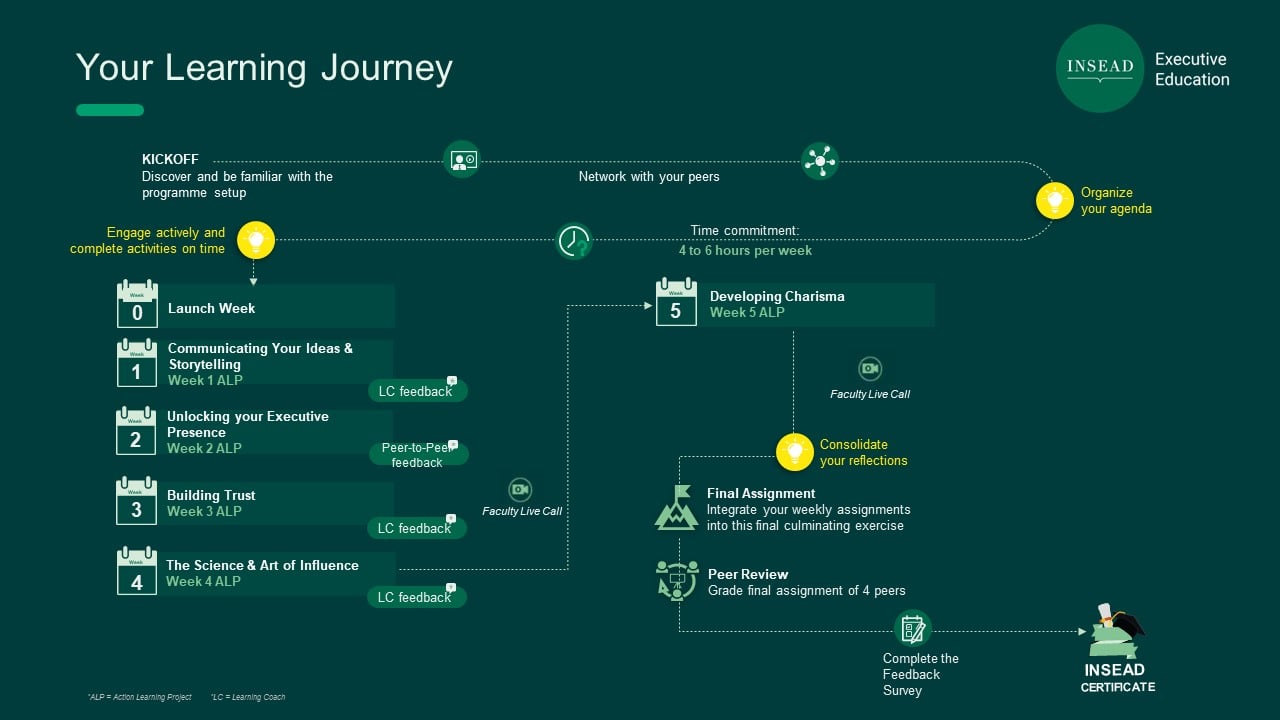
For specific dates, see calendar above.
Action Learning Project
Introduction
The Action Learning Project (ALP) is designed to help you apply the learnings from the course in the context of your job and organisation. The ALP is also intended to help the concepts come to life in your daily work.
You will acquire a set of evidence-based executive presence, influence, and communication techniques that will help you persuade, inspire, and build trusted long-term business relationships with your coworkers and clients. There are three parts to this ALP:
- To prepare you for the programme, this ALP will require you to answer a few questions in Week 1 about the challenges you currently face while managing people in your organization (i.e. your teammates, co-workers or superiors) or your clients and business partners. This will define the scope of your ALP. Focus on 2-3 specific individuals.
- To help you consolidate the key takeaways that are most applicable to your challenges, you will answer reflection questions at the end of each week. These questions will help you apply the techniques in your daily routine.
- The Final Assignment will require you to incorporate all the techniques you have learned to overcome the particularly challenging co-workers or clients that you described in the ALP assignment for Week 1, so carefully select the specific individuals you would like to influence, as they will be your focus for the entire Influence Plan.
Please start thinking about specific team members, coworkers or superiors that you are currently managing or collaborating with, or clients that you are currently working with or hope to work with, who you find to be particularly challenging to influence, so that you have a specific target audience in mind when the programme launches.
What to Expect for the Final Assignment
For the final assignment, you will bring together all the theory and planned actions into one comprehensive Influence Plan that will enable you to develop executive presence and influence in the workplace.
The Influence Plan should outline:
- Your Challenge: Describe why these 2 or 3 individuals are challenging. Do they have some traits/attitudes/belief systems/biases that you find challenging to overcome? Or do you have some personal challenges that are part of the problem?
- Your Plan: Provide a long-term action plan outlining how you are going to win these individuals over and measure your success. Use the communication skills you have acquired to tell a compelling and coherent "story" of your journey turning this challenging relationship with a coworker or client into a trusting business relationship.
- Highlight how specific persuasion and nudging strategies will help you to convince these individuals
- Identify how you have or will master techniques to acquire more executive presence, charisma and emotional intelligence
- Put these plans together and think about how you are building trust with these individuals over the long run.
Your final deliverable will be a reflective written presentation and action plan of your work from all the weekly ALP assignments.
Coaching Touchpoints
INSEAD's learning coaches are accomplished business professionals who will guide you through your learning journey. Your coach will be assigned to you in Week 1 of the programme.
Learning Coach Intervention Rhythm
Your coach will spend, on average, 2 hours in total during the programme on your Action Learning Project (ALP).
You will have 3 touchpoints with your Learning Coach:
- Touchpoint #1: After Week 1 closes, for feedback on Week 1 ALP submission
- Touchpoint #2: After Week 3 closes, for feedback on Week 3 ALP submission
- Touchpoint #3: Choose between Option A or B
- Option A: After Week 4 closes, for feedback on Week 4 ALP submission, combined with guidance on Week 5 reflections and Final Assignment submission
Or - Option B: Feedback on the draft of your Final Assignment only. In this case, your Learning coach will focus the feedback on how to improve your Final Assignment (drawing from your ALP journey so far) and NOT on how to pass the course. Coaches will not give indications or recommendations on grading.
- Option A: After Week 4 closes, for feedback on Week 4 ALP submission, combined with guidance on Week 5 reflections and Final Assignment submission
You should work closely with your Learning Coach to plan the best schedule for your submissions and feedback. Please note that you will only receive feedback (written or via call) once for each coaching touchpoint. You should reflect on the feedback you receive from your Coach and incorporate any updates in the following ALP assignments and/or the Final Assignment.
For Premium Journey participants, you will receive an additional 2 hours of ALP coaching on top of the standard allocation mentioned above. You have up to 1 month after the Final Assignment Review deadline to schedule your coaching sessions.
Certification Requirements
To successfully complete the programme and earn certification, you are required to meet all of the following criteria:
- Earn a minimum of 80% of available points from in-platform activities by the Final Assignment deadline
- Earn a minimum of 60% of available points from your Final ALP assignment submission and review by the Final Assignment Review deadline
More information will be provided in the learning platform.
Programme Brochure
For a copy of the online programme brochure, visit the dedicated Executive Education page.
