

Calendar
The following calendar includes all important dates and deadlines to help you with planning for your upcoming programme. You will receive an email with log-in details for the learning platform and connection details for the kick-off call one week before the programme starts.
Note: Dates or times may be subject to change. Once the programme begins, consult the learning platform for the final version of the programme calendar.
| Event/deadline | Date |
| Programme Launch and Kick-off Call | 13 April - 1:00 pm - 2:00 pm CEST |
| Live Call #1 with Faculty (Week 2 Elective) | 29 April - 12:00 pm - 12:30 pm CEST |
| Live Call #2 with Faculty (Week 2 Elective) | 29 April - 12:45 pm - 1:15 pm CEST |
| Live Call #3 with Faculty (Week 3 Elective) | 6 May - 12:00 pm - 12:30 pm CEST |
| Live Call #4 with Faculty (Week 3 Elective) | 6 May - 12:45 pm - 1:15 pm CEST |
| Live Call #5 with Faculty (Week 4 Elective) | 13 May - 12:00 pm - 12:30 pm CEST |
| Live Call #6 with Faculty (Week 4 Elective) | 13 May - 12:45 pm - 1:15 pm CEST |
| Close of Programme | 8 June |
| Learning Platform access ends | 13 October |
Attendance to the Kick-off and Live Call sessions is highly recommended but not mandatory. For those unable to join, the session will be recorded and made available on the platform.
| Event/deadline | Date |
| Programme Launch and Kick-off Call | 12 October - 1:00 pm - 2:00 pm CEST |
| Live Call #1 with Faculty (Week 2 Elective) | 28 October - 11:00 am - 11:30 am CET |
| Live Call #2 with Faculty (Week 2 Elective) | 28 October - 11:45 am - 12:15 pm CET |
| Live Call #3 with Faculty (Week 3 Elective) | 3 November - 11:00 am - 11:30 am CET |
| Live Call #4 with Faculty (Week 3 Elective) | 3 November - 11:45 am - 12:15 pm CET |
| Live Call #5 with Faculty (Week 4 Elective) | 10 November - 11:00 am - 11:30 am CET |
| Live Call #6 with Faculty (Week 4 Elective) | 10 November - 11:45 am - 12:15 pm CET |
| Close of Programme | 7 December |
| Learning Platform access ends | 12 April 2027 |
Attendance to the Kick-off and Live Call sessions is highly recommended but not mandatory. For those unable to join, the session will be recorded and made available on the platform.
Faculty

Professor of Management Practice of Decision Sciences

Professor of Organisational Behaviour

Professor of Organisational Behaviour
Syllabus
Programme Overview
Bringing stakeholders to agreement across divergent interests or perspectives, culture or gender can be enormously challenging. You may need to navigate difficult behaviour, entrenched views, imbalance of power and conflict. Bringing highly complex negotiations to a consensus when the stakes are high calls for the most advanced skill, and the highest level of expertise.
Advanced Negotiations provides you the opportunity to build the focused understanding, agility, honed capabilities and expert toolkit of the most skilled and successful negotiators.
At this advanced level, you will be challenged to sharpen your focus on specific, highly challenging negotiation scenarios. You will start with two mandatory electives: Critical Movements and Difficult Behaviours. You should then choose three electives from a selection of six (one in each week), to accelerate your skills in the specific areas of negotiation that map to your needs.
The programme fully leverages a breadth of strong, real-world case studies to bring the dynamics, techniques and skills at play in advanced negotiation to life across a range of topics – from gender and cross-cultural negotiations to negotiating power and power differences.
You emerge with the cutting-edge skills, the mindset, the nimbleness and dexterity to forge consensus and build strong agreement in the most complex scenarios and settings.
Programme Learning Objectives:
- Master the intricacies of successfully negotiating advanced challenges, including cross-cultural, multiparty, government and gender differences
- Leverage direct personalised feedback from our expert negotiation coaches to accelerate your skills and understanding
- Consolidate the learnings from the previous two negotiation programmes to become a well-rounded negotiator expert
-
Launch Week
-
In the Launch Week, you will find guidance on how to make the most of the programme, information on certification requirements, an overview of the learning journey and you will get to know your peers.
You will find information on how to organise your negotiation role play exercises and your coaching sessions.
-
Week 1: Expanding Your Negotiation Toolbox
-
In this week you will complete both mandatory electives to ground you in the dynamics of expert negotiation.
A. Critical Moments: Building from a more strategic approach to win-win and a deeper understanding of Value Negotiation, this segment revisits the idea of winwin and further clarifies the concept in ways that makes it more pragmatic and effective. Then it pivots to the more technical aspects of doing the best out of our negotiation critical moments.
Learning Objectives
- Learn how to manage your energy in line with negotiation scenarios
- Anticipate and diagnose common and unique critical moments
- Discover best practices that facilitate good decision making during critical moments
AND
B. Difficult Behaviours: Everyone has already negotiated with someone difficult. Be them tough or subtle, in-your-face or manipulative, difficult negotiators can become our worst negotiation nightmare and a significant obstacle to successful deals. In this segment, we deconstruct the difficult behaviours portrayed by difficult negotiators and introduce a strategy and specific moves to counter them successfully and consistently with win-win strategies.
Learning Objectives
- Learn how to minimise the odds of the counterparty becoming problematic
- Diagnose and make sense amidst numerous challenging tactics
- Practice robust strategies to convert difficult into productive negotiation behaviours
-
Week 2: Negotiating Your Surroundings
-
From this week onwards, you will deep dive on the elective topics that you have selected. Follow the content relevant to your weekly elective to fully benefit from the coaching and live call sessions in Week 2, 3 and 4.
A. Virtual Negotiation: Virtual negotiations have become ubiquitous since COVID. We were forced to move all our negotiations online through virtual means. The world of negotiation is unlikely to return to a F2F-only pattern, and yet there are fundamental differences between them that can hinder the performance of even the best of F2F negotiators. As advanced negotiators, we need to transit in and out of virtual with the same confidence as in our F2F negotiations.
Learning Objectives
- Appreciate the important differences between F2F and virtual negotiations
- Diagnose when negotiations require unique virtual strategies
- Practice tactics to choose and negotiate through the “best” channels
OR
B. Internal and Team Negotiations: Either fully present at the negotiation table or with members waiting back at their desks, most professional negotiations involve teams. Teams require internal negotiation among its members, which often can come across as harder than the external ones for which the team might be preparing. As such, advanced negotiators need to be aware and manage their team negotiations unique set of challenges, risks, and rewards.
Learning Objectives
- Diagnose the differences between internal and external negotiations
- Learn how to build and lead high-performance negotiation teams
- Understand how to lead your team to bridge external and internal negotiations
-
Week 3: Negotiating Individual Differences
-
A. Negotiating Conflict : As social animals, conflict is a part of life. Conflict often raises negative emotions, which highjack our ability to negotiate well, and pushes us into suboptimal outcomes, destroyed relationships, and painful processes. However, with the right techniques, we can minimize the negatives and turn a conflict into a source of opportunity for negotiation, value creation, and positive change.
Learning Objectives
- Learn what leads to conflict and how you can manage your own
- Understand how to manage particularly emotional and difficult negotiations
- Practice how to mediate third party disputes towards agreement
B. Cross-cultural and Gender Negotiations: Coming from different cultures makes it harder to communicate, build relationships, or create value in negotiations. In this segment, we deliver advice on how to negotiate with as many cultures as you need without having to become an expert in any of them. We also have an additional segment on gender negotiations given the timeliness and pervasive nature of this unique cross-cultural negotiation context.
Learning Objectives
- Understand the impact that culture and gender have on negotiations
- Learn how to diagnose cultural and gender from other negotiation challenges
- Practice negotiation strategies and moves that work across cultures and genders and how to bridge cultural and gender differences
-
Week 4: Negotiating Complex Contexts
-
A. Negotiating Power and Power Differences: Most negotiators wrongly believe that power is the most important variable in a negotiation. And while it is a very important one, it is often misused to the detriment of its wielder. Thus, understanding the relationship of power and negotiation will help you use your negotiation power wisely and counter power abuses from your counterparty (or yourself).
Learning Objectives
- Differentiate negotiation power from power in a negotiation
- Understand the different sources of negotiation power and their pros and cons
- Learn how to maximise your leverage independently of your initial position
OR
B. Multiparty Negotiation, Consensus Building and Stakeholder Management: As negotiations grow in value and complexity, advanced negotiators inevitably find themselves involved in multiparty dynamics. Be it an external stakeholder or an internal change management process, these negotiations are exponentially more complex, and at times difficult, than 1-on-1 negotiations. No advanced negotiator would be complete without mastering at least the basics of multiparty dynamics, and hopefully also its more win-win focus on consensus building.
Learning Objectives
- Appreciate the additional complexities of multiparty vs 1-on-1 negotiations
- Learn how to lead multiparty negotiation dynamics and its many stakeholders
- Practice consensus building strategies to build sustainable agreements
-
Role Plays
-
This programme includes 3 group role-play exercises. These simulated negotiations offer you an opportunity to practice various tactics in a low-risk setting that not only helps improve your skills, but also boost your confidence, a key ingredient to negotiation success. Each case is designed to help you focus on the key concept covered in the corresponding week. Please note that these role-plays are mandatory for your programme completion. More details will be provided during the kick-off call.
Learning Journey
This overview outlines the learning journey you will follow from the programme launch (kick-off session) to certification upon completion of the programme. It will be covered in more detail during the kick-off call.
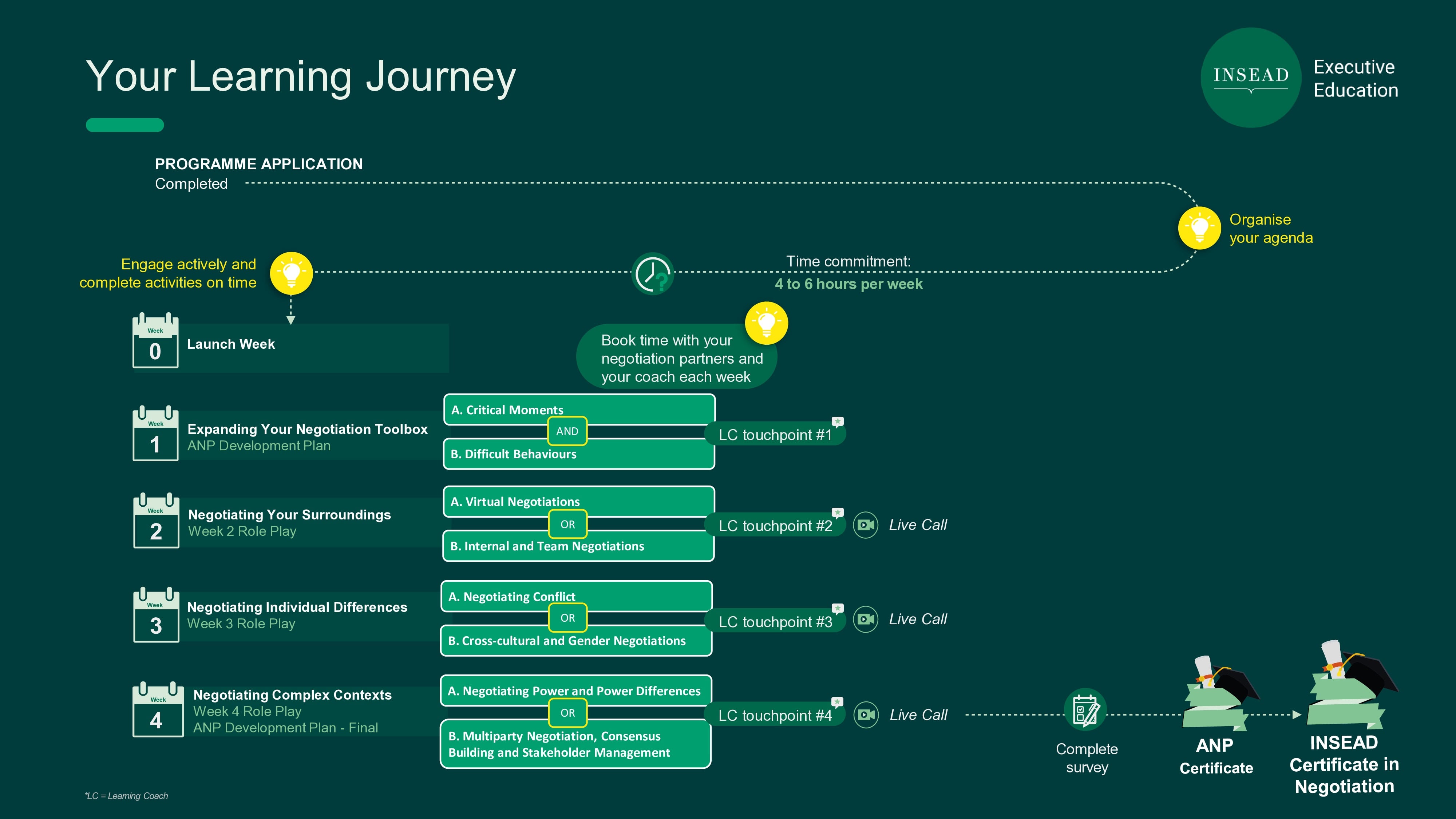
For specific dates, see calendar above.
Coaching Touchpoints
INSEAD's learning coaches are accomplished business professionals who will guide you through your learning journey. Your coach will be assigned to you in Week 1 of the programme.
Learning Coach Intervention Rhythm
Your coach will spend, on average, 2 hours in total during the programme, to share their feedback.
In total, you will have the opportunity to complete 4 coaching touchpoints with your Learning Coach. Please note that you will only receive feedback (via call) once at each coaching touchpoint.
- Touchpoint #1: Get introduced, share your current context and your ANP development plan (your main challenges, recurring questions/issues, areas of development and electives that you would like to focus on in this programme)
- Touchpoint #2: To discuss feedback on the Football Transfer Case exercise, based on your choice of elective for Week 2
- Touchpoint #3: To discuss feedback on the Prince Case exercise, based on your choice of elective for Week 3
- Touchpoint #4: To discuss feedback on the Golden Standard Case exercise, based on your choice of elective for Week 4
In this programme, you are expected to complete a minimum of 3 out of the 4 possible coaching sessions. We strongly recommend that you complete all 4, as the learning culminates progressively and we do not want to you miss out on this rich learning opportunity. The last coaching session should include feedback on your overall journey, so please let your coach know when getting ready for your final coaching session.
The coaching timeline and specific session dates are to be agreed directly with your coach. The sequence of the touchpoints must be followed but the timeline can be adjusted in agreement with your coach.
Coaching sessions are to be conducted after participants have completed all role play activities.
For Premium Journey participants, you will receive an additional 2 hours of ALP coaching on top of the standard allocation mentioned above. You have up to 1 month after the Final Assignment Review deadline to schedule your coaching sessions.
Certification Requirements
To successfully complete the programme and earn certification, you are required to meet all of the following criteria:
- Earn a minimum of 80% of available points from in-platform activities by the deadline
- Earn 5 badges for submitting the following:
- Week 1 - Development Plan
- Week 2 - Feedback Form (Football Transfer Role Play)
- Week 3 - Feedback Form (The Prince Role Play)
- Week 4 - Feedback Form (Golden Standard Role Play)
- Week 4 - Final Development Plan
- Earn a badge for conducting at least 3 out of the 4 coaching touchpoints (the badge will be awarded based on INSEAD's validation)
More information will be provided in the learning platform.
Programme Brochure
For a copy of the online programme brochure, visit the dedicated Executive Education page.
