

Calendar
The following calendar includes all important dates and deadlines to help you with planning for your upcoming programme. You will receive an email with log-in details for the learning platform and connection details for the kick-off call one week before the programme starts.
Note: Dates or times may be subject to change. Once the programme begins, consult the learning platform for the final version of the programme calendar.
| Event/deadline | Date |
| Programme Launch and Kick-off Call | 9 February - 1:00 pm - 2:00 pm CET |
| Live Call #1 with Faculty | 5 March - 11:30 am - 1:00 pm CET |
| Live Call #2 with Faculty | 19 March - 9:30 am - 11:00 am CET |
| Live Call #3 with Faculty | 26 March - 9:30 am - 11:00 am CET |
| Final Assignment due | 7 April |
| Final Assignment Review due and close of programme | 15 April |
| Learning Platform access ends | 9 August |
Attendance to the Kick-off and Live Call sessions is highly recommended but not mandatory. For those unable to join, the session will be recorded and made available on the platform.
| Event/deadline | Date |
| Programme Launch and Kick-off Call | 27 April - 1:00 pm - 2:00 pm CEST |
| Live Call #1 with Faculty | 21 May - 11:30 am - 1:00 pm CEST |
| Live Call #2 with Faculty | 4 June - 10:30 am - 12:00 pm CEST |
| Live Call #3 with Faculty | 11 June - 10:30 am - 12:00 pm CEST |
| Final Assignment due | 22 June |
| Final Assignment Review due and close of programme | 1 July |
| Learning Platform access ends | 27 October |
Attendance to the Kick-off and Live Call sessions is highly recommended but not mandatory. For those unable to join, the session will be recorded and made available on the platform.
| Event/deadline | Date |
| Programme Launch and Kick-off Call | 21 September - 1:00 pm - 2:00 pm CEST |
| Live Call #1 with Faculty | 15 October - 10:30 am - 12:00 pm CEST |
| Live Call #2 with Faculty | 29 October - 10:30 am - 12:00 pm CET |
| Live Call #3 with Faculty | 5 November- 10:30 am - 12:00 pm CET |
| Final Assignment due | 16 November |
| Final Assignment Review due and close of programme | 25 November |
| Learning Platform access ends | 21 March 2027 |
Attendance to the Kick-off and Live Call sessions is highly recommended but not mandatory. For those unable to join, the session will be recorded and made available on the platform.
| Event/deadline | Date |
| Programme Launch and Kick-off Call | 1 March - 1:00 pm - 2:00 pm CET |
| Live Call #1 with Faculty | 25 March - 9:30 am - 11:00 am CET |
| Live Call #2 with Faculty | 1 April - 10:30 am - 12:00 pm CEST |
| Live Call #3 with Faculty | 8 April - 10:30 am - 12:00 pm CEST |
| Final Assignment due | 26 April |
| Final Assignment Review due and close of programme | 5 May |
| Learning Platform access ends | 1 September |
Attendance to the Kick-off and Live Call sessions is highly recommended but not mandatory. For those unable to join, the session will be recorded and made available on the platform.
| Event/deadline | Date |
| Programme Launch and Kick-off Call | 31 May - 1:00 pm - 2:00 pm CEST |
| Live Call #1 with Faculty | 24 June - 10:30 am - 12:00 pm CEST |
| Live Call #2 with Faculty | 8 July - 10:30 am - 12:00 pm CEST |
| Live Call #3 with Faculty | 15 July - 10:30 am - 12:00 pm CEST |
| Final Assignment due | 26 July |
| Final Assignment Review due and close of programme | 4 August |
| Learning Platform access ends | 30 November |
Attendance to the Kick-off and Live Call sessions is highly recommended but not mandatory. For those unable to join, the session will be recorded and made available on the platform.
Faculty

Professor of Technology and Business

Professor of Strategy

Associate Professor of Technology and Operations Management
Syllabus
Programme Overview
Artificial Intelligence (AI) has emerged as the most important and transformative technology of our time.
Recent advances, particularly in deep learning and generative AI (like ChatGPT, Gemini, Claude, or DeepSeek) have led to a rapid proliferation of new applications that are changing business models and strategies for companies in almost all industries. This unique opportunity for transformation of your business also comes with risks– in conception, design and execution of your AI strategy.
What makes confronting these challenges particularly difficult is that they require an ability to integrate business knowledge, management, technical skills as well as broader perspectives about risks, regulations, policies and national or international AI topics. This programme is aimed squarely at managers with critical business relevant knowledge seeking to use AI to transform their organisations.
It also provides an encapsulated and gentle introduction to the core technical principles that any manager in this space must know, as well as detailed examination of how technology and organisation must mesh to produce transformation.
It will support you in becoming an AI change agent in your organisation– giving you the vocabulary to bridge between data science, business and strategic stakeholders.
Programme Learning Objectives:
- To give you a functional understanding of the fundamental AI principles (i.e. what they can or cannot do) that drive today’s AI and a high-level understanding of how they do it.
- How to get the best out of your data, data scientists and AI talent.
- How to prioritise and execute AI based projects that are likely to yield the best returns.
- How to maximise the success rate of your data and AI business projects.
- How to think about new risks these technologies can create for your business and society.
- Identify skill gaps for you and your organisation for your upskilling journey towards an AI-enabled organisation.
- Understand key trends in the broader space of AI, business and society.
Please note: In week 5 of this course, you will engage with AI-powered tools designed to enhance your learning experience, enabling more practical, personalised, and immersive exploration of the concepts covered.
Important: AI tools can make mistakes and be inaccurate. Please fact-check outputs and ensure that any information you disclose complies with applicable confidentiality obligations and your organisation’s policies.
-
Launch Week
-
In the introductory week of the programme, we will provide an overview of why using AI for business transformation can be challenging and explain how the course design aims to addresses these challenges.
Additionally, you will be introduced to the programme faculty and the key topics covered throughout the course. Guidance will be provided on how to make the most of the course, including details on programme completion, certification requirements, and an overview of your 8-week learning journey. You’ll also learn how to navigate the platform and explore its various functionalities.
Furthermore, you will be introduced to the “Action Learning Project” (ALP), a core component of the online programme. The ALP offers you the opportunity to apply what you’ve learned in TBAI to create a strategic proposal for AI-driven business transformation. The objective of the ALP is to reinforce your learning and provide a tangible space to apply concepts learned to your own real, relevant organisational context.
-
Week 1: Taking Stock of AI - The Broader Picture and your AI Strategy
-
This week, we will start by emphasising a key principle: understanding AI today requires expertise across multiple domains. We will explore the foundational scientific principles of AI, as well as the emerging "science of intelligence." We will explore the major breakthroughs in AI history, acknowledging that although the term "artificial intelligence" is relatively new, many of its core principles and technologies have existed for centuries and have been applied in business far longer than most people realise. Furthermore, we will examine what makes AI unique compared to other technologies, while also considering the ways in which it shares similarities with them. In addition, we will examine AI’s profound economic impact and the social and geopolitical implications of this technology.
Following this, we will shift our focus to AI in business, focusing on how to identify value creation opportunities for your business and build an AI portfolio. In particular we will discuss how to develop and implement your AI strategy and learn concepts that are useful when it comes to quantifying the potential business impact of AI.
Learning Objectives:
- Identify and correct common misconceptions about AI to develop a well-rounded understanding of its current capabilities.
- Explore the key domains of AI knowledge essential for navigating the evolving AI landscape effectively.
- Understand AI value creation opportunities and how to build and manage an AI portfolio.
- Learn how to design an AI strategy aligned with business goals, including methods for quantifying its business value.
-
Week 2: Building an AI-Driven Organisation - Strategy Execution, Risks and AI Governance
-
Understanding AI’s organisational impact requires a strategic approach that encompasses alignment, governance, and execution. We will explore three key areas: (1) executing an AI strategy effectively, including the implementation of specific AI use cases; (2) navigating a typical AI maturity journey of an organisation and the types of decisions one needs to make during such a transformation; and (3) understanding AI governance, its relationship to AI risks, regulations, and opportunities, and how it connects to an organisation’s broader AI strategy. Along the way, we will examine real-world examples of AI maturity journeys in organisations, explore the key capabilities that individuals, teams, and businesses need to develop to maximise the potential of AI, and consider critical risks and regulations that must be taken into account.
Learning Objectives:
- Analyse the organisational challenges involved in implementing and adopting AI solutions.
- Explore the stages of AI maturity and the key opportunities and obstacles businesses may encounter along the way.
- Understand the role of AI governance in managing risks, supporting strategy, and enabling responsible AI growth.
- Identify practical levers, tools, and real-world insights to guide an organisation’s AI journey and decision-making.
-
Week 3: The Generative AI Revolution – Deep Learning, Innovations, and Risks
-
Generative AI is built on decades of progress in machine learning, with deep learning at its core. This session begins with an overview of how AI systems learn, covering key machine learning principles and the evolution of deep learning, including neural networks and their role in modern AI. We will then explore the mechanics of Generative AI, including large language models (LLMs) and their reliance on word-by-word prediction, embeddings, and attention. The session will also examine the product lifecycle of GenAI, the startup ecosystem driving its growth, and the growing role of agentic AI and synthetic personas. Finally, we will discuss key challenges such as hallucinations, and techniques like RAG and RLHF that enhance AI safety and reliability.
Learning Objectives:
- Explain the fundamentals of deep learning and how they enable Generative AI, including the architecture and training of neural networks, as well as the roles of embeddings and attention in large language models (LLMs).
- Analyse the lifecycle of Generative AI products and their unique development pathways, comparing them with traditional AI approaches and exploring the startup ecosystem driving innovation.
- Evaluate key risks and safety considerations in Generative AI, such as hallucinations and security vulnerabilities, along with mitigation strategies like guardrails, RAG, and RLHF.
- Examine emerging applications of GenAI, including agentic AI and synthetic personas.
-
Week 4: Designing AI - Navigating Key Trade-Offs
-
Designing AI solutions involves balancing competing priorities such as accuracy, interpretability, fairness, and privacy. This session begins with the essential steps for developing an AI solution, from defining a business case to ensuring high-quality data. We will explore major trade-offs in AI design, including accuracy vs. interpretability, fairness vs. accuracy, and privacy vs. accuracy, using real-world case studies like fraud detection and the COMPAS algorithm. The discussion will highlight how bias can emerge in AI systems, the challenges of achieving fairness, and the critical role of high-quality data in AI success. Finally, we will explore AI implementation strategies, the role of competition-based AI development (e.g., Kaggle),
Learning Objectives:
- Develop a clear business case for AI initiatives.
- Identify and navigate key trade-offs in AI system design, such as accuracy vs. interpretability, fairness vs. accuracy, and privacy vs. accuracy.
- Analyse fairness and privacy challenges in AI, using real-world case studies and exploring techniques like differential privacy.
- Compare AI implementation strategies—such as in-house development vs outsourcing, and competition-based approaches—while understanding the role of privacy-preserving techniques like differential privacy in system design.
-
Week 5: Organising in the Age of Algorithms
-
This session will take a holistic view on how AI affects organisations. As the AI change agent in your organisation , you will need to develop a point of view on the management challenges that the advancement of AI poses. Accordingly, we cover issues around how AI changes general management, and organisation design.
Learning Objectives:
- How AI transforms management.
- Improving managerial decision making with zero-coding analytics.
- AI impact on human skills.
- AI and organisational hierarchy.
- What do human-centric organisations look like?
-
Final Assignment and Review
-
These two weeks are for you to synthesise your learning from the past few weeks into a compelling ALP Final Assignment submission. It will also offer an opportunity for you to give feedback to, and receive feedback from, your peers for the ALP Final Assignment. No new course content will be released in these weeks.
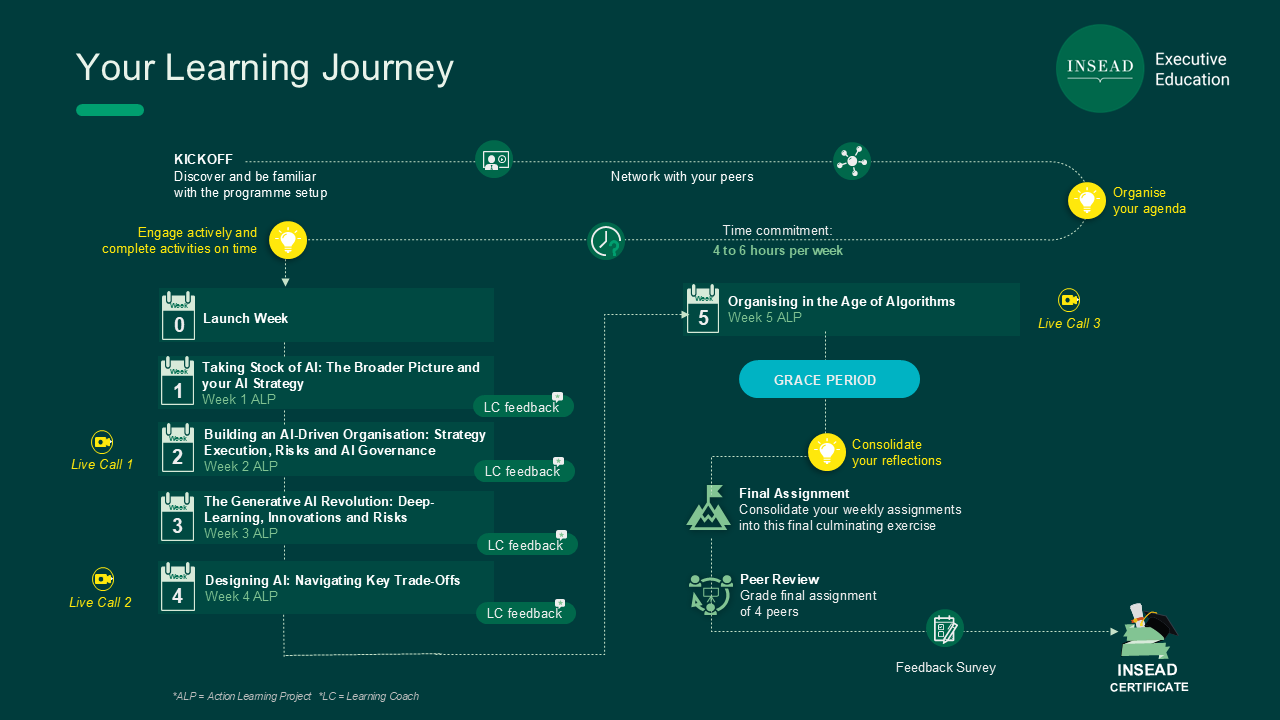
Learning Journey
This overview outlines the learning journey you will follow from the programme launch (kick-off session) to certification upon completion of the programme. It will be covered in more detail during the kick-off call.
For specific dates, see calendar above.
Action Learning Project
Introduction
Welcome to the Action Learning Project (ALP) for the INSEAD Online Programme, Transforming Your Business with AI (TBAI). The objective of this ALP is to offer you a space to apply the learnings from this programme in the context of your organisation or that of your client’s organisation. The ALP is intended to help you tackle organisational challenges that are related to the TBAI programme content, and relevant to your current role and context.
Over the next five weeks, we will take you through a step-by-step journey of reflection and action planning to help you put together a strategic proposal to leverage AI to transform your business or that of your client’s. You will reflect on key areas – identifying an AI-solvable problem, evaluating organisational readiness for implementation, determining the best approach to building your AI model, assessing whether your AI adoption strategy is accounting for both business and human impact and identifying your execution plan. Your context of course will be unique, but the objective is to strengthen your skills in using AI to bring about business impact.
Start reflecting on an AI-driven problem or challenge within your organisation or your client's organisation, so that you have a clear project in mind when the programme kicks off.
You can work individually or, when applicable, together with other members of your organisation who are also taking the course to deliver your ALP (if you are attending the programme as a group from one organisation, you can work together in small groups of maximum 4–5 members).
What to Expect for the Final Assignment
For the final assignment, you are expected to synthesise your work from all weeks into a coherent, compelling strategy proposal. This must showcase the story of your learning journey in TBAI and make the case for using AI to enhance business impact in the organisation.
Your final assignment submission must:
- Include an executive summary where you highlight your key findings and proposed strategy.
- Describe your business context to set the stage for your story.
- Highlight opportunities or challenges for leveraging AI and elaborate on the AI solvable problem.
- Examine your / client organisation’s capability to implement and execute on AI.
- Explain how GenAI could enhance your solution, risks involved, and responsible use strategies.
- Summarise your assessment of whether to build your AI solution in-house or to outsource.
- Discuss how AI adoption may reshape roles, skills, and culture in the organisation, and how your strategy addresses both business and human impact.
- Identify the key actions you will take to move your proposal from idea to execution and outline how you will evaluate its effectiveness.
Your final deliverable will be a high-level written final presentation based on your weekly ALP submissions and outlining your AI Strategy Proposal.
Coaching Touchpoints
INSEAD's learning coaches are accomplished business professionals who will guide you through your learning journey. Your coach will be assigned to you in Week 1 of the programme.
Learning Coach Intervention Rhythm
Your coach will spend, on average, 2 hours in total during the programme on your Action Learning Project (ALP), whether you are working on it individually or in a company group with your colleagues.
You will have 4 touchpoints with your Learning Coach:
- Touchpoint #1: After Week 1 closes for feedback on Week 1 ALP assignment submission
- Touchpoint #2: After Week 2 closes for feedback on Week 2 ALP assignment submission
- Touchpoint #3: After Week 3 closes for feedback on Week 3 ALP assignment submission
- Touchpoint #4: After Week 4 closes for feedback on Week 4 ALP assignment submission and combined guidance on Week 5 reflections.
You should work closely with your Learning Coach to plan the best schedule for your submissions and feedback. Please note that you will only receive feedback (written or via call) once for each coaching touchpoint. You should reflect on the feedback you receive from your Coach and incorporate any updates in the following ALP assignments and/or the Final Assignment.
For Premium Journey participants, you will receive an additional 2 hours of ALP coaching on top of the standard allocation mentioned above. You have up to 1 month after the Final Assignment Review deadline to schedule your coaching sessions.
Certification Requirements
To successfully complete the programme and earn certification, you are required to meet all of the following criteria:
- Earn a minimum of 80% of available points from in-platform activities by the Final Assignment deadline
- Earn a minimum of 60% of available points from your Final ALP assignment submission and review by the Final Assignment Review deadline
More information will be provided in the learning platform.
Programme Brochure
For a copy of the online programme brochure, visit the dedicated Executive Education page.
