

Calendar
The following calendar includes all important dates and deadlines to help you with planning for your upcoming programme. You will receive an email with log-in details for the learning platform and connection details for the kick-off call one week before the programme starts.
Note: Dates or times may be subject to change. Once the programme begins, consult the learning platform for the final version of the programme calendar.
| Event/deadline | Date |
| Programme Launch and Kick-off Call | 13 April - 1:00 pm - 2:00 pm CEST |
| Live Call #1 with Faculty | 29 April - 1:00 pm - 2:30 pm CEST |
| Live Call #2 with Faculty | 18 May - 1:00 pm - 2:30 pm CEST |
| Live Call #3 with Faculty | 2 June - 1:00 pm - 2:30 pm CEST |
| Final Assignment due | 15 June |
| Final Assignment Review due and close of programme | 24 June |
| Learning Platform access ends | 13 October |
Attendance to the Kick-off and Live Call sessions is highly recommended but not mandatory. For those unable to join, the session will be recorded and made available on the platform.
| Event/deadline | Date |
| Programme Launch and Kick-off Call | 7 September - 1:00 pm - 2:00 pm CEST |
| Live Call #1 with Faculty | 25 September - 1:00 pm - 2:30 pm CEST |
| Live Call #2 with Faculty | 14 October - 1:00 pm - 2:30 pm CEST |
| Live Call #3 with Faculty | 30 October - 1:00 pm - 2:30 pm CET |
| Final Assignment due | 9 November |
| Final Assignment Review due and close of programme | 18 November |
| Learning Platform access ends | 7 March 2027 |
Attendance to the Kick-off and Live Call sessions is highly recommended but not mandatory. For those unable to join, the session will be recorded and made available on the platform.
Faculty

Professor of Management Practice

Professor of Organisational Behaviour
Syllabus
Programme Overview
In a digitised environment characterised by rapid and continual disruption, it is critical for organisations to be agile and quickly respond to change. As a result, businesses require leaders who are not only effective interpersonally, but who can also manage increasingly complex organisations.
Effective leaders today must be able to make decisions faster and lead change efficiently, while skillfully influencing in a more interconnected, collaborative landscape. Additionally, they need to foster a “digital-ready” organisational culture that embraces – rather than resists – continuous change. The foundation for modern high performing organisations is adaptation, coordinated action, and speed.
Leading Organisations in Disruptive Times is an online programme that takes a closer look at the challenges facing senior leaders today – from conducting fair decision-making processes to enabling their organisations to navigate wider political and cultural challenges.
Building on research in organisational behaviour, the programme will develop your ability to drive faster decision-making, accelerate change processes, shape organisational culture, and build your capacity for ambidextrous leadership. It will provide you with a set of concepts and tools enabling you to lead your organisation with greater impact and efficiency.
Programme Learning Objectives:
- Understand the key challenges senior leaders face in leading more complex organisations
- Learn practical tools (including the Fair-Process Leadership approach) for helping teams make critical decisions
- Improve your ability to manage large, formal change management processes
- Examine power and influence dynamics in organisations, including effective network development
- Acquire skills for discerning the organisational culture you really have – not just the one you wish for – and how to shape that culture
- Expand your ability to balance contradictory forces within your organisation
-
Launch Week
-
In the Launch Week, you will find guidance on how to make the most of the programme, information on completion and certification requirements, and an overview of the learning journey. You will learn how to navigate the platform, get to know your faculty and peers.
You will also find out about the “Action Learning Project” (ALP). The ALP is an integral part of the online course. It offers you the opportunity to apply your learning to explore ways to contribute to digital strategy design and execution in your work. The objective of the ALP is to reinforce your learning and develop a tangible action plan for strategy execution. During the Launch Week, you will need to submit the scope of your ALP.
Note: In order to successfully pass this programme, you must complete your ALP to a high standard.
-
Week 1: The Decision Challenge
-
The introductory week begins with foundations in effective leadership. We acknowledge a paradox of leadership: it should be easy, given how natural hierarchical systems are amongst human populations and history, but we know that it is hard, that humans are complex—as much as we accept ranks and power differences, we also challenge our leaders, expect them to conform to various norms that are beyond even the authority of the most powerful leaders. We therefore need leadership models that acknowledge certain core human principles (most explicitly fairness and procedural justice) while leaders carry the responsibility to shape and enact, in other words own and be accountable. In Week 1, we explore one such model. We will challenge some common practices of leadership and offer a more modern perspective.
Learning Objectives:
- Acknowledge the importance and impact of decision-making as the core work of leadership
- Recognise how decision-making in today’s “empowered” workforce is less about “telling” than it is about guiding and facilitating an effective decision-making path
- Explore a practical model for implementing Fair-Process Leadership norms in your setting.
-
Week 2: The Change Challenge
-
Week 2 turns the lens outward, from the leadership of relatively smaller units (although scalable, from specific people, to teams, to larger groups) to orchestrating change in larger organisational settings. Based on aggregate research reviews on the most popular change models in recent decades, we take you through the fundamental steps and considerations in leading programmatic change (meaning planned change). These are the essential ideas around change leadership that have accumulated in this vast literature over the decades, and they form an important set of tools and principles for leaders needing to ensure adaptive organisations.
Learning Objectives:
- Deepen your understanding of the complexities of change amidst digitisation
- Explore ten pillars to guide organizational change in your organisation
- Acknowledge the ‘X factor’ to change management while considering essential shared elements to lead to success.
-
Week 3: The Social Capital Questionnaire
-
In Week 3 you will complete a Social Capital Questionnaire which will give you a personal report that captures key features of your social network and help you better understand the concepts around political influence and social capital that will be covered in Week 4.
-
Week 4: The Political Challenge
-
Week 4 builds on the change challenge, but it confronts an uncomfortable reality of leadership—while we must have solid, systematic tools for leadership and strategic change, sometimes leaders need to “move mountains” without full authority while facing powerful undercurrents and political challenges in the organisation, confronting ideas and assumptions that don’t normally surface and yet create major obstacles to change. We believe these types of challenges are a reality for many digital/disruptive forces, because they can be so distant from the “status quo” of the organisation. We need to deepen, therefore, the modern leaders toolkit. We need to explore the challenges of power and politics in leadership, and we need to offer some additional ideas and tools. But we need to do this while grappling with the paradox of leadership with which we started, that leaders will face challenges to their plans, ideas and authority and yet must somehow find a way to shepherd change while being mindful of the norms of her/his community. We will also delve deeper and consider some of the political dynamics leaders should be aware of and the mindfulness of successfully navigating political challenges.
Learning Objectives:
- Explore why people often have ambivalent reactions to power and influence
- Differentiate between hard and soft power, emphasizing the significance of developing the latter, especially in increasingly horizontal and network-driven work environments
- Examine the human proclivity for “familiar” and “clan-like” relationships, instead of exploring new and diverse relations, and understanding the importance of cultivating social curiosity and openness.
-
Week 5: The Culture Challenge
-
Week 5 continues the theme of being effective “under the current” leaders, having tools that go beyond “normal” programmatic change. Inevitably, this means confronting organisational culture, perhaps the deepest frontier of resistance or challenge faced by leaders, powerful, because it is so silent but stable and repetitive. Also, digital and disruptive forces, we have found, face substantial challenges from organisational culture, and tend to require new assumptions (about time, cooperation, responsibilities, etc.). Modern executives, therefore, need tools that can help them deal with organisational culture.
Learning Objectives:
- Develop a deeper understanding of how to pinpoint and define something as seemingly abstract as organisational culture
- Gain insights into analysing organisational culture and navigating the array of diverse mental models and competing organisational narratives
- Explore ideas for shaping organisational culture so that it supports your change management strategy.
-
Week 6: The Ambidexterity Challenge
-
Week 6 brings together insights and research from the general area of Ambidextrous Leadership – effectively the “art” of coping with contradictory forces and operations in modern business organisations. A key starting point is the acceptance that ‘contradiction’ is a good thing and that successful companies do not try to “resolve” but instead find a way to embrace it. To successfully deal with such forces, personal development of paradoxical thinking is essential. We will examine ambidexterity at both micro (leadership and team mindset) and macro levels (structural design, contextual work) and our focus will be on the challenge of balancing conflicting forces within modern, complex organisations: the near and far, to explore and execute, whether autonomously or through synergies.
Learning Objectives:
- Develop an understanding of the major contradictions facing organisations in fast-paced environments
- Learn from companies that manage ambidexterity well
- Discover the MC (Managing Contradictions) Framework to help you manage contradictory forces in your organisation.
-
Final Assignment and Review
-
The last two weeks are for you to synthesise your learning from the programme into a compelling Final ALP Assignment submission, building on your reflections from your weekly ALPs into your narrative for your change initiative.
The Peer Review process offers you an opportunity to give feedback to, and receive feedback from, your peers on the Final Assignment.
Learning Journey
This overview outlines the learning journey you will follow from the programme launch (kick-off session) to certification upon completion of the programme. It will be covered in more detail during the kick-off call.
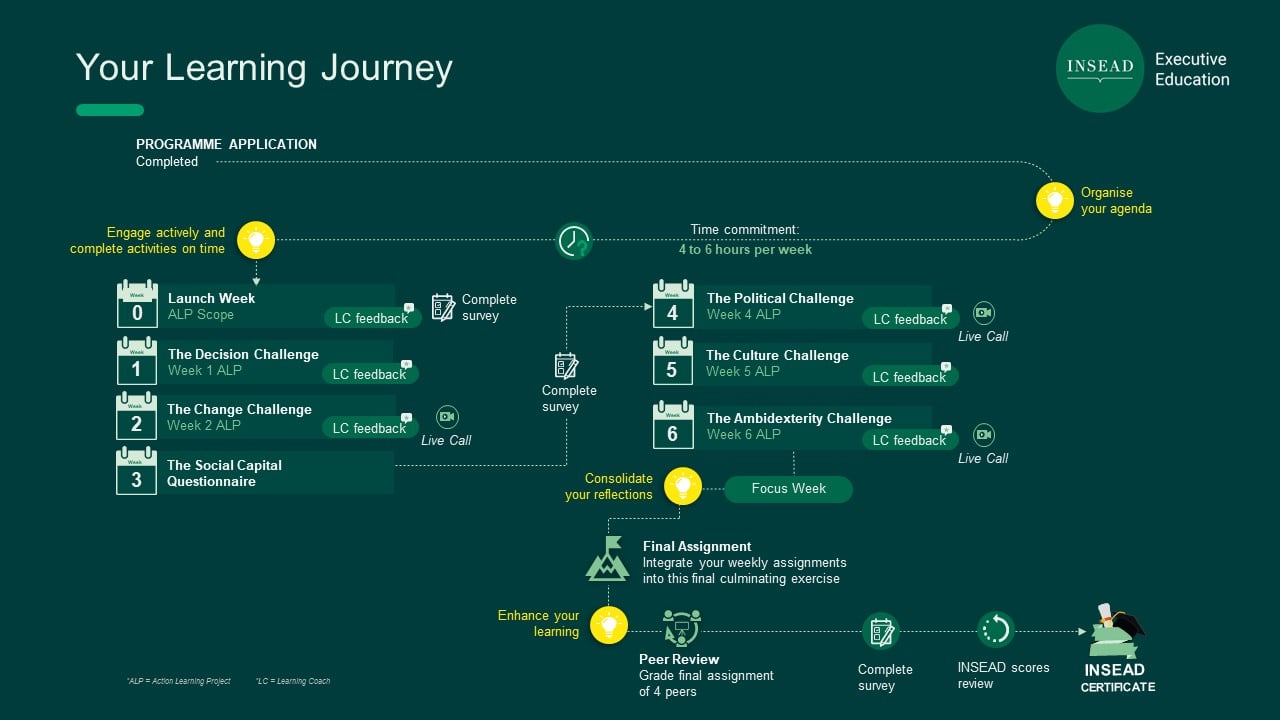
For specific dates, see calendar above.
Action Learning Project
Introduction
The Action Learning Project (ALP) focuses on building your Leadership Action Plan and gives you the opportunity to practice applying your learning to your own leadership role, and particularly in exercising diagnostic tools.
The objective of this ALP is to help you exercise the learnings from the programme in your context, to help you tackle the organisational challenges that are related to the LODT course content and your current role and organisation.
We will take you through a step-by-step journey of reflection and action planning to help you become more effective as an organisational leader. You will reflect on five key aspects - your conduct as a “fair-process” leader, your ideas or plans for organisational change, your political challenges, your organisational culture and your capacity for ambidextrous leadership. Your context, of course, will be unique, but the idea is to strengthen your hand in navigating your organisation through a significant change or disruptive context.
Please start thinking about a change happening given your context, so that you have a specific project in mind when the programme launches.
What to Expect for the Final Assignment
For the Final Assignment, you will continue your reflection from your weekly ALP assignments and build your narrative for your change initiative. As you work on your narrative, you will be asked to consider the below aspects:
- How to make the decision-making process fairer
- An effective change management process covering all pillars discussed in the course
- Successfully navigate the political waters leveraging your social and political capital and being mindful of the power plays
- Aligning the changing context and the organisational culture to be in sync and consequentially effective
- Balancing the contradictory forces within your organisation and expanding your capacity for ambidextrous leadership
Your final deliverable will be a high-level written final presentation of your Leadership Action Plan.
Coaching Touchpoints
INSEAD's learning coaches are accomplished business professionals who will guide you through your learning journey. Your coach will be assigned to you in Week 1 of the programme.
Learning Coach Intervention Rhythm
Your coach will spend, on average, 3 hours in total during the programme on your Action Learning Project (ALP), whether you are working on it individually or in a company group with your colleagues.
You will have 6 touchpoints with your Learning Coach:
- Touchpoint #1: After ALP Scope submission
- Touchpoint #2: After Week 1 ALP submission
- Touchpoint #3: After Week 2 ALP submission
- Touchpoint #4: After Week 4 ALP submission
- Touchpoint #5: After Week 5 ALP submission
- Touchpoint #6: Choose between Option A or B
- Option A: After Week 6 reflections (note there is no platform submission for Week 6) and before Final Assignment submission for feedback on Week 6 Reflections combined with Final Assignment guidance. OR
- Option B: Feedback on the draft of your Final Assignment only. In this case, your Learning coach will focus the feedback on how to improve your Final Assignment (drawing from your ALP journey so far) and NOT on how to pass the course. Coaches will not give indications or recommendations on grading
You should work closely with your Learning Coach to plan the best schedule for your submissions and feedback. Please note that you will only receive feedback (written or via call) once for each coaching touchpoint. You should reflect on the feedback you receive from your Coach and incorporate any updates in the following ALP assignments and/or the Final Assignment.
For Premium Journey participants, you will receive an additional 2 hours of ALP coaching on top of the standard allocation mentioned above. You have up to 1 month after the Final Assignment Review deadline to schedule your coaching sessions.
Certification Requirements
To successfully complete the programme and earn certification, you are required to meet all of the following criteria:
- Earn a minimum of 80% of available points from in-platform activities by the Final Assignment deadline
- Earn a minimum of 60% of available points from your Final ALP assignment submission and review by the Final Assignment Review deadline
More information will be provided in the learning platform.
Programme Brochure
For a copy of the online programme brochure, visit the dedicated Executive Education page.
