

Faculty

Professor of Management Practice

Professor of Organisational Behaviour
Syllabus
In a digitised environment characterised by rapid and continual disruption, it is critical for organisations to be agile and quickly respond to change. As a result, businesses require leaders who are not only effective interpersonally, but who can also manage increasingly complex organisations.
Effective leaders today must be able to make decisions faster and lead change efficiently, while skillfully influencing in a more interconnected, collaborative landscape. Additionally, they need to foster a “digital-ready” organisational culture that embraces – rather than resists – continuous change. The foundation for modern high performing organisations is adaptation, coordinated action, and speed.
Leading in Disruptive Times is an online module that takes a closer look at the challenges facing senior leaders today – from conducting fair decision-making processes to enabling their organisations to navigate wider political and cultural challenges.
Building on research in organisational behaviour, this module will develop your ability to drive faster decision-making, accelerate change processes, and shape organisational culture. It will provide you with a set of concepts and tools enabling you to lead your organisation with greater impact and efficiency.
Overall Learning Objectives:
- Understand the key challenges senior leaders face in leading more complex organisations.
- Learn practical tools (including the Fair-Process Leadership approach) for helping teams make critical decisions.
- Improve your ability to manage large, formal change management processes.
- Examine power and influence dynamics in organisations, including effective network development.
- Acquire skills for discerning the organisational culture you really have – not just the one you wish for – and how to shape that culture.
- Expand your ability to balance contradictory forces within your organisation.
-
Introduction
-
To start with this module, you will find guidance on how to make the most of it, your will be provided with information on completion requirements, and an overview of the learning journey.
You will also find out about the “Action Learning Practice” (ALP). It offers you the opportunity to apply your learning to explore ways to contribute to digital strategy design and execution in your work. The objective of the ALP is to reinforce your learning and develop a tangible action plan for strategy execution.
-
Week 1: The Decision Challenge
-
Week 1 begins with foundations in effective leadership. We acknowledge a paradox of leadership: it should be easy, given how natural hierarchical systems are amongst human populations and history, but we know that it is hard, that humans are complex—as much as we accept ranks and power differences, we also challenge our leaders, expect them to conform to various norms that are beyond even the authority of the most powerful leaders. We therefore need leadership models that acknowledge certain core human principles (most explicitly fairness and procedural justice) while leaders carry the responsibility to shape and enact, in other words own and be accountable. In Week 1, we explore one such model. We will challenge some common practices of leadership and offer a more modern perspective.
Learning Objectives:
- Understand why making decisions is the core work of leadership.
- Recognise how decision-making in today’s “empowered” workforce is less about “telling” than it is about guiding and facilitating an effective decision-making path.
- Discover a concrete model for enacting Fair-Process Leadership norms in your setting.
-
Week 2: The Change Challenge
-
Week 2 turns the lens outward, from the leadership of relatively smaller units (although scalable, from specific people, to teams, to larger groups) to orchestrating change in larger organisational settings. Based on aggregate research reviews on the most popular change models in recent decades, we take you through the fundamental steps and considerations in leading programmatic change (meaning planned change). These are the essential ideas around change leadership that have accumulated in this vast literature over the decades, and they form an important set of tools and principles for leaders needing to ensure adaptive organisations.
Learning Objectives:
- Understand in more detail why change in the context of digitisation can be so difficult.
- Discover ten pillars of leading organizational change aggregated from years of research and writing on change management.
- Accept that there will always be an ‘X factor’ to change management, a unique chemistry that the leader brings…although with some common elements that are important to consider.
-
Week 3: The Social Capital Questionnaire
-
In Week 3 you will complete a Social Capital Questionnaire which will give you a personal report that captures key features of your social network and help you better understand the concepts around political influence and social capital that will be covered in Week 4.
-
Week 4: The Political Challenge
-
Week 4 builds on the change challenge, but it confronts an uncomfortable reality of leadership—while we must have solid, systematic tools for leadership and strategic change, sometimes leaders need to “move mountains” without full authority while facing powerful undercurrents and political challenges in the organisation, confronting ideas and assumptions that don’t normally surface and yet create major obstacles to change. We believe these types of challenges are a reality for many digital/disruptive forces, because they can be so distant from the “status quo” of the organisation. We need to deepen, therefore, the modern leaders toolkit. We need to explore the challenges of power and politics in leadership, and we need to offer some additional ideas and tools. But we need to do this while grappling with the paradox of leadership with which we started, that leaders will face challenges to their plans, ideas and authority and yet must somehow find a way to shepherd change while being mindful of the norms of her/his community. We will also delve deeper and consider some of the political dynamics leaders should be aware of and the mindfulness of successfully navigating political challenges.
Learning Objectives:
- Explore why people often have ambivalent reactions to power and influence.
- Understand the difference between hard and soft power, and why developing the latter is important – especially in increasingly horizontal and network-driven work environments.
- Learn about the human proclivity for “familiar” and “clan-like” relationships, focusing on our cliques instead of exploring new relations, and why disruption may require us to become more socially curious and exploratory.
-
Week 5: The Culture Challenge
-
Week 5 continues the theme of being effective “under the current” leaders, having tools that go beyond “normal” programmatic change. Inevitably, this means confronting organisational culture, perhaps the deepest frontier of resistance or challenge faced by leaders, powerful, because it is so silent but stable and repetitive. Also, digital and disruptive forces, we have found, face substantial challenges from organisational culture, and tend to require new assumptions (about time, cooperation, responsibilities, etc.). Modern executives, therefore, need tools that can help them deal with organisational culture.
Learning Objectives:
- Develop an understanding of how to pinpoint and define something as seemingly abstract as organisational culture.
- Gain insights into how to shape such a culture and navigate diverse mental models and competing organisational narratives.
- Explore what it means to develop effective digital-ready cultures.
-
Week 6: The Ambidexterity Challenge
-
Week 6 brings together insights and research from the general area of Ambidextrous Leadership – effectively the “art” of coping with contradictory forces and operations in modern business organisations. A key starting point is the acceptance that ‘contradiction’ is a good thing and that successful companies do not try to “resolve” but instead find a way to embrace it. To successfully deal with such forces, personal development of paradoxical thinking is essential. We will examine ambidexterity at both micro (leadership and team mindset) and macro levels (structural design, contextual work) and our focus will be on the challenge of balancing conflicting forces within modern, complex organisations: the near and far, to explore and execute, whether autonomously or through synergies.
Learning Objectives:
- Develop an understanding of the major contradictions facing organisations in fast-paced environments.
- Learn from companies that manage ambidexterity well.
- Discover the MC (Managing Contradictions) Framework to help you manage contradictory forces in your organisation.
Learning Journey
This overview outlines the learning journey you will follow for this module. Please take a moment to review the Learning Journey as it covers important steps of the module.
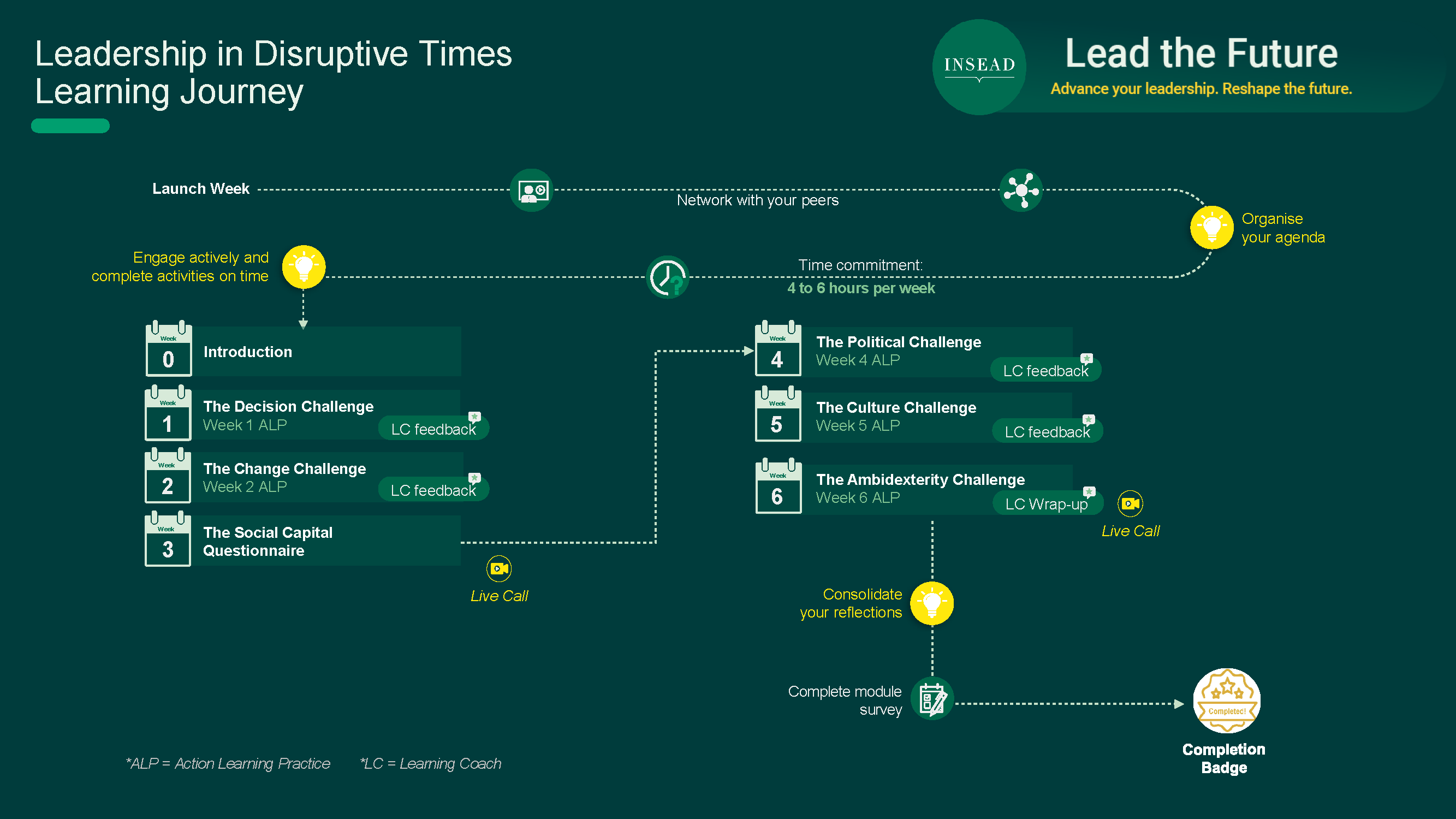
Coaching Touchpoints
Your coach will spend, on average, 2.5 hours in total during the module on your ALP. During the module, you will have 5 touchpoints with your Learning Coach.
Learning Coach intervention rhythm:
- Touch point #1: After Week 1 closes for feedback on Week 1 ALP assignment submission
- Touch point #2: After Week 2 closes for feedback on Week 2 ALP assignment submission
- Touch point #3: After Week 4 closes for feedback on Week 4 ALP assignment submission
- Touch point #4: After Week 5 closes for feedback on Week 5 ALP assignment submission
- Touch point #5: After Week 6 closes to wrap up the module.
Action Learning Practice
Developing your leadership skills, not just knowledge, is an ambition of the Leadership in Disruptive Times module.
With this in mind, the Action Learning Practice (ALP) focuses on building your Leadership Action Plan and gives you the opportunity to practice applying your learning to your own leadership role, and particularly in exercising diagnostic tools.
The objective of this ALP is to help you exercise the learnings from the module in your context, to help you tackle the organisational challenges that are related to the content and your current role and organisation.
We will take you through a step-by-step journey of reflection and action planning to help you become more effective as an organisational leader. You will reflect on five key aspects - your conduct as a “fair-process” leader, your ideas or plans for organisational change, your political challenges, your organisational culture and your capacity for ambidextrous leadership. Your context, of course, will be unique, but the idea is to strengthen your hand in navigating your organisation through a significant change or disruptive context.
