

Faculty

Senior Affiliate Professor of Finance
Syllabus
Sustainability issues are becoming increasingly important to businesses around the world, affecting everything from strategy to operations. They are also a key consideration in the finance industry, where asset managers, banks, insurers and others now standardly integrate environmental and social concerns into their decision making and dealings with firms.
How companies manage environmental and social issues presents financial risks and opportunities, in particular for those who invest in or lend to them. At the same time, through their capital allocation decisions and other actions, providers of capital and other financial services can play an important role in supporting businesses in having real world environmental and social impact.
This module examines sustainable finance from various angles. It covers broad themes, from net zero and decarbonisation for real economy businesses and financial sector firms to developments in sustainability reporting and environmental, social and governance (ESG) ratings.
Sustainable Finance also focuses specifically on sustainable investing, which is the integration of sustainability in asset management, financing, and the use of green and sustainability-linked bonds and loans, from both a banking and corporate finance angle.
Overall Learning Objectives:
- Explain how sustainability is incorporated in financial decision making.
- Explain how environmental and social issues financially impact real economy businesses and the financial sector.
- Discuss the real-world impacts of sustainable investment and financing activities.
- Apply the concepts and best practices from the programme to your organisation.
-
Introduction
-
We begin with the essential information regarding the completion of this module. You will discover the insightful overview and learning journey you are about to embark upon in the coming weeks.
-
Week 1 : Sustainability, Climate Change and Finance
-
This week introduces you to a framework that connects finance, and in particular providers of capital and other financial services, to sustainability issues. This framework provides a structured way of thinking about a wide range of topics in Sustainable Finance, and we will return to it in all the subsequent modules of the programme.
Here, we develop the framework by focusing on action on climate change, starting with some of the basics of the science of climate change and the net zero transition. In subsequent modules, we will see that the framework applies equally to other environmental and social issues.
Learning Objectives:
- Describe common sustainability frameworks; discuss the connection between global warming, emissions and carbon budgets as well as between emission pathways, net zero and carbon offsetting.
- Discuss the two main channels that link finance and sustainability.
- Discuss the evidence that illustrates the financial impact of climate change on providers of capital and other financial services.
- Explore actionable ideas that you might further develop into a personal action plan.
-
Week 2 : Decarbonisation
-
One of the main ways in which providers of capital can both support action on climate change and manage climate risks in their portfolios is to engage with the real economy companies they finance on the net zero transition.
This week takes a deep dive into decarbonisation, starting with the basics of measuring firm emissions and assessing both emission reduction targets as well as broader net zero transition plans for real economy firms. It then addresses how owners and lenders measure their financed emissions and set targets for reducing these emissions over time. Finally, the module discusses the role of various financial sector Net Zero initiatives in real economy decarbonisation.
Learning Objectives:
- Explain how greenhouse gas emissions are measured for real economy and financial sector firms.
- Assess emission reduction targets and net zero transition plans for real economy and financial sector firms.
- Assess the role of financial sector net zero initiatives and the impact on decarbonising the real economy.
- Discuss the implications of the relationship between financed and real-world emissions
-
Week 3: Sustainability Reporting and ESG Ratings
-
Sustainable finance integrates sustainability considerations (environmental and social factors) into financial decision making. Having good data on the sustainability performance of firms is therefore essential for providers of capital and other financial services.
This week explores sustainability data from two perspectives: 1) corporate sustainability reporting, which is the disclosure of sustainability data by organisations themselves, and 2) environmental, social and governance (ESG) ratings, which provide a third-party assessment of an organisation's performance on ESG factors. It also discusses the link between sustainability reporting and ESG ratings.
Learning Objectives:
- Describe the different types of materiality of sustainability data.
- Discuss the foundational sustainability frameworks, such as the Task Force on Climate-related Financial Disclosures (TCFD) and the Sustainability Accounting Standards Board (SASB), on which global sustainability reporting regulation is built.
- Classify foundational sustainability disclosure frameworks according to the type of materiality.
-
Week 4: Sustainable Investing
-
Sustainable investing, the integration of sustainability or E&S considerations into investment products and strategies, has been one of the most important trends in asset management in recent years.
This week examines different types of sustainable investing approaches, from exclusions and divestment to ESG integration and ESG engagement. In each case, we will explore how and why sustainability is integrated into the approach, the impact on financial performance, and any real-world impact. We will thereby be able to identify in which instances it is possible to 'do well by doing good' through sustainable investing.
Learning Objectives:
- Describe the main types of sustainable investment strategies and explain how investing sustainably affects financial performance; discuss different types of greenwashing.
- Describe the real-world impacts of the main types of sustainable investment strategies.
- Critique an organisation’s sustainable investing approach by interpreting its financial performance and real-world impact.
-
Week 5: Sustainable Financing
-
This week explores sustainable financing, that is, the use of debt instruments where sustainability is integrated into the design of the bond or loan. We will consider two basic types, green and sustainability linked, from the perspective of both lenders and borrowers. In each case, we will consider whether the use of this type of financing by corporates results in real world impact and how the pricing of sustainable debt differs from that of plain vanilla instruments.
Finally, we will also consider the various mechanisms in place that aim to enhance transparency and reduce the potential for greenwashing, such as external verification, guidelines for market best practices and the use of taxonomies.
Learning Objectives:
- Describe the main types of sustainable financing instruments (green, sustainability-linked).Explain the use of sustainable financing from a company (issuer) perspective.
- Explain the use of sustainable financing from a company (issuer) perspective and the pricing (financial performance) of sustainable financing instruments (greenium).
- Discuss the additionality of sustainable financing; describe market best practices for sustainable financing instruments; discuss potential greenwashing and key developments around green taxonomies.
Learning Journey
Please take a moment to review the Learning Journey as it covers important steps of the module.
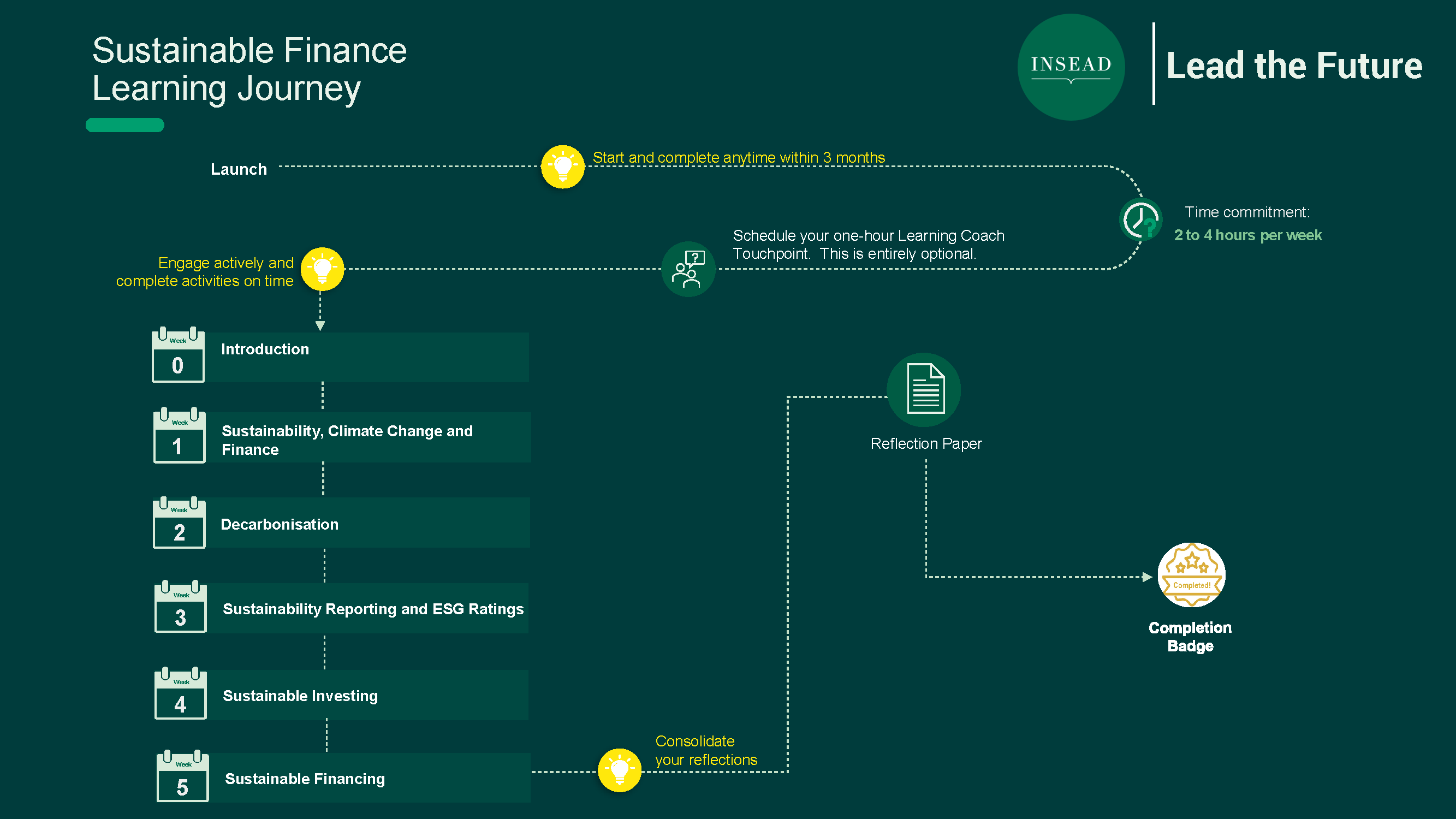
Reflection Assignment
In this reflective exercise, you will apply course concepts to analyse how sustainable finance integrates into your personal or business context. Your task is to explore a key sustainability challenge in your organisation or industry and assess its financial impact. You will reflect on areas such as sustainability in financial decision-making, decarbonization efforts, ESG reporting, sustainable investing, and financing strategies. Your final submission should be a 1-2 page document that synthesises your insights and recommendations. In your conclusion, integrate your reflections into an action plan, considering best practices, policy effectiveness, and potential improvements to enhance sustainability within your organisation or industry.
