

Faculty

Professor of Strategy
Syllabus
Confronted with the threats of disruption and a shifting competitive landscape, companies are pushing for greater agility by fostering strategic acumen throughout their organisation. Strategy is no longer a skill confined to senior leadership. Instead, it is crucial for professional success and advancement across a wide range of roles and responsibilities. The greater their understanding of business strategy, the more executives and managers can deliver faster and smarter decision-making. They will also be better equipped to drive the innovation and change that organisations need to succeed and maintain long-term sustainability in today’s challenging markets.
Are you an executive – in any function, from operations, HR, marketing, legal, IT, etc. – who is now being called upon to take a strategic perspective on your organisation? Developing your business acumen will allow you to better understand the drivers behind an organisation’s performance, as well as how to leverage that knowledge in your areas of responsibility.
Do you work in corporate sales or advisory and need to understand your clients’ evolving business challenges? Business acumen will improve your ability to act as a strategic partner for your clients, tailoring your recommendations and clearly communicating your organisation’s distinctive value proposition.
Strategy in Turbulent Times is designed to give you the key tools and perspectives from strategy to achieve these objectives. This module will help you understand the evolving strategic agenda of a company and then leverage that understanding to identify concrete opportunities to elaborate the strategy, drive organisational alignment, and ultimately enhance performance.
Overall Learning Objectives:
- Develop your ability to think strategically and see the big picture so that you can align an organisation’s internal resources and capabilities with its evolving external environment.
- Learn to take a value approach to navigating business decisions and driving sustainable competitive advantage.
-
Introduction
-
We begin with establishing why it is important for business professionals to understand and implement strategy to make timely, sustainable decisions for their organisation. Using global examples from the beverage, pharmaceutical, and digital industries, you will be introduced to strategic principles and the relevance of using strategy in today’s turbulent times. We reflect on how data, devices, and detection can influence decision-making now and in the future, and how ESG, social values or other externalities also impact decision-making. This week will lay the groundwork for the remainder of the module.
You will find also guidance on how to make the most of the course, information on completion requirements, and an overview of the journey you will take over the module.
You will also find out about the “Action Learning Practice” (ALP). The ALP is an integral part of the online course. It offers you the opportunity to apply your learning to explore ways to contribute to digital strategy design and execution in companies. The objective of the ALP is to reinforce your learning and develop a tangible action plan for strategy execution.
-
Week 1: What is Strategy?
-
Week 1 starts by exploring the question, what is strategy? You will focus on two complementary answers. The first is that strategy is about helping organisations fit into their external environment, often in the face of accelerating pressures for change. The second is that strategic thinking should enable companies to invest in such a way so as to drive superior performance. You will relate these ideas to a simple definition of strategy and the classic SWOT (Strengths, Weaknesses, Opportunities, and Threats) framework. You will also practice using the PESTLE framework to analyse the environment and industry around an organisation. This week provides important foundations for the rest of the course.
Learning Objectives:
- Understanding what strategy is really about.
- Ensuring fit with a dynamic external environment.
- Examining performance differences within and across sectors.
- Analysing trends in the industry and the environment.
- Meeting the challenge of market turbulence and disruption.
-
Week 2: Follow the Value
-
A focus on value provides a powerful compass for navigating changes in an industry. The second week of the module introduces the key concepts of value creation, value capture, willingness-to-pay (WTP) and resource costs and illustrates how to use them to assess the impact of new products and technologies. For example, how can you identify new opportunities based on the market demand for sustainable and environmentally-friendly products, such as electric vehicles? We shift our focus from the external environment to how you can formulate compelling new value propositions. The value-approach is used to deepen the analysis of the external changes impacting your business, developing a more structured approach to disruption and shifts in market size.
Learning Objectives
- Understanding the challenge of creating and capturing value.
- Driving competitive advantage through added value.
- Balancing willingness-to-pay and resource costs.
- Identifying willingness-to-pay drivers in B2B and B2C settings.
- Understanding and anticipating shifts in market size.
-
Week 3: Managing Your Value Network
-
Week 3 continues our focus on how strategy can transform the industry landscape, with a shift in focus to added value, social value and willingness-to-supply (WTS). We will consider how external changes, competitive pressures, and positive feedback can shift the set of activities and players in an industry value chain. How can you assure that you have a robust business model that not only sustainably creates value for customers and society but also positions you to capture a significant share? You will also study the case of TripActions, a travel management scale-up, and how it responded strategically to significant disruptions due to the Covid-19 pandemic.
Learning Objectives:
- Understanding the fundamental strategic question of who captures value and how much.
- Identifying the industry value chain and using it to map shifting dynamics (activities and players) within the industry.
- Analysing the impact of competition on value using the Five Forces framework.
-
Week 4: Aligning Activities
-
Strategy creates not only threats to current business but also opportunities to create whole new businesses as well as to enhance your position in existing markets. What does it take to seize these opportunities? With the help of a new strategic tool - the company value chain - you will discover how key activities within an organisation are critical to delivering new value propositions and how those activities themselves can be transformed for enhanced value. Moreover, drilling competitive advantage down into the tissue of the organisation is also critical for assuring the sustainability of your advantages. In addition to examining generic strategies for competitive advantage, you will explore how Blue Ocean Strategy, support function strategy and shifting from business to corporate strategy can enhance an organisation’s value.
Learning Objectives:
- Crafting your value proposition to drive added value and competitive advantage.
- Aligning your organisational activities with your value proposition.
- Evaluating which opportunities to implement generic strategies, Blue Ocean Strategy or support function strategy.
- Differentiating between business strategy and corporate strategy.
-
Week 5: Agile Execution
-
How to effectively and systematically execute on a strategy? This week focuses on the tension between the need for greater strategic agility and the traditional need for a longer-term orientation to assure that the company builds the key resources required for success. With ever greater industry “clock speed,” strategy analysis and formulation needs to become an ongoing process driven by feedback from strategy execution. At the same time, success still depends critically on developing an integrated strategy over time where the value proposition, organisational activities and underlying resources are aligned. Strategic partnerships offer an important route for achieving agility given current resource constraints, while also allowing you to build the new resources needed for the future.
Learning Objectives:
- Aligning value, activities and resources to drive strategy execution.
- Learning how to rethink the strategy process for agility.
- Balancing strategic agility with the need for long-term stability.
- Exploring how strategic partnerships can fuel growth while mitigating risks.
Learning Journey
This overview outlines the learning journey you will follow for this module. Please take a moment to review the Learning Journey as it covers important steps of the module.
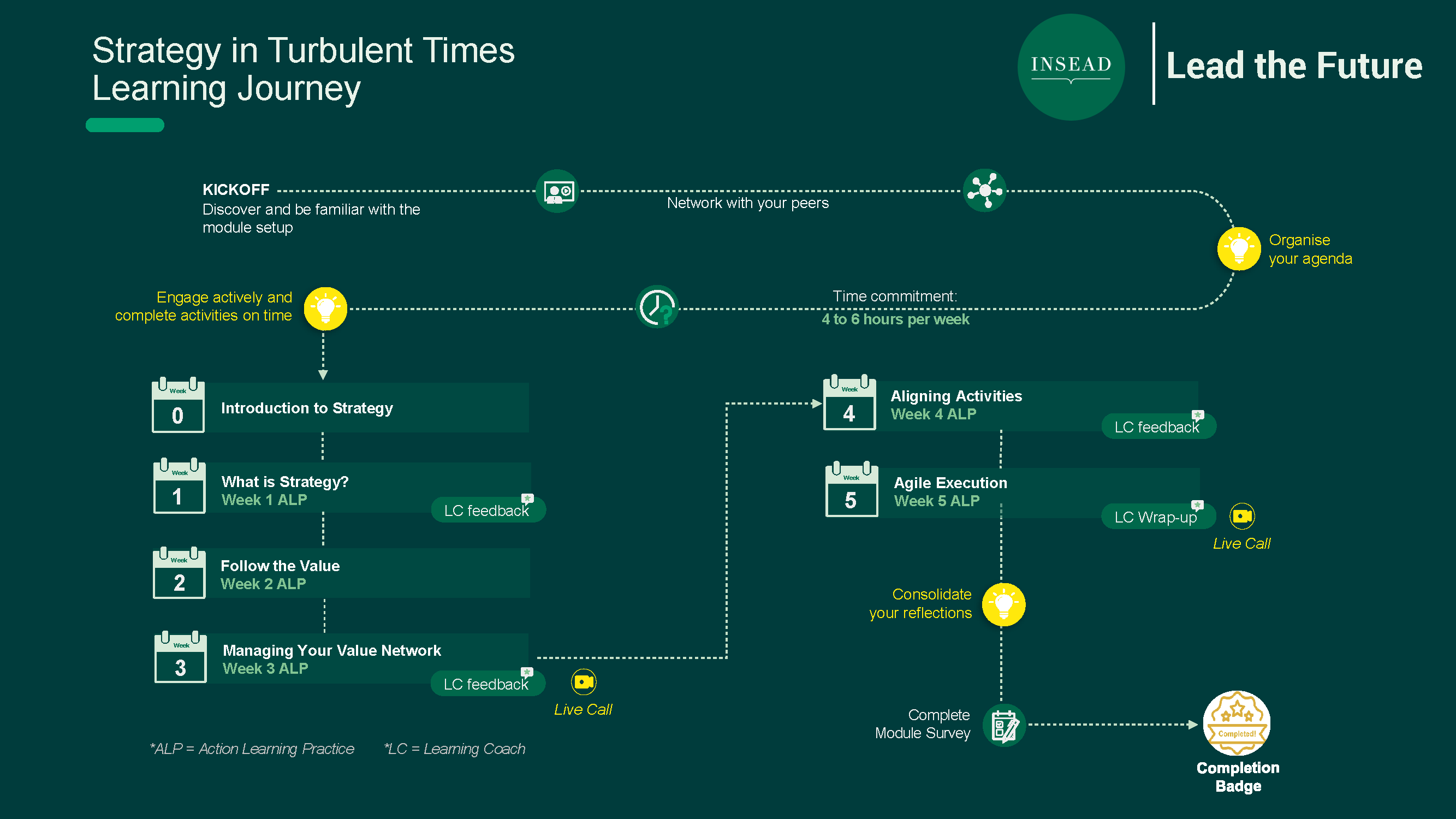
Coaching Touchpoints
Your coach will spend, on average, 2 hours in total during the module on your ALP. During the module, you will have 4 touchpoints with your Learning Coach:
- Touchpoint #1: After Week 1 closes for feedback on Week 1 ALP. assignment submission
- Touchpoint #2: After Week 3 closes, for feedback on Week 2 and 3 ALP assignment submission
- Touchpoint #3: After Week 4 closes, for feedback on Week 4 ALP assignment submission
- Touchpoint #4: Before Week 5 closes to wrap up the module.
Action Learning Practice
You will need to decide on which Path to follow for your ALP. Below is a brief introduction to the 2 Paths; more details are in the Week 1 ALP Worksheet.
Path 1: External - Strategic Partner
The Strategic Partner Action Learning Practice (ALP) is designed for those in B2B businesses and want to enhance their position as a trusted strategic partner to their clients. This ALP is especially relevant for those in B2B client relationship roles, but can also be relevant for those interested in leading B2B businesses.
- Understand your client’s strategic agenda,
- Align your offerings as compelling value propositions for your client, and
- Elaborate on how these offerings can fit into the client’s overall plans for strategy execution.
Path 2: Internal - Strategic Initiative
The Strategic Initiative Action Learning Practice (ALP) is designed for those who want to more deeply understand their own organization’s strategic agenda, and to leverage that understanding to contribute to strategy execution and formulation.
- Understand your organization’s strategic agenda,
- Elaborate a strategic initiative that fits with the overall organization strategy and drives value creation for your organization, and
- Propose a strategy execution plan for the initiative for a positive impact on the company.
With this in mind, the Action-Learning Practice (ALP) will give you the opportunity to apply your learning directly to your own business context. Working with your learning coach, you will put together an ALP that is relevant for your organization and for your personal learning objectives.
