

Faculty

Professor of Management Practice of Decision Sciences

Professor of Organisational Behaviour

Professor of Organisational Behaviour
Syllabus
Humans are social animals, who must rely on others to build successful and happy lives. Negotiation is the core process humans use to interact with others. As such, negotiation underpins every aspect of human interactions because, if well done, it helps us secure personal and collective goals, drive change, or experience belonging. Doing so effectively requires us to understand and develop superior negotiation skills so that we can collaborate more effectively over shared interests, anticipate collaboration obstacles, and ensure that we are not taken advantage of during the process.
Negotiation Excellence module presents vocabulary, tools, and ideas that are evidence-based and tested in the real world. They cover concepts and skills that offer the foundation to becoming a sophisticated negotiator.
Negotiation Excellence accelerates your ability to determine what matters (and what doesn’t), what works (and what doesn’t) and in which contexts, thereby helping you to identify and deploy strategies that enhance your negotiating behaviours and outcomes as well as those of the people around you.
Overall Learning Objectives:
- Master the essentials of evidence-based negotiation frameworks with practical application.
- Build your self-awareness as a negotiator to customize your approach and fully leverage your strengths.
- Develop the core negotiation skills every negotiator should have, but few actually do.
-
Introduction
-
We begin with the essential information regarding the completion of this module. You will discover the insightful overview and learning journey you are about to embark upon in the coming weeks.
-
Week 1: Fundamental Negotiation Concepts
-
The first week introduces fundamental concepts and key frameworks to help you prepare for your negotiations.
Learning Objectives:
- Gain a solid understanding of science-based negotiation knowledge, which involves fundamental parameters in every negotiation.
- Understand how these parameters help you design negotiation strategies and choose practical moves with a higher likelihood of success.
- Discover and understand well-researched moves such as anchoring, when to make the first offer, the effectiveness of framing offers, and how to develop a concession making strategy.
-
Week 2: Interest Based Negotiation
-
The second week teaches the importance of understanding the underlying structure of negotiations and the value of interest-based approaches.
Learning Objectives:
- Examine when to adopt a more sophisticated negotiation approach that enables negotiators to collaborate and create value.
- Understand the difference between interests and positions, building interdependence and trust, and perspective taking Improve your ability to ask effective questions that offer insight into value creation opportunities
-
Week 3: How to Compete and Collaborate Simultaneously
-
The third week examines win-win strategies, scoring systems to prepare for and evaluate your negotiations, and the practice of proactive learning.
Learning Objectives:
- Learn how to create more value, craft superior deals, structure negotiations, and avoid lazy compromises.
- Prepare for complex negotiations more systematically and learn how to make valuable trade-offs.
- Understand the value and principles of effective listening and learn a negotiation-specific framework to listen successfully.
-
Week 4: Bringing It All Together
-
The last week helps you understand how to advocate for your objectives more effectively and achieve better outcomes.
Learning Objectives:
- Learn how to improve your ability to advocate and how to choose between different methods of persuasion.
Learning Journey
Please take a moment to review the Learning Journey as it covers important steps of the module.
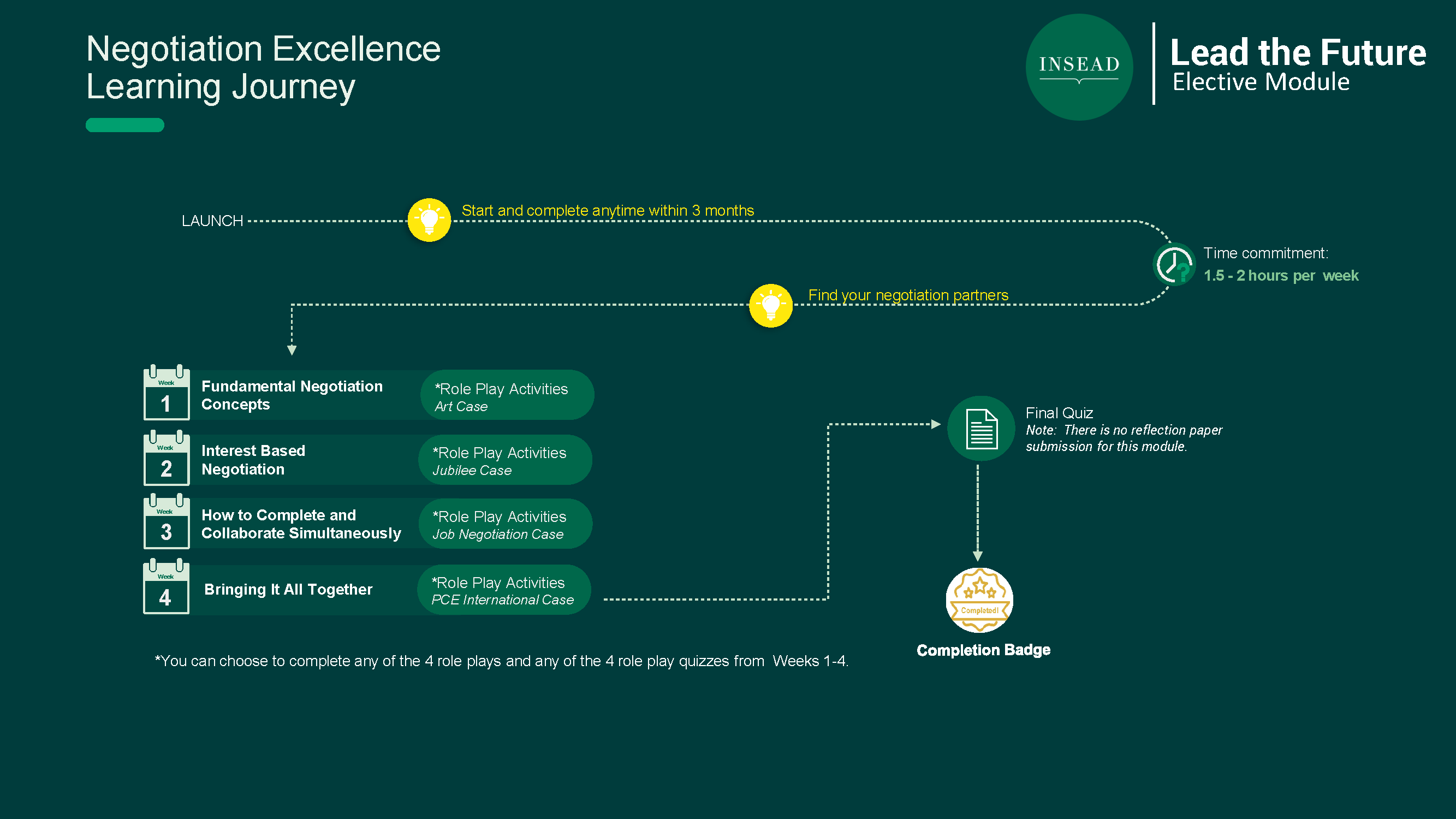
Reflection Assignment
There is no reflection paper submission for this elective. Instead, you are required to complete the role-play exercise and pass the quizzes. More details will be shared once the module starts.
