

Faculty

Visiting Professor of Accounting and Control

Professor of Accounting and Control
Syllabus
Mastering Financial Analysis is designed to empower you with the knowledge, tools and the evidence-backed techniques to make better, more courageous decisions as a leader of business. You will dig deep into the role of financial accounting, financial reporting, evaluation and financial decision-making—building a fail-proof financial compass to navigate the often bumpy road towards sustained value creation.
The module will take you through the core pillars of value creation to build rock-solid understanding and absolute fluency in the language of finance. You emerge with mastery not only of the techniques of valuation, but of the principles of value creation.
Overall Learning Objectives:
- To deepen the understanding of the tie between financial reporting and sustainable value creation.
- To assess the financial health of your organization through tools, techniques and frameworks.
- To accelerate one’s strategic decision making and empower oneself to make courageous decisions.
- To build authority and fluency in the language of finance for enhanced communication and for a more holistic leadership approach.
-
Introduction
-
We begin with the essential information regarding the completion of this module. You will discover the insightful overview and learning journey you are about to embark upon in the coming weeks.
An integral component of your learning experience is the "Action Learning Practice" (ALP) that will provide you with the opportunity to directly apply your knowledge to your own business context. Throughout the ALP, you will be guided step-by-step in developing a financial perspective on a current business decision that you are currently facing. This practical exercise will enable you to actively apply financial analysis techniques and gain valuable insights into the potential consequences of different decisions.
-
Week 1: Role of Financial Accounting
-
Financial reports provide information about how a company allocates its resources and how well it uses those resources to execute its strategy. Hence, financial acumen is a key part of successful strategic thinking. With this in mind, we begin the week by discussing the balance sheet and income statement, which are the two key financial statements. We discuss why these statements are presented to investors and the information they convey – including a focus on the Return on Assets (ROA) measure. We also discuss the challenges of reporting actions aimed at environmental sustainability, and obligations to stakeholders.
Learning Objectives:
- Understand overall role of financial reporting in sustaining value.
- Understand how balance sheet identifies key strategic initiatives.
- Understand how income statement measures performance.
-
Week 2: Financial Reporting and Strategic Choices
-
During this week we deepen our understanding of financial reports and discuss how to use them to evaluate a company’s strategy execution. We discuss key financial reporting issues including the difference between cash and accrual accounting, capitalising versus expensing costs, the meaning of “earnings quality”, and subsequently move on to studying the cash flow statements to understand the sources and uses of cash.
Learning Objectives:
- Understand how significant accounting decisions can affect reported profits.
- Contrast accrual accounting from income statement to cash flow basis accounting.
- Evaluate earnings quality and relate it to what it says about strategic execution and ability to sustain value.
- Understand how the statement of cash flows captures changes in firm liquidity and reveals threats to sustainability.
-
Week 3: Evaluating Strategic Execution
-
In Week 3, you will gain a comprehensive understanding of key financial performance measures and their implications for organizational success. We will start by defining two vital performance measures, Return on Equity (ROE) and Return on Invested Capital (ROIC), and explore their significance in evaluating financial performance. We also discuss how these measures improve upon the ROA metric defined in the previous two weeks. Additionally, you will learn how to evaluate management's effectiveness in converting sales into profits and utilizing resources to generate sales. Furthermore, we will delve into other solvency financial statistics that provide insights into an organization's financial health.
Learning Objectives:
- Define two key performance measures: Return on Equity (ROE) and Return on Invested Capital (ROIC).
- Evaluate how management converts sales into profits.
- Evaluate how management uses resources to generate sales.
- Understand other solvency financial statistics that measure financial health.
-
Week 4: Financial Decision Making
-
In Week 4, we will explore the topic of financial decision-making and prospective analysis. We will delve into the process of making informed decisions based on forecasts, considering the company's past performance and various future factors such as new product launches, market expansions, and workforce expansions. You will learn how to effectively evaluate and anticipate the company's future performance by incorporating all available information. Additionally, we will discuss the concept of valuation, equipping you with the knowledge and tools to assess the intrinsic value of a company. By the end of this week, you will have a comprehensive understanding of financial decision-making, prospective analysis, and valuation, enabling you to make informed and strategic financial decisions in a dynamic business environment.
Learning Objectives:
- Forecast financial performance using historical data and analysis of the sustainability of current strategic choices.
- Understand the trends and sustainability of financial performances overtime.
- Link forecast to the generation of cash flow.
- Understand time value of money and how to make an informed choice between different projects.
- Link cash flow to sustainable value.
Learning Journey
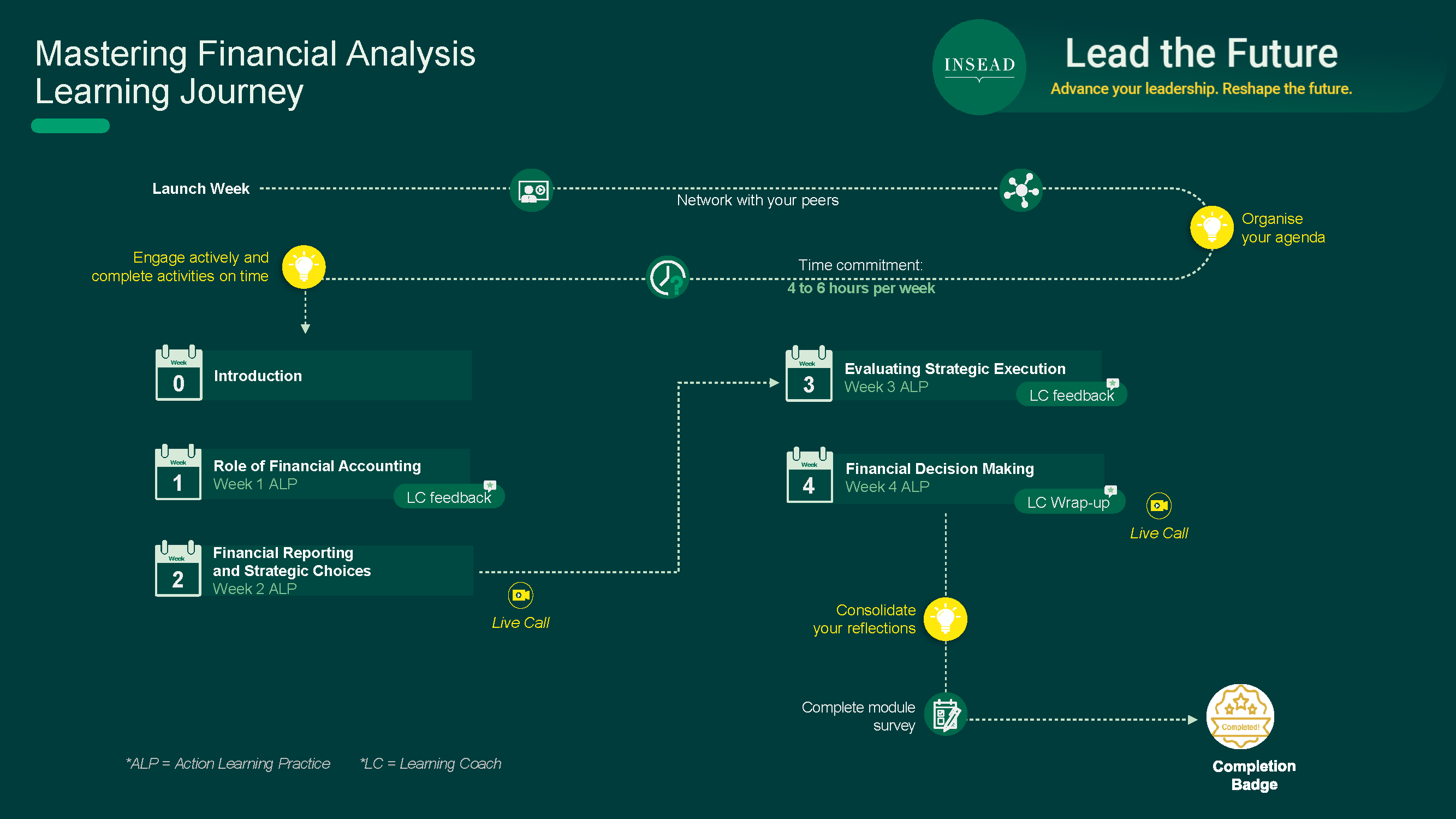
This overview outlines the learning journey you will follow for this module. Please take a moment to review the Learning Journey as it covers important steps of the module.
Coaching Touchpoints
Your coach will spend, on average, 1.5 hours in total during the module on your ALP. During the module, you will have 3 touchpoints with your Learning Coach:
- Touchpoint #1: After Week 1 closes for feedback on Week 1 ALP. assignment submission
- Touchpoint #2: After Week 3 closes, for feedback on Week 3 ALP assignment submission
- Touchpoint #3: After Week 4 for feedback on Week 4 ALP assignment submission and to wrap up the module
Action Learning Practice
Practice the application of the tools being delivered within this module while also performing an assessment of the financial impact of your proposed initiative.
This Action Learning Practice (ALP) is designed to help you come up with a concrete plan on how to apply the key financial and non-financial performance measures and further evaluate the proposed initiative within your organisation.
Regardless of whether your initiative is based on a current (implementation & planning phase) or future (entirely new) project, the ALP will provide you with a framework to think through the challenges and solutions in a systematic and strategic manner.
You might already have a clear view on the key challenges for your initiative but do not have a plan to tackle them, or you might still need to build the business case for change and then diagnose the challenges. Likewise, you might have some existing initiatives which you want to improve and add to. Whatever your starting point, the ALP will enable you to make a full diagnosis and build a comprehensive plan to improve on it.
Note: For this module's ALP, you need to have your organisation's financial statements. If you do not have access to your organisation's financial statements, then can you access your functional department’s or your business unit’s. If that is also not possible, then choose a publicly listed company that is in the same industry as your organisation and practice the concepts using this company’s statements.
