

Faculty

Professor of Technology and Operations Management
Syllabus
Becoming a ‘catalyst of innovation’ requires mastering three fundamental creative skills. You need to uncover innovation opportunities by looking at problems and situations with a user-centric mindset; you need to think differently to search for novel alternatives to your existing solution paths; and you need to embrace an experimental attitude to iteratively discover what is truly useful, feasible and viable. Importantly, such creative skills can actually be learnt and honed.
Creative thinking is a transformational force that helps organisations develop products, services and experiences that connect and resonate with customers. This enables meaningful and emotional differentiation in the eyes of consumers. Not surprisingly, creative thinking has become increasingly important in business circles and organisations are increasingly trying to understand and master the competitive advantage creativity can offer. To help address today’s business challenges in innovative ways, business leaders are seeking to develop their creative thinking skills.
In this module, we will take you on a hands-on learning journey to develop the creative thinking skills needed to innovate in any organisational context. By elevating your creative skills, you will be able to develop and support a creative culture within your organisation, a culture that is capable of confidently pushing and sustaining innovative efforts.
Overall Learning Objectives:
- Learn to think about your organisational challenges through a customer-centric lens.
- Build the skills you need to spark and sustain creative and design thinking capabilities.
- Acquire the mindset and managerial levers you need to develop and lean an innovative organisational culture.
- Master practical and effective methodologies to put creative thinking into action.
- Prepare to deliver sustained competitive advantage in a hyper-competitive and fast-changing landscape.
-
Introduction
-
You will find guidance on how to make the most of the module, information on completion requirements, and an overview of the upcoming week’s journey.
-
Week 1: User-Centered Insighting
-
Searching for user-centered insights and translating those insights into innovation opportunities is at the core of what you will be learning in this module. We will introduce a structured approach to do this. You will have the opportunity to start developing your ability to uncover innovation opportunities around a given problem or situation and understanding it in-depth from the user's perspective. The goal is not only to discover what users need but also what could potentially delight them even when they do not know it yet.
Learning Objectives:
- Understand the importance of developing empathy for the end user to uncover user-centered insights that lead to meaningful innovation opportunities.
- Learn how to build and use journey maps to fast-track the development of empathy and insight discovery.
- Develop an “inquiring” mindset to formulate insightful innovation challenges that truly matter to the end-user.
-
Week 2: Creative Ideating
-
This week, we will discuss the factors that fuel and hinder the creative power inside you as an individual and as a member of a team. Then, you will put into practice creative strategies that will enable you to dream up novel ideas that may lead to innovative solutions to any innovation challenge.
Learning Objectives:
- Understand the key factors that drive and hinder creativity.
- Acquire three effective strategies to overcome creativity blockers that prevent us from ideating innovative solutions.
- Develop the mindset to search for potentially creative solutions to any challenge or in any context.
-
Week 3: Agile Iterating
-
Although the notion of “iterating” refers to “repeating”, we will use this term to recognize that repetition is carried out to incorporate into an original idea the lessons learnt from testing such an idea. In this module, you will appreciate how being agile is critical to iteratively create offerings that are not only novel but also impactful in terms of desirability, feasibility, and viability. We will discuss how to manage agile iterating in small teams as well as in large organisations.
Learning Objectives:
- Discover the key elements that comprise a design iteration and how to bring agility to it.
- Appreciate the value of rapid and cheap prototyping to leverage feedback on early-stage creative ideas.
- Develop a mindset that encourages agile experimentation and celebrates learning from failure.
Learning Journey
Please take a moment to review the Learning Journey as it covers important steps of the module.
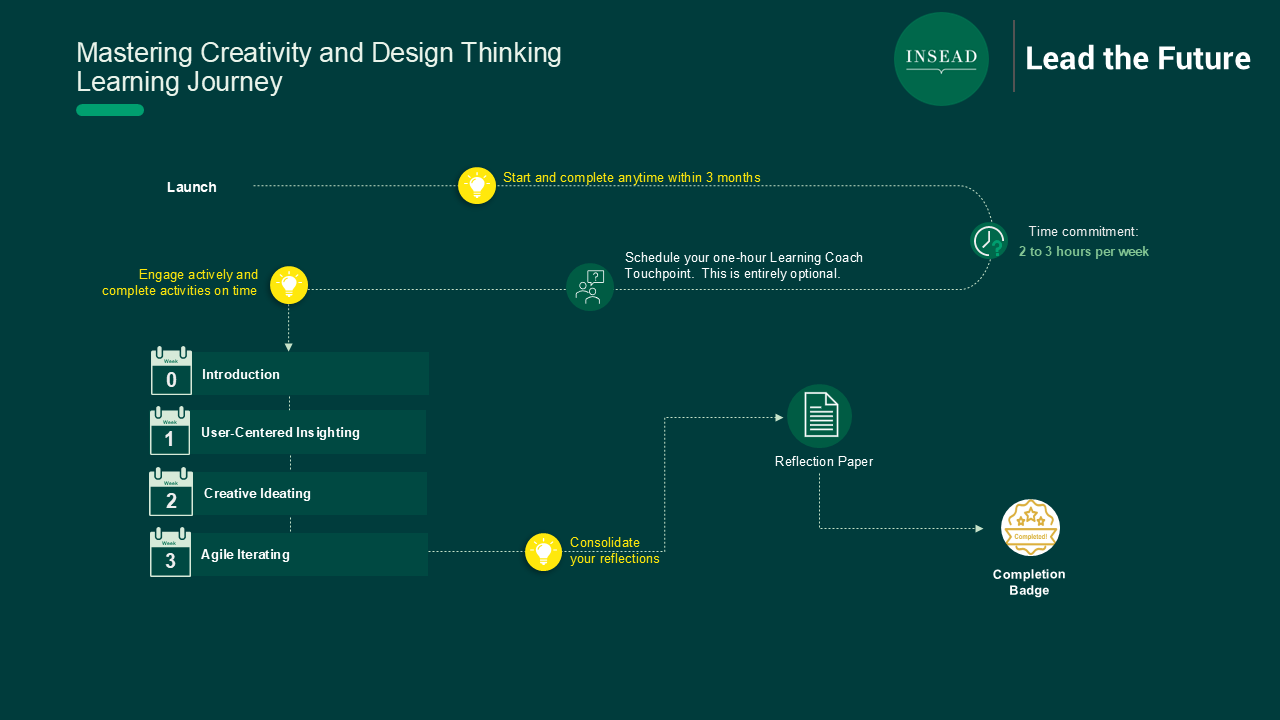
Reflection Assignment
This reflection exercise helps you become an innovation catalyst by applying course concepts to identify opportunities, generate creative solutions, and implement an action plan. You will start by defining your business challenge, focusing on user-centered insights to uncover unmet needs. Next, you will explore creative ideation techniques to generate novel solutions and develop an agile iteration plan to test key uncertainties. Finally, you will strategise on implementation, anticipating challenges and resource needs, and integrate all reflections into a high-level action plan. Your deliverable is a 1-2 page document capturing your innovation journey, insights gained, and concrete steps to make innovation happen.
