

Faculty

Senior Affiliate Professor of Marketing

Associate Professor of Marketing
Syllabus
Becoming a successful marketing strategist in the digital age requires mastering three brand new customer-focused skills.
First, you need to understand when and how to leverage the latest analytics technology, from Big Data to AI or IoT, and continuously uncover novel “live” insights about the customer and the marketplace. Second, you need to effectively transform these insights into new customer value by generating outstanding experiences along the customer journey. Finally, the key to your future success as a business leader is your ability to shape a customer-centric marketing organisation equipped to select, experiment and scale the use of successive waves of technologies such as social media, robotics or blockchain within your product or service strategies.
Digital technologies are the transformational forces that have shaped the way we communicate, consume, work, buy and sell and have profoundly disrupted how we do business. To address new customer needs effectively today’s marketing leaders must rethink their approaches.
Marketing Strategies in a Digital World will take you on a learning journey to develop your skills to become a successful marketing strategist and achieve business success by creating and delivering new customer value. You will explore the challenges and opportunities of digital disruptions around your customers and learn new strategic data-driven skills to empower you to make better business decisions for future growth. This module will also enable you to effectively design and deploy bold and competitive marketing strategies around the customer in the digital age.
Overall Learning Objectives:
- Learn how to create and deliver value and secure sustainable competitive advantage.
- Acquire basic analytical skills around "big" customer data to inform marketing strategy effectiveness throughout the customer funnel.
- Strategically monitor and create content to generate stronger engagement with customers online. Effectively manage online crises.
- Effectively implement and execute a digital marketing strategy in your organisation by recognising and utilising key drivers.
-
Introduction
-
You will find guidance on how to make the most of the module, information on completion requirements, and an overview of the upcoming week’s journey.
-
Week 1: Transformational Shifts In Marketing
-
Digital is profoundly changing our economy and the way we work. Rapidly advancing technologies and digital trends, changing customer behaviours, and disruptive competitors are making it increasingly difficult for organisations to drive sustainable and profitable growth. CEOs report that many of their digital transformation efforts fail and our research is showing that up to 70% of organisations failed to exceed their return on digital investment goals.
Leaders are well aware of the need to transform but are desperately in need of direction as to how to change and even where change is required. In this first week we will discuss success factors and the steps organisations can take to achieve profitable growth in a digital world.
Learning Objectives:
- Familiarise yourself with technological game changers and the changing customer behaviour in a digital age.
- Embrace the three transformational shifts in marketing strategy by delivering powerful customer experiences and data-driven business models.
- Understand the importance of moving from a product-centric perspective to customer-centric perspective.
-
Week 2: Bringing Technology And Strategy Effectively
-
The road to successfully use digital technologies to create customer value is full of pitfalls. The first risk entails focusing on the technology rather than the customer. The second risk is not knowing where to start. Many companies do not have clear objectives when applying digital technologies to their business. The third one is failing to effectively select effective technologies to augment customer relationships. The fourth one is a lack of transformation of the organisation. This week is about how to effectively navigate this crowded space and keep the customer value at the core.
Learning Objectives:
- Understand how to select, experiment and scale up technological solutions driving customer value for different segments and markets
and efficiency. - Learn the steps to build a customer-centric digital marketing organisation and leverage digital solutions to improve marketing speed.
- Understand how to select, experiment and scale up technological solutions driving customer value for different segments and markets
-
Week 3: Data and Analytics-Driven Customer Value Creation
-
A central way in which digital technologies create value is through data. This week focuses on how you can identity relevant digital sources of data for your business, turn them into novel insights by integrating data into decision-making and ultimately create greater customer value in the marketplace.
Learning Objectives:
- Learn when and how you can leverage “big” data to generate customer insights and embed these insights into your products and services strategy.
- Engage with basic, powerful analytical skills around “big” customer data to unpack your customer behaviour and measure the effectiveness of a marketing strategy.
-
Week 4: Content-Driven Outstanding Customer Experience
-
By opening the door Digital technologies have fully altered how consumers interact and experience products and services. This week focuses on the functions and forms of online content, how it can generate value though experience and how to turn your company into a content powerhouse supporting outstanding customer experiences along the customer journey.
Learning Objectives:
- Learn how to deliver powerful customer experiences along the customer journey.
- Internalise the strategic importance of online content in the digital age and how you can turn your organisation into a content powerhouse in the marketplace.
-
Week 5: Understanding And Leveraging Key Enablers
-
Driving a digital marketing strategy would be woefully incomplete without addressing the critical enablers of digital transformation. Although customer centricity should be the number one principal when transforming your business, organisational, governance, process and technology change is the backbone of every transformative initiative. You can only be successful as a company when you put these important enablers in place and if you understand the right next steps for your organisation.
Learning Objectives:
- Gain a view and appreciation for the design of a digital marketing organization including the roles, structures, and movements required to drive effective change.
- Learn how to manage internal change in organisational structure, leadership, processes, governance, talent, incentives, culture, and – most importantly – employees.
Learning Journey
Please take a moment to review the Learning Journey as it covers important steps of the module.
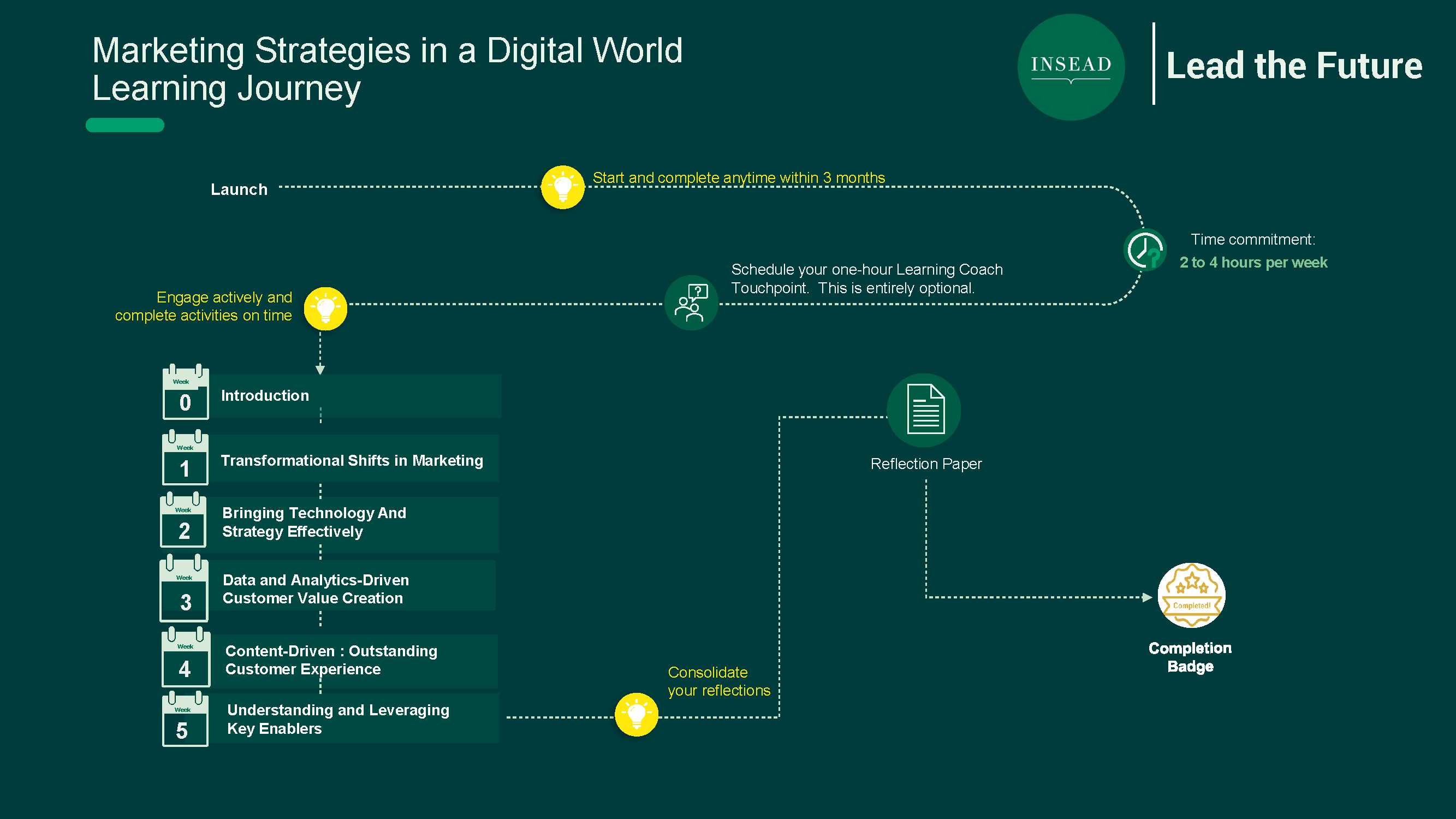
Reflection Assignment
This reflection exercise will guide you in developing a Digital Business Plan by applying course concepts to your specific professional or personal context. You will define your business challenge, explore how technology and digital engagement can enhance customer interactions, and develop a data-driven strategy to address key pain points. By analysing customer journeys and optimising content strategies, you will craft a targeted approach to solving your challenge.
The final step integrates all insights into a concrete action plan, considering necessary support and long-term execution. Your Digital Business Plan should be 1-2 pages,outlining strategic steps to drive growth and value within your organisation.
