

Faculty

Professor of Accounting and Control
Syllabus
Financial information helps managers understand a firm's performance and make value-based decisions. This session focuses on developing financial acumen to assess profitability. Participants will explore cost and profit behavior and how profitability is determined. The session aims to enhance their understanding of financial data, its interpretation, and practical application. Additionally, it will guide them on asking the right questions based on financial insights.
-
Week 1: Understanding Profitability
-
Financial information about the firm’s products, services, processes, assets, and customers provides managers with key inputs to understand the firm’s current performance and support value-based decision making. In Week 1 our main objective is to equip you with the financial acumen to understand and evaluate profitability information. We begin by considering cost and profit behaviour and how profitability is determined. This week will give participants a deeper understanding of the financial information they receive, how to interpret and use it, and provide insight as to what questions to ask.
Learning Objectives:
- Develop tools for profit planning and understand how strategic choices influence an organisation’s cost and profit structure.
- Understand the mechanics of profit determination and apply this capability through more advanced approaches and to varied contexts.
- Gain insight into how profitability information can be used to improve profitability and firm value.
-
Week 2: Tactical and Strategic Decisions
-
Week 2 introduces the calculus of good decision making, including the identification of relevant information. We consider how the nature of a decision, its duration, and the current and future operations of the organization will result in different relevant costs and revenues for each decision-making situation. Further, we will critically evaluate the extent that internal information systems provide decision relevant information for value creation. We then build on our decision-making calculus to consider strategic and longer-term decisions, referred to as investment analysis. We will develop an understanding of Net Present Value (NPV), which enables us to value projects or actions of any duration, through to valuing entire organizations.
Learning Objectives:
- Develop a calculus for identifying relevant information for every type of organisational decision.
- Understand the importance of opportunity costs and the exclusion of sunk costs in value-based decision making and the extent financial information can provide inputs into value-based strategic choices.
- Gain an ability to evaluate long-term value creating choices and determine the expected value of long-term projects.
-
Week 3: Performance Measurement and Evaluation
-
Organizations’ delegate decision rights to managers to make critical business decisions and execute strategy. In week 3, we develop tools to evaluate the performance of managers and their divisions’ performance. We introduce and evaluate some commonly used financial performance metrics and consider their benefits and potential weaknesses for decision-making and evaluation. We then consider how to link strategy to both financial and non-financial performance metrics to achieve organizational objectives, as well as the strengths and weaknesses of using performance measures to explicitly incentivize employees.
Learning Objectives:
- Consider the role of performance measurement for both decision making and evaluation, and the trade-offs of using performance measures to explicitly incentive employees.
- Gain an understanding of commonly used financial performance measures and the extent they are consistent with long-term value creation.
- Develop insight how to link financial and non-performance performance measures to your project’s or overall organisation’s strategy and objectives.
Learning Journey
Please take a moment to review the Learning Journey as it covers important steps of the module.
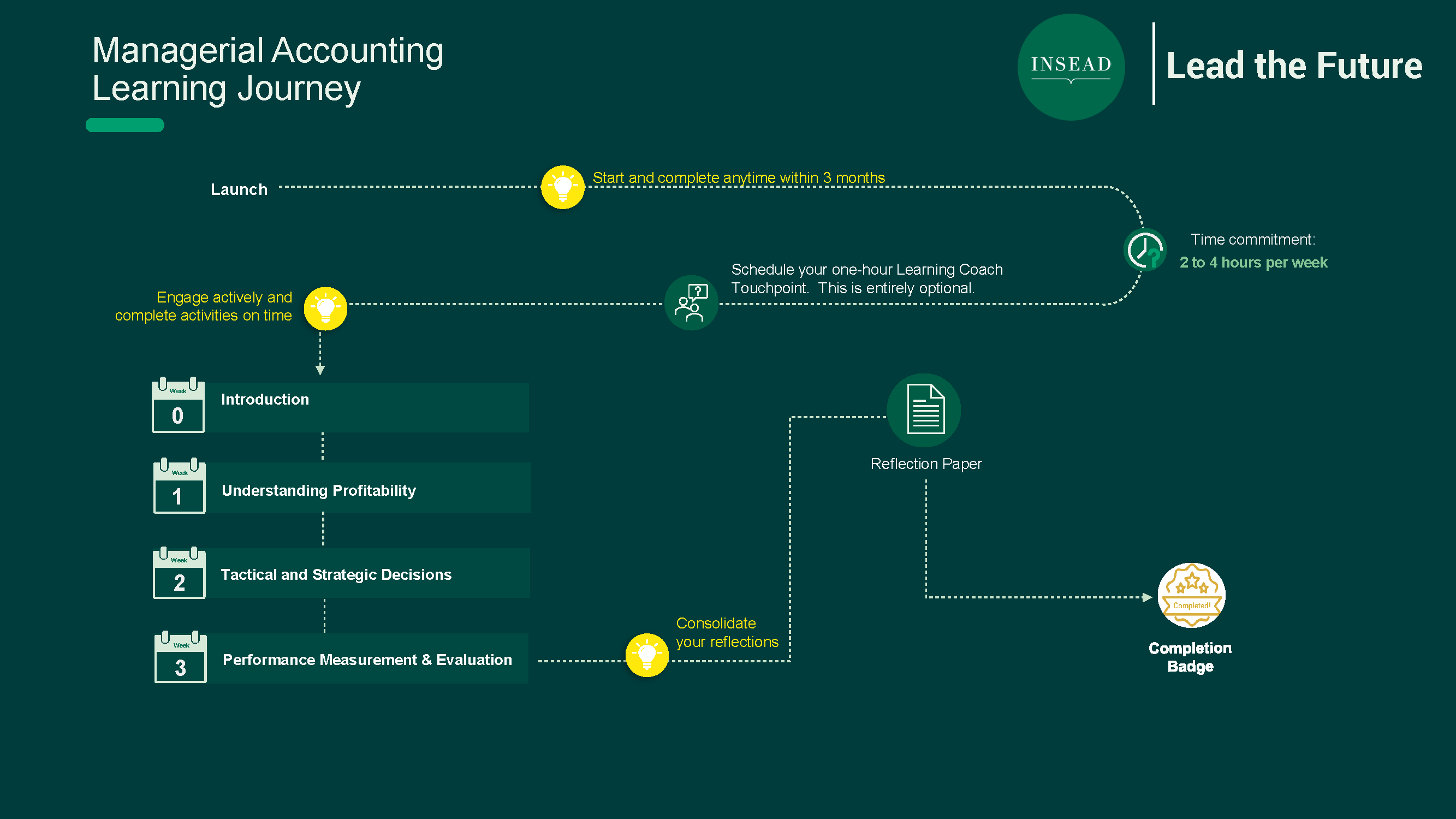
Reflection Assignment
In this reflection exercise, you will apply course concepts to your professional or personal context by analyzing a strategic initiative within your organization. Your reflection paper should be 1-2 pages long and structured around three focus areas: Understanding Profitability, Tactical and Strategic Decisions, and Performance Evaluation. You will examine cost behaviors, cost allocation methods, and their impact on profitability and decision-making. Additionally, you will evaluate how cost drivers influence strategic choices, pricing strategies, and investment decisions while considering methods to measure project costs and benefits. You will also reflect on performance measurement, analysing how KPIs and evaluation mechanisms align with organisational goals. Finally, you will synthesise your insights into an action plan to enhance decision-making, resource allocation, and performance management within your organisation.
