

Faculty

Lecturer

Professor of Organisational Behaviour

Associate Professor of Organisational Behaviour
Syllabus
Diversity and inclusion (D&I) are priorities for all organisations today. While informed leaders and organisations understand the strategic importance of diversity and inclusion, realising that goal is challenging.
How do you address cultural, systemic or structural obstacles within your organisation and your culture – obstacles that impede the progress and advancement of all of your people? And how do you design and implement the kinds of strategies, programmes and processes – as well as the behavioural norms – that not only attract, but retain and empower the diversity of talent that your organisation truly needs?
The Leading Diversity, Equity and Inclusion module empowers you to seize and leverage the power of difference in a way that is as meaningful as it is sustainable. Targeting five strategic areas of focus, the programme equips you with the understanding, the vision and the frameworks to identify the obstacles, build the strategies, and nurture the inclusive culture, processes and interpersonal dynamics to truly lead change.
Leading Diversity, Equity and Inclusion is your roadmap to unlocking the promise of diversity for your organisation today and tomorrow.
Overall Learning Objectives:
- Identify and address the challenges that block diverse and inclusive culture.
- Formulate game-changing strategies to accelerate progress.
- Challenge cultural roadblocks and shift mindsets.
- Implement inclusive processes and interpersonal practices that inspire and reward positive change.
- Lead tangible and quantifiable change across the entirety of your organisation.
-
Introduction
-
You will find guidance on how to make the most of the module, information on completion requirements, and an overview of the upcoming week’s journey.
-
Week 1: Understanding Barriers to Advancing Diversity and Inclusion
-
The focus of week 1 is to build a thorough understanding of the barriers to advancing diversity and inclusion within organisations. You will explore a model of the systemic web of challenges which underpins and grounds the programme. It shows that there are a range of barriers, such as exclusionary norms, processes, and structures, which reinforce and amplify each other, and undermine organisations efforts to build truly inclusive cultures.
You will find one video dedicated to each of the barriers. At the end of this week, you’ll be able to conduct a diagnosis of the key blockers in your context which you will use in subsequent weeks when you explore solutions.
Learning Objectives:
- Explore the web of systemic challenges that block the advancement of members of historically underrepresented groups in workplaces.
- Examine how implicit biases, exclusionary norms, and the unawareness of dominant group members create non-inclusive cultures.
- Understand how unexamined organisational structures and processes often amplify the effects of underrepresentation.
- Discover why well-intentioned advocacy programmes often fail to benefit members of underrepresented groups.
-
Week 2: Creating Impactful Diversity and Inclusion Strategies
-
In Week 2, you will learn how to create transformative diversity strategies that address systemic challenges and individual experiences. As each organisation is different, it is important to tailor your diversity strategy to the unique circumstances of your organisation. You will learn how to define your starting point, using data to diagnose your current culture and analyse your existing workforce diversity. This week will also teach you how to define specific KPIs and targets for both representation and inclusion as well as how to evaluate pay equitably in your organisation.
Learning Objectives:
- Design a diversity and inclusion strategy that promotes progress within your organisation.
- Identify the most powerful champions and learn how to embed inclusion throughout the organisation.
- Learn how to set KPIs and targets that support inclusive practices and sustainable representative diversity.
- Define, analyse and track organisational data that will reveal current climate, representation and pipeline potential.
- Understand how to conduct pay audits fairly.
-
Week 3: Building Foundations for an Inclusive Climate
-
The focus of Week 3 is to prepare your organisation so that lasting change can take root. No strategy will succeed if the culture and climate of the organisation do not support the change. You need to invest in creating a climate that supports and fosters inclusion. This week, you will learn how to create an environment where people feel psychologically safe and empowered. You will explore self-affirmation techniques and how to reset masculine defaults in the workplace. Creating an inclusive climate also means paying attention to the physical environment of the workplace and attending to the visual representations of the organisation. Finally, we will talk about how to deal with overt hostility.
Learning Objectives:
- Understand the power of psychological safety for inclusion and learn techniques to enhance well-being in your organisation.
- Shift behavioural norms that block the progress of members of underrepresented groups on a day-to-day basis.
- Formulate strategies to counter prevalent myths about members of underrepresented groups in workplaces.
- Rethink how you physically organise and visually represent your organisation to ensure inclusiveness.
-
Week 4: Designing Inclusive Processes
-
In Week 4, we move from building a foundation for inclusive climate to designing inclusive processes. We will breakdown the recruitment process and look at interventions at each step that can debias your process and increase your chances of hiring a representative workforce.
You will learn how to attract candidates who represent the diversity of the society in which your organisation is based, how to winnow them down to a shortlist, how to assess candidates fairly, and how to make offers and negotiate salary. You will also learn about the ways bias creeps into the evaluation process and what to do about it, and how to overcome practical challenges related to underrepresentation.
Learning Objectives:
- Redesign your recruitment processes to ensure fair representation of different social groups.
- Build more mindful evaluation processes that minimise bias.
- Counteract the effects of underrepresentation by ensuring a fair distribution of work projects.
- Encourage a culture that normalises flexible working while building organisational engagement.
-
Week 5: Fostering Inclusive Interpersonal Interactions
-
In Week 5, you will learn how to foster inclusive interpersonal interactions that allow employees to deepen mutual connections across difference. The learning in this week provides techniques to lower the barriers people often create in their relationships with members of other social identity groups.
You will examine the importance of formal mentorship and sponsorship programmes for members of underrepresented groups and discover how to make these relationships more impactful at creating opportunities for advancement. You will also learn about allyship, organisational role models, and employee resource groups as opportunities to bolster the sense of belonging for members of underrepresented groups.
Learning Objectives:
- Design mentorship programmes that provide meaningful guidance to members of underrepresented groups.
- Rethink who you put forward as role models and the impacts of these symbols.
- Launch formal sponsorship programmes that foster promotion opportunities for members of underrepresented groups.
- Organise allyship programmes that inspire and empower employees to act as change agents.
Discover recommended do's and don’ts for using employee resource groups.
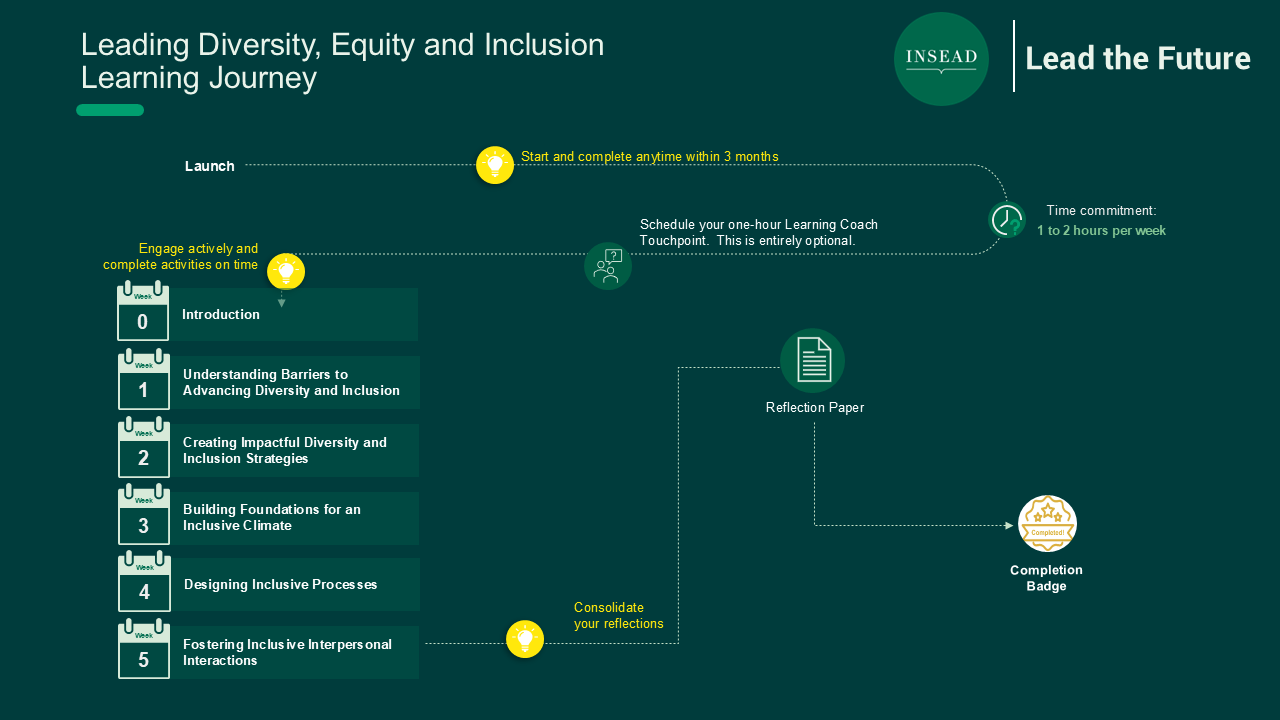
Learning Journey
Please take a moment to review the Learning Journey as it covers important steps of the module.
Reflection Assignment
In this reflection exercise, you will develop an Integrative Strategy to advance diversity and inclusion (D&I) in your organisation. Your goal is to apply course concepts to build a compelling case for key stakeholders on why your D&I strategy should be adopted. Your final output should be a 1-2 page document that outlines insights from the course and concrete action steps for implementation. Start by defining your organisational context, identifying barriers to inclusion, and assessing existing initiatives. Then, formulate a clear D&I strategy by engaging stakeholders, setting objectives, and tracking progress. Reflect on fostering an inclusive culture, improving recruitment and talent management, and addressing systemic biases. Finally, integrate your reflections into a structured action plan with measurable initiatives to drive meaningful change.
