

Faculty

Professor of Strategy
Syllabus
Fostering Innovation in the Age of Disruption online module enables you to understand the “how” of innovation. As the world becomes more dynamic, driven in part by digital disruption, individuals and organisations need to reinvent themselves using innovation to discover new sources of growth and solve old problems. The good news is that innovation has become a capability, like any other capability such as marketing or finance. Although there is an element of chance in everything, especially innovation, over the last two decades research has uncovered the repeatable behaviours, processes, and structures that increase our probability of success in doing new things, whether they are products, process, internal initiatives, business model innovation or transformation (especially digital transformation). This innovation capability is fundamental to the success of many endeavours: creating value from a new idea or an existing asset, delivering policies and programmes that positively impact those we lead, seeing old problems in a new way, discovering the best path forward with digital, and leading transformation. This course is about unpacking and applying this new science of innovation based on two decades of accumulated research.
At the heart of the module are three critical areas to successfully innovate: people, process and philosophy. People focuses on the research-backed behaviours that you can practice and coach in your team to help you see the world in new ways and discover new opportunities.
Process addresses the latest tools for testing new ideas using rapid experimentation techniques to deeply understand customer needs, prototype solutions, and innovate on business models. Philosophy describes the broad set of things to adapt your organisation and habits to make room for innovation. It includes leadership, culture, governance, structure, and most importantly, uncertainty ability.
Drawing upon case studies of over 400 businesses across industries and contexts (e.g., B2B and B2C, private and public, startup and established company, innovation for sustainability), we explore the “how” of using these tools to develop the innovation capability of your team. This work draws on the latest research in domains like ideation, creativity, lean start-up, design thinking, agile, business model innovation and dynamic strategy to develop a single, end-to-end framework for generating and testing innovation ideas. Said differently, this module is about how we get ideas, test ideas, win support for ideas, make room for ideas in an organisation and develop the courage to pursue ideas.
Overall Learning Objectives:
- Build personal innovation leadership behaviours to develop new ideas and how to improve them.
- Apply Innovation process tools derived from lean start-up, design thinking, and related frameworks to respond in a more agile manner.
- Develop leadership perspective to transform into an agile and innovative organisation.
- Cultivate the “uncertainty ability” at the heart of doing new things and leading through change and crisis.
-
Introduction - Innovator’s Method: Foundations
-
In the beginning of the module, we establish why we need innovation capabilities to succeed at doing new things, how they differ from more familiar management practices, and why they are critical for any new activity, whether it be creating a new product, changing a process, launching an internal initiative, entering a new geography, starting a new project, launching a new venture, adopting digital tools, or launching a digital transformation. Whenever you do something new there are untested assumptions, some of which you may not be aware. We introduce innovation management, or “Blue” ways of working, as a second and complementary toolkit to existing management practices that will help you increase your chances of success in doing new things. In essence, this is about the “how” of innovation, Blue Ocean Strategy, ambidexterity, explore vs exploit, and other frameworks that may be familiar. We proceed to discuss the tools that established companies could employ to become more agile and more effectively navigate an uncertain future and innovate themselves. We conclude the week by introducing the three elements that are at the heart of effective innovation: people, process, and philosophy.
You will also find guidance on how to make the most of the module, information on completion requirements, and an overview of the upcoming week’s journey. Lastly, you'll also receive an introduction to the "Action Learning Practice" (ALP), designed to help you apply the concepts learned in the course to your work.
-
Week 1: Innovator’s Method: People
-
In Week 1, we tackle the “people” element by exploring our research into the behaviours of innovative leaders. Creative leadership is one of the most prized leadership capabilities yet most of us believe it to be genetic. Research shows however, that it is mostly a learned behaviour. Our research, based on interviews and surveys with thousands of leaders, unpacks the behaviours you can practice and coach in your teams to increase the ability to generate new ideas, new ways of seeing things and new approaches to old problems. We discuss these behaviours in detail with examples and tools to practice. In addition, we provide you with the opportunity to take a professional assessment of these behaviours, tested with over 16,000 leaders, to give you a benchmark for personal development and to reflect on how to improve your innovation capability and leadership.
-
Week 2: Innovator’s Method: Process
-
This week, we take you into the heart of the Innovator's Method: the process to more effectively test ideas. These tools synthesise the latest frameworks from lean start-up, design thinking, agile methodology, and business model innovation, into a process that will allow us to more effectively innovate our way through uncertainty. We show how to apply this process in established companies or startups, B2B or B2C, private or public, to test a new product, process, business model, internal initiative, transformation strategy, or any other situation involving uncertainty. We discuss traps and remedies identified in over a decade of our own research applying these tools and from the broader body of empirical research and field experiments on how to repeatedly innovate.
-
Week 3: Innovator’s Method: Process Deep Dive
-
In Week 3, we will take a deep dive into the process element of the Innovator’s Method. Guided by Professor Furr, we will introduce a set of tools, with examples of them in action in a real-life case study. Then you will be given the chance to practice these same tools applying them to another innovative project. We will then show these tools used in a B2B setting and a public institution setting before inviting you to apply them to your own situation
-
Week 4: Innovator’s Method: Philosophy
-
In Week 4, we explore how to create the context for innovation to happen. One dilemma we all face is that many of our organisations, and personal habits, are designed for repetition and execution. In this environment it is particularly challenging for new ideas or approaches to surface and mature. This week explores the philosophy of innovative organisations, which is a catch-all term for the leadership, governance, infrastructure, and culture that allow for innovation. We will describe the research-backed best practices with the objective of giving you ideas, inspiration, and approaches to lead innovative, agile organisations.
-
Week 5: Innovator’s Method: Uncertainty Ability
-
In Week 5, we touch upon a foundational attribute critical to innovation but rarely discussed: uncertainty ability or the ability to face uncertainty well to discover new possibilities. Although we talk frequently about innovation, change, and transformation, we rarely acknowledge that to do these things, we must first step into the unknown. Moreover, life and careers are full of surprises that create setbacks, disappointment, and unplanned uncertainty. Yet few of us are given the tools to navigate either planned or unplanned uncertainty. Drawing upon the research described in The Upside of Uncertainty (Harvard, 2022), we explore the tools that innovators, creators, designers, and leaders use to face uncertainty with courage and resilience, as well as help those they lead to build their own and their organisation’s uncertainty ability.
Learning Journey
This overview outlines the learning journey you will follow for this module. Please take a moment to review the Learning Journey as it covers important steps of the module.
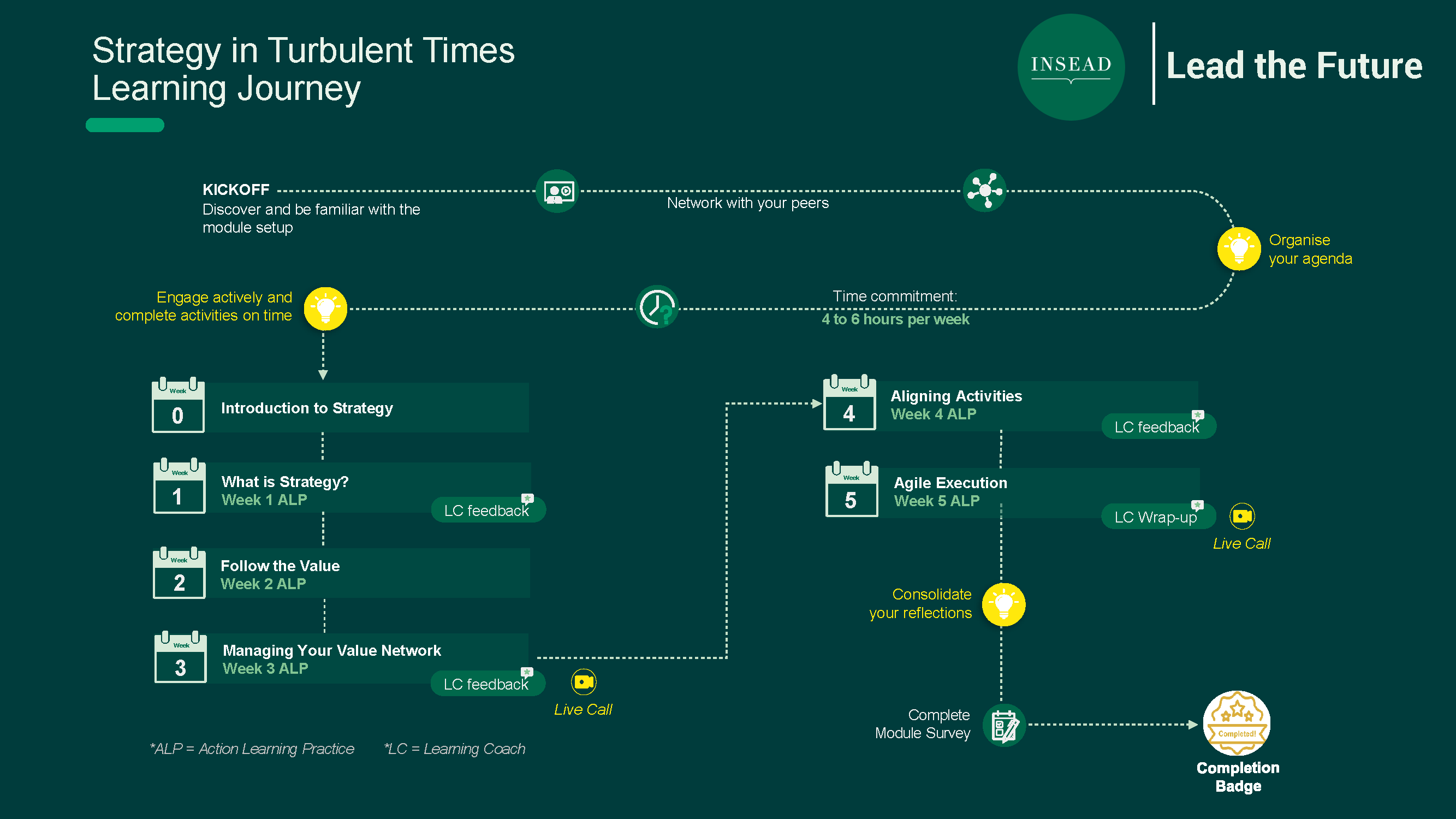
Coaching Touchpoints
INSEAD's learning coaches are accomplished business professionals who will guide you through your learning journey. Your coach will be assigned to you in Week 1 of the programme. Your coach will spend, on average, 2 hours in total during the module on your ALP. During the module, you will have 4 touchpoints with your Learning Coach:
- Touchpoint #1: Before Week 2 closes for feedback on Week 1 ALP. assignment submission
- Touchpoint #2: After Week 3 closes, for feedback on Week 3 ALP assignment submission
- Touchpoint #3: After Week 4 closes, for feedback on Week 4 ALP assignment submission
- Touchpoint #4: After Week 5 closes to wrap up the module.
Action Learning Practice
The Action Learning Practice (ALP) will take you through a step-by-step journey to become an innovative leader and drive innovation within your organisation.
You will choose a problem that you want to solve innovatively and in the subsequent weeks, you will apply the tools acquired through the Innovator’s Method to this problem. During the ALP, you will also reflect on your and your organisation’s innovative behaviours, as well as uncertainty ability. At the end of the module, we hope for you to have acquired new insights into your problem, design potential solutions, grow your own Innovative DNA and how to foster innovation in your organisation.
With this in mind, the Action Learning Practice (ALP) will give you the opportunity to apply the lessons you learn directly in your own business or personal context. Working with your learning coach, you will put together an ALP that is relevant for your organisation and for your personal learning objectives.
