

Faculty

Senior Affiliated Professor of Organisational Behaviour

Professor of Organisational Behaviour
Syllabus
Embarking on a leadership role brings forth the need for emerging leaders to cultivate new skills and deepen their self-awareness, essential for inspiring and leading high-performing teams. In our contemporary landscape, where boundaries blur, collaborations evolve, and businesses face immense pressure to be agile, the question arises: What defines effective and mindful leadership in such a rapidly changing landscape of the business world? How can leaders enhance resilience and adapt their leadership in uncertain times? Do traditional leadership models endure, or does the digital age herald the emergence of a new leadership model?
This module offers a distinctive perspective on leadership, tailored to help executives navigate the challenges faced by organisations in this rapidly evolving landscape. It will take you on a transformative journey of learning to lead yourself, and then translates that knowledge into leading others, leading change and designing effective, collaborative teams while adapting to the changing nature of work. As an emerging leader, you will establish a link between leadership and business performance, gaining insights into your own behaviours and their impact on others. You will navigate challenges in your environment and go beyond leading individuals – forming a shared mindset while collaborating within a diverse global team.
As you embark on your leadership journey, this module empowers you with skills to overcome the constraints of your organisation’s leadership culture. It will help you to step forward with a new perspective on leading your team in these fast-evolving times. This module is rooted in the philosophy that while the foundations of leadership endure, contemporary leaders must excel at adapting and advancing in this dynamic, uncertain environment.
Overall Learning Objectives:
- Learn to continuously monitor and mould your own behaviour.
- Grow your awareness of how your behaviour affects others and become skillful at providing effective feedback and cultivating culture of learning.
- Understand the challenges of change and how to approach change based on the type of problem at hand.
- Design effective teams by forming meaningful collaborations in a rapidly changing organisational landscape.
- Assess the contemporary workplace trends and their impact in creating a holistic employee value proposition.
.
-
Introduction to the Leadership Practice
-
You will find guidance on how to make the most of the module, information on completion requirements, and an overview of the upcoming week’s journey.
In this introductory week, our focus will be on understanding the pivotal role that behavioural skills play in the development of our leadership practice. We will explore the core elements of leadership – myself, others, and task – and their relevance in the leadership arena. We will ask the central question on how are we ‘showing up’ in the leadership arena and how it influences performance. We will also consider how we, as leaders, are showing up, in the ‘systems we care about’ and how our leadership presence resonates within these systems.
Learning Objectives:
- Define leadership and explore the importance of behavioural skills in developing own leadership practice.
- Identify the three elements of leadership and their relevance in the leadership arena (Myself, Others & Task).
- Examine how you showing up in the leadership arena affects performance.
- Illustrate how you show up in the systems you care about.
-
Week 1: Leadership Yourself
-
In this first week, we will dive into the concept of self-leadership. As we explore the interplay between own leadership and ‘the systems we care about’, we will recognise the inevitable gap between intended and actual outcomes and why it is essential to create a culture of learning in order to be effective as a leader. We will define resilience and explore ways to respond to challenging experiences. Turning our attention to emotional intelligence, we will identify the five essential elements and the importance of cultivating self-awareness to recognise how our emotions affect our interactions with our world. We will explore the concept of a mindful leader and the benefits of mindfulness practice in cultivating resilience. Finally, we will emphasise the importance of a growth mindset in leadership, by highlighting the significance of continuous learning and cultivating a mindset geared towards growth.
Learning Objectives:
- Analyse the concept of self-leadership and its significance in leadership development.
- Recognise the important aspects of your leadership to the systems we care about.
- Define what resilience is and how you can respond to difficult experiences.
- Examine five elements of emotional intelligence and the essential role of self-awareness.
- Identify a mindful leader and benefits of mindfulness practice.
- Adopt the culture of learning and cultivating a growth mindset.
-
Week 2: Leading Others
-
Week 2 shifts out focus from self-leadership to the realm of leading others effectively. Leading others is about demonstrating our capacity to establish developmental relationships with people around us, make them feel seen as human beings, worthy of development. By completing the Leading Others Questionnaire, you will assess your manager’s and your own behaviour and the impact it has on how you are perceived by others. The Johari Window, a powerful tool for self-discovery, will be introduced to help you analyse the relationship between you and others and expand your awareness of both known and unknown aspects of yourself. Effective feedback is a cornerstone of learning and effective leadership. We will identify the key elements that constitute effective and ineffective feedback and practice giving effective feedback using the SBI (Situation, Behaviour, Impact) tool, to equip you with the skills to deliver feedback that fosters growth and development.
Learning Objectives:
- Examine how exceptional managers engage and lead others effectively.
- Assess your awareness of how your behaviour is perceived by others as a leader and how that affects their behaviour towards you.
- Explore the Johari Window to analyse the relationship between you and others.
- Identify the elements that constitute effective and ineffective feedback.
- Practice using the SBI tool to give effective feedback.
-
Week 3: Leading Change
-
This week, we will begin by illustrating why context is paramount in change initiative and why, despite the evident benefits, we often find change challenging. A key aspect of leading change is acknowledging unconscious biases and their impact on decision-making processes during times of change. Understanding and mitigating unconscious biases is essential for fostering an inclusive and adaptable culture. Distinguishing between Tame (Technical) and Wicked (Adaptive) challenges is crucial and we will reflect on the approaches for adapted solutions and implementation. Finally, we will discuss why creating conditions conducive to learning and facilitating difficult conversation is essential for sustainable change and ensuring constructive and open dialogue throughout the change process.
Learning Objectives:
- Illustrate why context in change initiatives matters and why we struggle to change.
- Recognise the challenge of unconscious biases.
- Explain the difference between Tame (Technical) and Wicked (Adaptive) challenges and how to approach each in solution and implementation.
- Establish conditions where learning and difficult conversations can be held effectively.
-
Week 4: Leading Collaborative Teams
-
We will start by delving into the fundamental question on why and when collaboration is beneficial and examine the key drivers of collaboration. We will explore the three dimensions of effectiveness in team collaboration – output, collaborative ability, individual development. The cornerstone of effective collaboration lies in creating supportive conditions – The Effectiveness Pyramid – that will empower you to create an environment where collaboration thrives and your teams can achieve their full potential. Finally, we will discuss your role as a leader in designing collaborative and high-performing teams.
Learning Objectives:
- Understand why and when we should collaborate.
Describe key drivers of collaboration and dimensions of effectiveness in team collaboration.
Identify essential conditions (The Effectiveness Pyramid) that enable successful collaboration - Compelling Direction, Strong Structure, Supportive Context, Shared Mindset.
Design high collaboration and performance teams.
- Understand why and when we should collaborate.
-
Week 5: The Changing Nature of Work
-
In this final week, we will explore the dynamic landscape of the contemporary workplace and the evolving trends that shape the way we work. Redefining hybridity goes beyond mere physical location. We will explore the ‘truly hybrid’ workplace and how the questions around hybridity affect the organisational design, as well as the employee experience. We will also examine the tension between effectiveness, staffing and social fabric which makes decisions around hybrid workplace so challenging. Adopting a holistic approach is important to attracting and retaining talent in this evolving landscape and we will use a data-driven approach to help you examine the various factors and intentionally define an integrated Employee Value Proposition. Finally, we will address critical ‘human’ challenges to help you foster an environment where individuals thrive and collaborate effectively.
Learning Objectives:
- Understand the contemporary workplace trends – context and contributing factors.
- Re-define hybridity as more than just about physical location.
- Examine the three-way tension between effectiveness, staffing and social fabric.
- Define an integrated approach to Employee Value Proposition.
- Address the three critical ‘human’ challenges: Power & Fairness, Culture, Trust & Psychological Safety.
Learning Journey
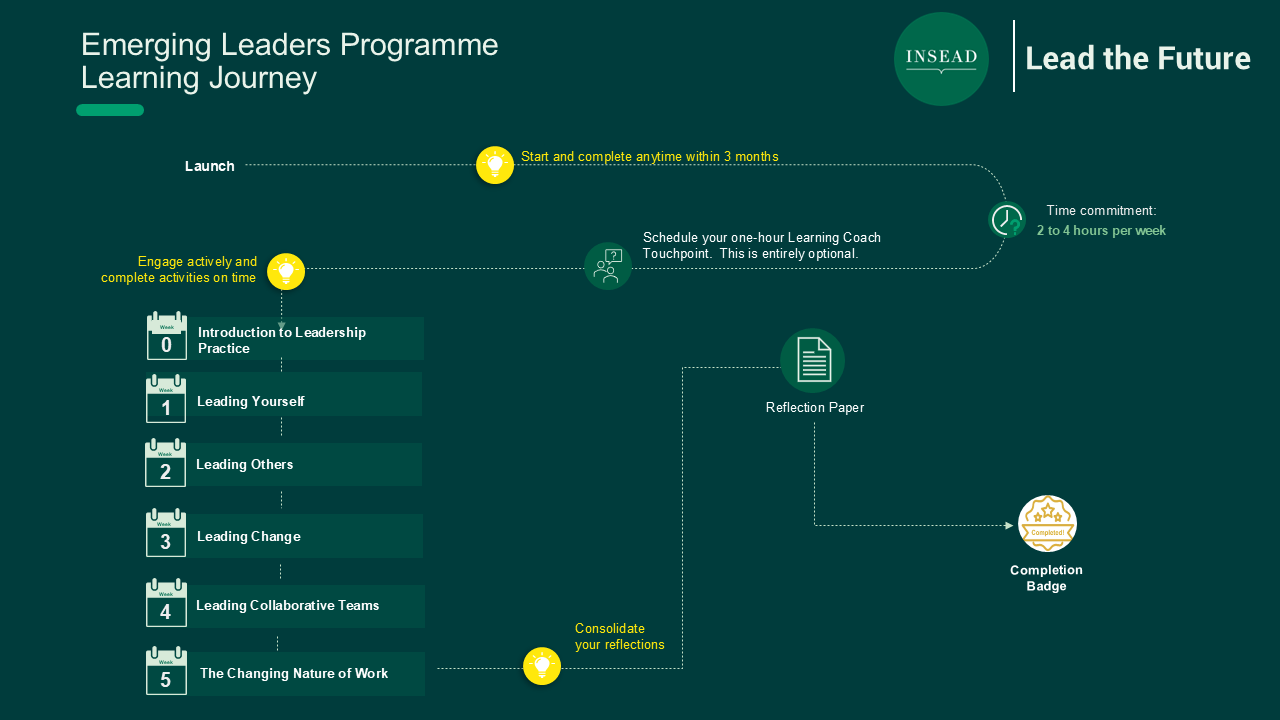
Please take a moment to review the Learning Journey as it covers important steps of the module.
Reflection Assignment
In this reflection exercise, you will create a Leadership Action Plan by applying course concepts to your own leadership context. Your task is to analyse your leadership challenges, goals, and strategies for improvement across four key areas: Leading Yourself, Leading Others, Effective Collaboration, and Navigating Digital Challenges. You will structure your reflection into a 1-2 page document, incorporating insights from the course and outlining actionable steps. You will begin by defining your leadership context, then reflect on personal leadership challenges, team dynamics, collaboration strategies, and digital integration. Finally, synthesize your reflections into a concrete action plan with specific steps, timelines, and measures of success.
