

Faculty

Professor of Technology and Operations Management
Syllabus
Sustainability has become a top priority among decision-makers in our current global economic, political and business environment. It affects everything from the environment and our health to economic growth.
As a manager and leader, you’ve likely focused attention on recycling and sustainability and may have discussed circularity. But what exactly is circularity? Is it the perfect balance between recycling and reducing, or is it about reusing valuable materials more? Through research and interactions with leading organisations in the sustainable business paradigm, it becomes evident that it is neither of those. Circularity is more about resource efficiency combined with pollution prevention, both of which entail complex challenges associated with product model choices beyond recycling.
In this module, you will explore different circular business models and what drives different organisations to adopt one model over another. You’ll focus on designing for circularity and take a deep dive into INSEAD’s proprietary value, access and process framework.
Overall Learning Objectives:
- Describe the principles of a circular economy.
- Identify the challenges of circularity.
- Create a framework linking product or market characteristics to circular business model choices.
- Apply the circular business model from design to strategy.
- Create a roadmap to circularity for an organisation.
-
Introduction
-
We begin with the essential information regarding the completion of this module. You will discover the insightful overview and learning journey you are about to embark upon in the coming weeks.
-
Week 1 : Introduction to the Circular Economy
-
This week, you will learn about several ideas around the circular economy, dive into concepts such as the cascading circles and explore circular strategies such as the shared economy, product life extension and reusing, repurposing and recycling.
As you proceed through this week, consider the following questions.
- What is the circular economy?
- Is it possible to build a business model that is good for both profit and the environment?
- What are some economic barriers keeping organisations from adopting a circular approach?
Learning Objectives:
- Identify the basic principles of circularity.
- Evaluate the quality of the proposed circularity preference in the context of a product.
- Discuss the challenges of implementing a circular economy.
- Evaluate opportunities for circularity in an organisation.
-
Week 2 : Designing for Circularity
-
In this week, Professor Atasu explores various methods of designing for circularity, including design for disassembly (DfA), material substitution (MS) and design for durability (DA). This module will also introduce you to the three barriers of circularity – access, process and value. This week demonstrates these concepts through the lens of a VHS tape company that needs to find the best solution for minimising the environmental impact of tapes without putting themselves out of business in the process.
As you proceed through this week, consider the following questions:
- What does it mean for an organisation to design for circularity?
- What are the circular design options that this module mentions, and how might your organisation use each of them either individually or concurrently to transition from a linear business model to a circular business model?
- What are some of the challenges organisations face when designing for circularity?
Learning Objectives:
- Analyse the circularity opportunities elements of a peer's road map towards circularity.
- Investigate the need for product redesign as a building block for the circular economy transition.
- Identify the circular design options.
- Formulate a plan to redesign a product for circularity.
- Describe the obstacles to redesigning a product for circularity.
-
Week 3: Obstacles to Circularity - Refining Value, Access and Process (VAP)
-
This week, Professor Atasu further explores the value, access and process (VAP) framework using real-life examples. You will learn some of the challenges organisations face in working to create a circular economy strategy that is economically viable. The content of this week also examines why careful planning, testing and analysis are essential when executing a circular economy strategy.
As you proceed through this week, consider the following questions.
- What are the three key obstacles to circularity, and why is it important to consider all three when executing a circular economy strategy?
- What are some of the issues organisations face when developing a reverse logistics plan to regain access to used versions of their products?
- Which of the components of the VAP framework do you feel might be the most challenging for your organisation?
Learning Objectives:
- Analyse the redesign elements of a peer's road map towards circularity.
- Discuss why access to used products is difficult.
- Evaluate the role consumers play in product access.
- Propose strategies for circularity when used products are not accessible.
- Evaluate the value proposition associated with circular business models from a consumer perspective.
- Forecast the value, access and process challenges for a product.
-
Week 4: Circularity Execution
-
Organisations often face challenges in developing a viable business case for the implementation of their sustainability goals. Transitioning to closed-loop manufacturing and other forms of circular economy presents the unique challenge of retaining maximum value of the materials and goods present in the production–consumption–reproduction cycle. Value retention and project viability often require that organisations have access to pivotal points in the loop, find affordable alternative processes, which may compromise other goals, and soothe various logistical and financial pain points. In the final evaluation, organisations must weigh a project’s intangible risks and benefits, which are often difficult to quantify, along with the tangible cost and savings calculated in traditional financial models.
In this week, you will participate in the Alpha LiveCase. It is a lively scenario designed to help you explore, examine and reflect on technology and operations management. Additionally, it will provide you with an opportunity to understand the pressures that you may encounter while evaluating a circular business case proposal.
Learning Objectives:
- Analyse the VAP challenges elements of a peer's road map towards circularity.
- Take part in the development of a business case for a circular economy.
- Analyse variables associated with circular economy initiatives.
- Identify actions needed to create organisational buy-in for a circularity project.
-
Week 5: The Takeaway - A Circular Business Framework
-
In this week, you will examine the concept of circularity in business models and its value potential for organisations. Professor Atasu identifies three fundamental approaches to circularity that define circular business models: product as a service, product life extension and design for recycling. The variations in these models are largely driven by the materiality of an organisation's product and the economics of circular operations. You will also uncover the importance of secondary markets, consumer participation and recovery process complexity in determining an organisation's ability to generate value from circularity.
As you proceed through this module, consider the following questions:
- Which of the three fundamental circularity approaches do you think might be a viable option for your organisation?
- How do the accessibility and recovery processes of used products impact an organisation's ability to implement circular business models?
- How can the value potential for circularity be measured?
Learning Objectives:
- Analyse the buy-in elements of a peer's road map towards circularity.
- Distinguish between different circular business models and link those choices to the VAP framework.
- Create a road map to circularity for an organisation.
- Analyse a peer's road map towards circularity.
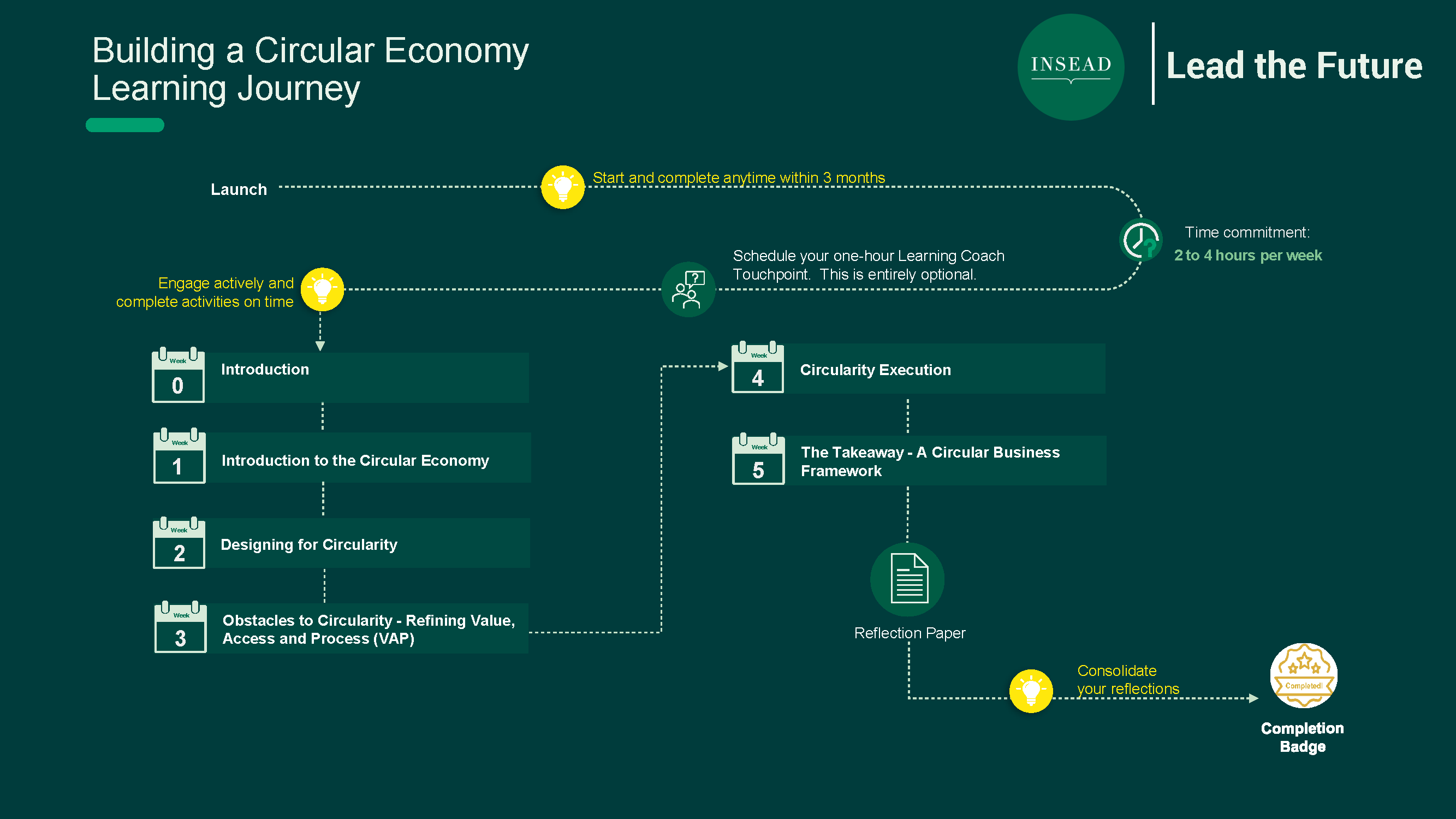
Learning Journey
Please take a moment to review the Learning Journey as it covers important steps of the module.
Reflection Assignment
In this reflection exercise, you will develop a Circularity Strategy by applying circular economy principles to address a challenge in your organisation or industry. Your task is to identify a key issue, explore design strategies for circularity, and consider the barriers and opportunities in adopting a circular business model. The reflection will be structured into four sections: context, designing for circularity, value, access and process (VAP) challenges, and circularity execution. You will assess challenges related to value retention, access to used products, and process improvements while proposing solutions to overcome these obstacles. Finally, you will outline an action plan with key milestones, timelines, and expected outcomes, ensuring alignment with your organisation’s sustainability goals. The final submission should be a 1-2 page document summarising your insights and proposed strategy.
