

Faculty

Associate Professor of Organisational Behaviour
Syllabus
Leading teams and organisations effectively in today’s climate of endless uncertainty is contingent on your ability to inspire confidence in other people – in those who work for and with you, in your senior leadership, and across your ecosystem of clients and business partners. In our current climate of ambiguity and unpredictability, it is more critical than ever that your team sees you as a leader to follow and to empower them; that your peers and customers have faith in your abilities and dependability; and that your executive leaders and board have confidence in your potential to lead change, unlock innovation and translate vision into reality.
Inspiring this kind of confidence requires you not only articulate and communicate your ideas with clarity and composure; you also have to build trust – trust in your competencies as a leader and decision-maker, in your technical capabilities, and in your absolute commitment to follow through on what you say you will do.
Leadership Excellence and Influence aims to demystify these qualities – redefining them as skills that can be learned and mastered rather than innate traits or characteristics.
Overall Learning Objectives:
- Learn tactics to unlock your own executive presence such that your stakeholders have confidence, respect and trust in your competencies and reliability.
- Discover evidence-based strategies that are effective, practical and ethical to influence other people without imposing your power.
- Master when and how to employ these influence strategies with different stakeholders and in different contexts in your personal leadership challenges.
- Understand the psychology of trust, and how to establish trust to build fruitful long-term business relationships with your teams, superiors and with clients.
-
Introduction
-
We begin with the essential information regarding the completion of this module. You will discover the insightful overview and learning journey you are about to embark upon in the coming weeks.
-
Week 1: Communication Your Ideas & Storytelling
-
The first step in having greater presence and influence is to look at the concepts that help craft relevant, memorable and impactful messages. This entails understanding how the human mind makes sense of content and ideas. We will explore what makes someone an effective communicator and how they make their ideas not only reach their target, but stick.
Learning Objectives:
- Discover the anatomy of ideas and messages—why do some ideas stick and others don’t?
- Explore how to engage, persuade, and inspire your audience, regardless of whether they are clients, bosses or team members.
- Map out these principles to make ideas sticky across a variety of contexts including interpersonal communication, personal branding, marketing and publicity, public pitches and organizational change.
-
Week 2: Unlocking your Executive Presence
-
Body language is a universal medium of communication and influence. Across nations, cultures and organisations, your body language shapes the way your message is perceived. Commanding attention, and conveying competence and trustworthiness is contingent as much on how you say things as it is on what you say.
Learning Objectives:
- Discover which body language cues signify power, confidence, trustworthiness and competence.
- Learn to adopt and deploy these cues to command a presence that is powerful yet also warm and inviting.
- Explore what executive presence looks like in virtual settings.
- Using a video-case and a practical self-awareness exercise determine the steps you will take to become more mindful about your own presence and the style that you aspire to have.
-
Week 3: Building Trust
-
Strong long-term relationships and business outcomes are built on trust. But trust needs to be earned – and losing it can be highly costly. As we strive to influence others, our efforts can actually have the effect of undermining trust. To build, nurture and sustain high levels of trust over time we need to be hugely mindful about the dynamics of trust-building and the requirement to be transparent in terms of information-sharing.
Learning Objectives:
- Take a deep dive into the psychology of trust in business relationships.
- Define trust and determine the criteria we use in evaluating someone’s trustworthiness?
- Discover how to build trust quickly and how to repair trust when it is impaired.
- Learn how to establish trust that signals credibility, benevolence, and integrity.
-
Week 4: The Science & Art of Influence
-
Week 4 and 5 will help you develop and apply interpersonal persuasion skills and will highlight the importance of strategy formulation, inspirational and charismatic leadership, managerial agility, and emotional intelligence. We will also consider how observation and reflection can improve your understanding of diverse cultural or social landscapes, and how that can inform your strategy and approach in any given influence situation.
Learning Objectives:
- How to influence without formal power.
- How to persuade difficult people.
- Avoiding common persuasion mistakes.
- How to win hearts and minds.
- Evidence-based, simple, and costless techniques with real-world examples
-
Week 5: Developing Charisma
-
Week 4 and 5 will help you develop and apply interpersonal persuasion skills and will highlight the importance of strategy formulation, inspirational and charismatic leadership, managerial agility, and emotional intelligence. We will also consider how observation and reflection can improve your understanding of diverse cultural or social landscapes, and how that can inform your strategy and approach in any given influence situation.
Learning Objectives:
- Understanding the attraction of charismatic people.
- Learning to be charismatic.
- Science-backed techniques to become more charismatic by drawing on research in person perception and the psychology of attraction.
- Exploring how to become more emotionally intelligent by learning about self-awareness, self-regulation, motivation, empathy, reading emotions and relationship management.
- Type I Leadership: Introverted Charisma.
Learning Journey
Please take a moment to review the Learning Journey as it covers important steps of the module.
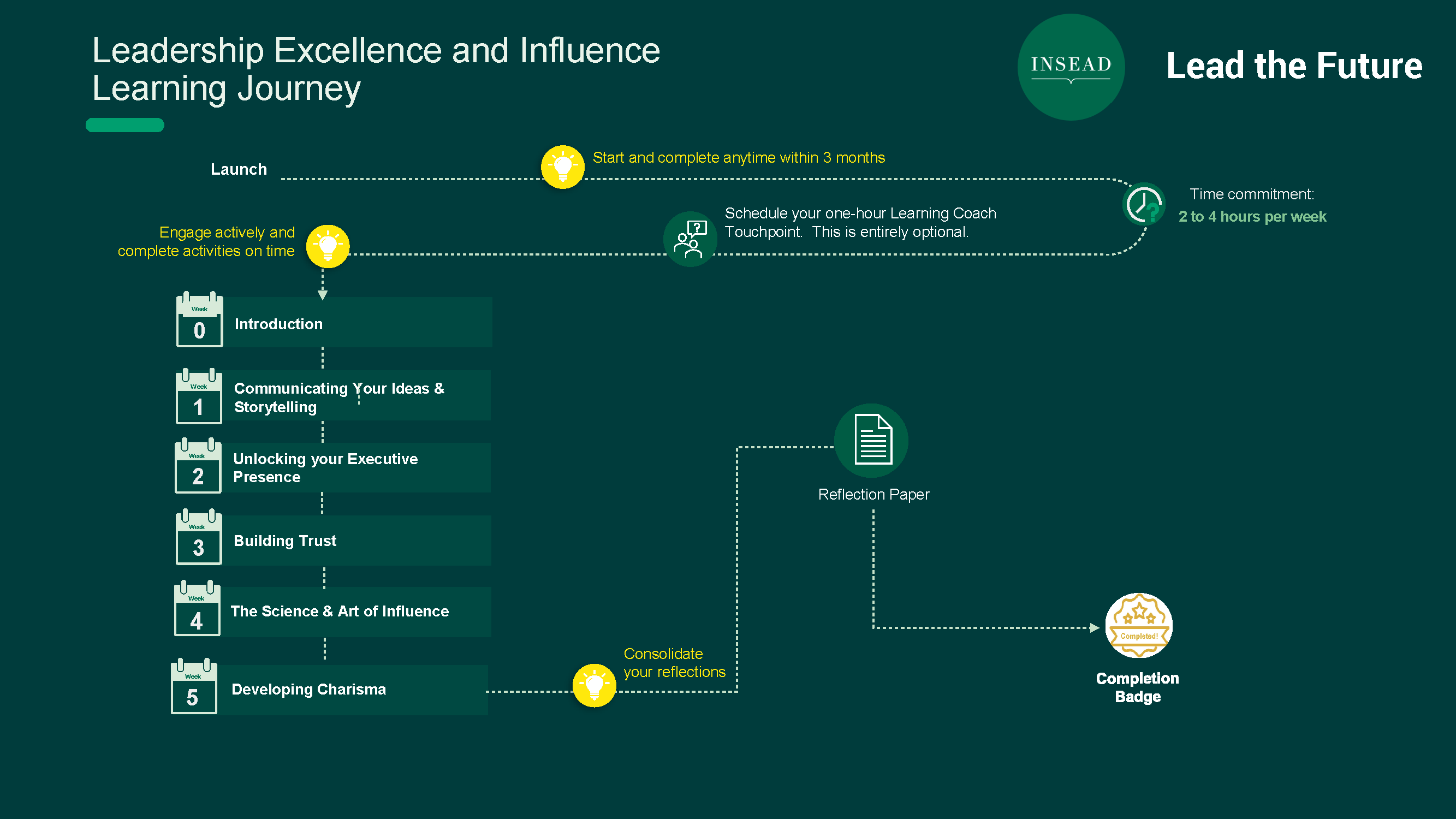
Reflection Assignment
In this reflection exercise, you will develop an Influence Plan to enhance your ability to persuade, inspire, and build trusted business relationships with stakeholders. Your goal is to apply course concepts to craft a structured approach for improving your influence. Your final output should be a 1-2 page document that incorporates insights from the course and outlines specific strategies. Begin by defining your professional context and identifying key stakeholders, especially those who are challenging to influence. Reflect on your executive presence, body language, and trust-building strategies to strengthen your relationships. Explore persuasion techniques, charisma, and emotional intelligence to enhance your impact. Finally, integrate your reflections into a concrete action plan with clear steps, timelines, and expected outcomes.
