

Faculty

Associate Professor of Organisational Behaviour
Syllabus
In today’s complex and fast-paced business environment, a leader’s ability to communicate with clarity, credibility, and presence is no longer optional—it is essential. This programme is designed to help leaders elevate their leadership impact by mastering the art and science of communication. Through a blend of video lectures, immersive video cases, real-world examples, self-reflection, and peer dialogue, participants will learn how to communicate and influence across levels, inspire trust, and engage diverse stakeholders.
Each week explores a core dimension of impactful communication—from understanding how your personality impacts your communication style, to crafting messages that resonate, telling stories that move people to action, projecting leadership presence, and handling the hardest conversations with confidence and composure.
To support application and practice, the programme integrates AI-driven tools that simulate real-world communication challenges. These tools allow participants to rehearse difficult conversations, storytelling, and leadership messaging in a safe, low-risk environment—while receiving personalised feedback grounded in the frameworks taught in the course.
Participants will leave the programme with a practical toolkit and a more intentional approach to leadership communication—one that enhances their ability to lead, connect, and mobilise others effectively.
Overall Learning Objectives:
- Sharpen self-awareness to enhance authenticity and leadership impact.
- Craft audience-centred messages that drive trust and engagement.
- Use storytelling and leadership presence to communicate with clarity, charisma, and authority.
- Navigate high-stakes and mentoring conversations with emotional intelligence and strategic structure.
- Apply course insights to real-world challenges through an Action Learning Project and personalised communication plan.
-
Introduction
-
You will find guidance on how to make the most of the module, information on completion requirements, and an overview of the upcoming week’s journey.
-
Week 1: Know Thyself
-
Organisational leaders operate in high-stakes environments where every word, gesture, and decision carries weight. Yet, many leaders remain unaware of how their communication is truly perceived. This session invites executives to move beyond self-perception and gain deeper insight into how their personality shapes their communication style—and, in turn, how it affects trust, engagement, and decision-making.
Learning Objectives:
- Enhance self-awareness to sharpen communication effectiveness.
- Identify blind spots that may be limiting one’s influence.
- Learn practical strategies to amplify strengths and outsmart blind spots.
- Engage in thought-provoking discussions about perception vs. reality in leadership communication.
- Gain a sharper, more intentional approach to leadership communication, be empowered to inspire confidence, foster trust, and drive meaningful engagement.
-
Week 2: Know Thy Audience
-
Great leaders don’t just deliver messages—they shape them to resonate. Yet too often, executives speak from their own perspective, assuming what engages them will engage others. This session pushes leaders to move beyond egocentric bias and truly decode their audience. You’ll learn to apply cultural intelligence tools to navigate nuances, bridge differences, and master communication across cultures and global teams. Through audience profiling, credibility management, and adaptive messaging, you will gain practical strategies to boost engagement, build trust, and maximise impact in high-stakes leadership communication.
Learning Objectives:
- Overcome egocentric bias to craft audience-centred messaging.
- Apply the DECODE framework to profile and adapt to any audience.
- Strengthen credibility and influence in leadership communication.
- Enhance real-time adaptability by reading audience signals and feedback.
- Drive higher engagement and persuasion across different stakeholders.
-
Week 3: Lead With Storytelling
-
Stories are the most powerful tool in a leader’s arsenal. Data and logic persuade, but stories inspire action, build trust, and create lasting impact. Indeed, facts tell but stories sell. In this session, senior executives will learn how to craft and deliver compelling narratives that drive influence, engagement, and decision-making. Whether delivering a keynote, rallying a team, or making a business case, storytelling is the key to making messages stick. You will explore how to structure powerful stories, integrate them into speeches and presentations, and avoid common storytelling pitfalls.
Learning Objectives:
- Learn how to use storytelling as a leadership tool to inspire and persuade.
- Develop a structured approach to crafting impactful narratives.
- Understand how to integrate stories into speeches, presentations, and leadership moments.
- Refine storytelling delivery skills through practice and feedback.
- Build a story bank of meaningful personal and professional experiences for future use.
-
Week 4: Master Leadership Presence
-
In leadership, what you say matters—but how you say it matters even more. Body language is a powerful, universal medium that shapes how others perceive your confidence, authority, and trustworthiness. Senior executives are constantly judged—not just by their words, but by their gestures, posture, eye contact, and overall presence. These subtle cues influence credibility, influence, and decision-making at the highest levels.
Learning Objectives:
- Project confidence and authority through open and controlled body language.
- Master nonverbal cues—gestures, eye contact, stance, and movement—to reinforce leadership presence.
- Adapt your physical communication to different professional contexts, from informal encounters to high-stakes negotiations.
- Use body language strategically to build trust, command attention, and influence outcomes.
- Develop a personalised action plan to refine and strengthen your leadership presence.
-
Week 5: Navigate Difficult Conversations
-
Difficult conversations are often marked by high stakes, emotional intensity, or the responsibility of guiding someone’s development—making them complex and easy to avoid. This session equips leaders with tools to recognise what makes conversations difficult and how to approach them with clarity and composure. We will explore techniques for regulating emotions in tense moments, as well as strategies for addressing impostor syndrome—both in ourselves and in those we mentor. Using practical frameworks and real-world examples, you will learn how to lead hard talks with empathy, confidence, and impact.
Learning Objectives:
- Identify what makes a conversation difficult and why leaders often avoid them.
- Apply emotion regulation techniques to stay grounded under pressure.
- Recognise and navigate impostor syndrome in yourself and your mentees.
- Use structured frameworks to lead high-stakes or developmental conversations.
- Balance empathy and assertiveness to drive clarity, growth, and trust.
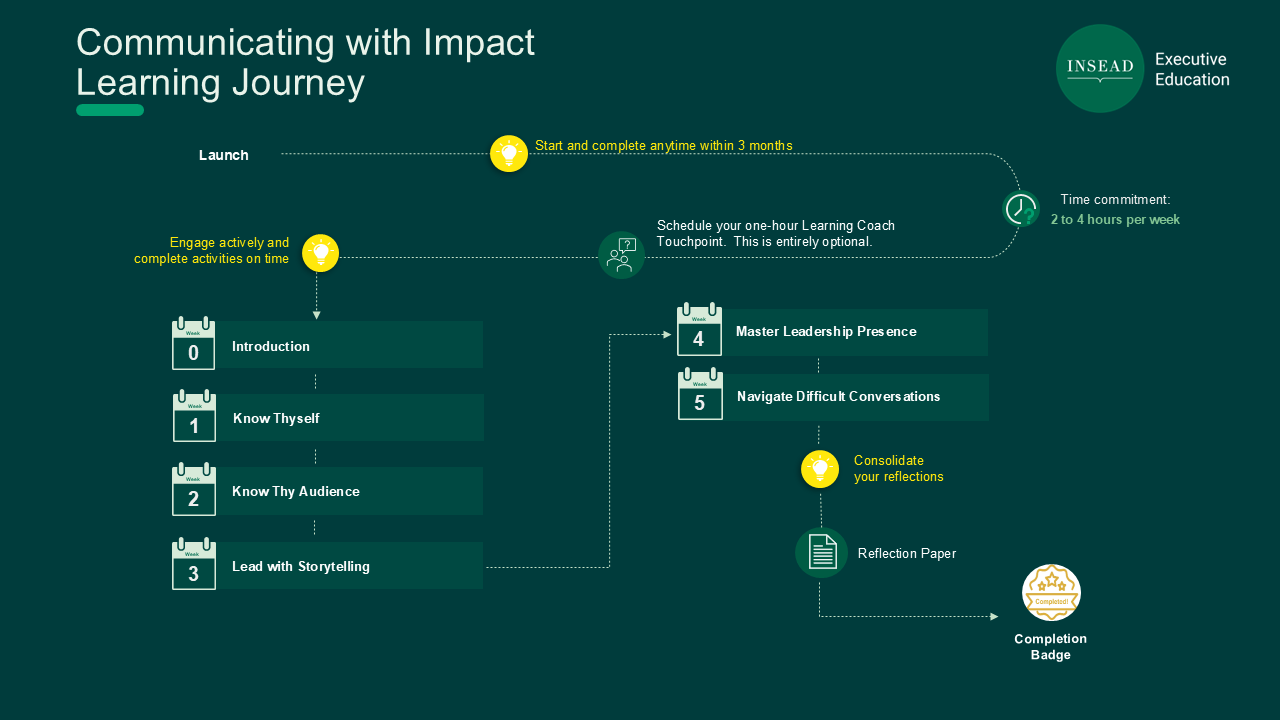
Learning Journey
Please take a moment to review the Learning Journey as it covers important steps of the module.
Reflection Assignment
In this reflective exercise, you will develop a personalised Impactful Communication Plan based on a real workplace scenario. Drawing on course concepts, frameworks, and techniques, you will reflect on your communication style, analyse your audience, apply storytelling and leadership presence, and identify strategies for navigating difficult conversations with clarity and poise. Your submission should be 1–2 pages and structured around the key thematic areas covered in the course.
