

Serious Games & Web 2.0
-
Overview
-
Serious Games & Web 2.0
 Read about Professor Angehrn's Inter-Organizational Learning and Collaboration 2.0 corporate research partnerships
 Downloads:
- CNN(International).com, Executive Education, "Tackling business problems with online games" (June 5, 2009), featuring the EagleRacing Simulation
- "Serious games", web 2.0 : le Gouvernement accélère la mutation de l'économie française, May 2009
- From the June 2009 web 2.0 summit, Tim O'Reilly's video presentation of the new web squared and related white paper
- How companies are benefiting from Web 2.0: McKinsey Global Survey Results (September 2009)
- French press article describing Professor Angehrn's INSEAD research: Trajectoires (page 11), Nov. 2008
- 2008 presentation (pdf)
- European Corporate Learning Forum (ECLF) survey on future of video gaming, 2008
- Video presentation: "Game Hostile Environments" by Albert A. Angehrn (n°7, on list), at "Serious Games on the Move" conference in Cambridge, UK, June 2008
- Interview of Professor Angehrn, by Cyril Jost, Bilan No.250, 21.05.08 on the subject of "Serious Games;" article in French: "Les jeux de simulation poussent les employés à se surpasser")
- Professor Angehrn's video presentation on Small World Simulations (SWSs), June 2007
FAQs
What is meant by the reference "Serious Games and Web 2.0?"
Throughout the years, Professor Albert A. Angehrn and his team of researchers have been dedicated to the task of designing, deploying and analyzing games, or more precisely: games with a purpose (serious games).
At the same time, spurred by the technological advances of web 2.0, the new games that he has developed have effectively become Web 2.0 enhanced, i.e., they make extensive use of video, profiling, game dynamics, agents and network visualizations.
And finally, Professor Angehrn's research has led him to create an interactive web 2.0 online network environment: this is the new Inno-Tube platform, part of the larger CALT-Tube series that he has been developing at INSEAD.
Why game-based learning?
It may be said that three forces have been identified as now combining to create a demand for this new type of game-based learning, as illustrated by the following figure:
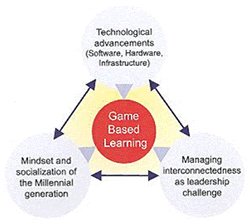
These three forces may be summarized as:
- New realities in leadership
that must account for a global world with greater complexity and unpredictability, i.e.: leaders need to learn how to operate in a more complex, interconnected world where decisions are multi-cultural and multi-dimensional
- Changing demographics of future leaders
who will increasingly come from the Millennial generation, a generation that thrives on interactivity and gaming
- New technology and media tools
processor speed, cost of memory, as well as a quickly improving infrastructure of broadband deployment that enable satisfactory levels of participatory experiences in online gaming
For further information on projections concerning the development of game-based learning, download the European Corporate Learning Forum (ECLF) report, 2008 (page 25, "Plenary Discussion and Key Insights on Video gaming as a Learning Tool").What is meant by the term Small World Simulations (SWSs)?
The term Small World Simulations (SWSs) specifically refers to simulations that use believable characters and real situations that challenge players (managers and leaders) to think and work through problems.
It may be simply said that the SmallWorld Simulations (SWSs) are also Serious Games, or games with a purpose.
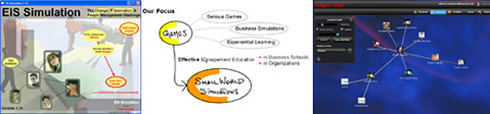
The underpinnings and inherent practical approaches of the SmallWorld Simulations (SWSs) emphasize the following elements:
- a realistic scenario
- a challenging management mission
- believable characters
- a range of managerial actions
- realistic dynamics (i.e., that reflect different organizational dynamics including: psychological/motivational and organizational/cultural factors; knowledge integration dynamics; and technological opportunities and constraints)
For further information on this subject, see Professor Angehrn's 2007 video presentation of his INSEAD CALT research.In sum then, what are the issues addressed by Professor Angehrn's Serious Games [which, as we have seen, may alternatively be referred to as "games with a purpose," or Small World Simulations (SWSs)?
Simply said, the overall goal of Professor Angehrn's new Serious Games, with their corresponding enhanced Web 2.0 technology, is to provide a realistic means for people to gain insight into their own thought patterns and behaviors, while increasing their understanding of how to work with and/or influence others.
The general issues addressed are:
- Change, Innovation & Leadership
- Cross-Sector Collaboration and Decision-Making
- Cross-Cultural Issues
- Web Trends & Strategies
- Collaborative Learning
- Network-Based Knowledge Exchange
What more to add about collaborative learning?
Professor Angehrn's INSEAD games focus extensively on developing collaboration among players because in many organizations, people are not skilled in collaborating spontaneously and genuinely with others.
The collaboration-building techniques designed into these games range from relatively “simple” to “complex:”
- At the simple end of the spectrum, the collaboration is strictly internal, among the players of the game
- At the complex end of the spectrum, some of the more recently developed games take the collaboration beyond the game to external sources
And the generation of user value?
Professor Angehrn uses distributed collaboration technologies, and this enhancement extends the experiential time frame of each game so as to support sustained learning, i.e., with people communicating over shared networks on a continuing basis after the intensive game experience.
The objective here is to capture the attention and involvement of the learning community members by generating three different types of user value:
- connection value
- actionable learning value
- entertainment and instant gratification value
What do the Serious Games & Web 2.0 teach us about addressing change?
Indeed, Professor Angehrn's research focuses at the individual level by challenging people to go to the limits of their competencies, and at the organizational level by modeling change dynamics and enhancing the readiness of people’s ability to adapt to change.
And, leaders learn experientially by taking actions and making decisions that have an impact on sequential episodes of the game itself. They may work in teams to experience collaborative decision making as well.
At IKEA, deployment even required people to find their own group to do the game.
And leadership and culture?
Some of Professor Angehrn's research has been oriented to developing leadership for different cultures, such as understanding the nature of leadership in China versus a Western European culture. The LingHe Simulation is such an example.
With the recent INSEAD R&D project entitled ChangeMasters Middle East, the cultural design context was that of the Middle East. The output is a new simulation, entitled: GulfCom.
Professor Angehrn has also designed and developed games for the public sector such as the Scottish Government, which clearly had different leadership goals and issues than those in games for the commercial sector.
Any design-related insights for the future?
Over the years, a number of design-related insights have been gleaned that further drive the development of the these games, namely:
- they must hit straight on the most critical and complex learning areas
- they need to document the impact of the game and support “epidemic diffusion” (if a game is successful, it spreads quickly to others)
- they must go beyond the classroom context
- they need to keep the user-interface simple (it was found that managers become lost with sophisticated interfaces and complicated interfaces make people perceive the game as just a game, as opposed to a more realistic simulation)
- they must design their internal dynamics to push the players to the limits of their (in)competence by building in traps and breakdowns
- they need to focus on “external dynamics” (the inter-player dynamics) and have a debriefing / reflection phase
What is the research focus of Professor Angehrn today?
To generally summarize, the key challenge for Professor Angehrn and his team of researchers is the creative design of effective simulation games addressing complex management subjects such as change, collaboration and innovation.
Going hand-in-hand with this main activity is the analysis of the impact, be it short or long-term, that such simulations have on the organizations which deploy them with their managers.
Furthermore, as stated in his CALT 2009 report (page 5), in the following years his research will focus on projects aimed at connecting (both conceptually and technologically) the two research streams he and his team of researchers have focused on until now: Game Dynamics (in Management and Organizational Learning), and (Collaborative Organizational & Interorganizational) Learning Networks.

In short, we might say that this means a further exploration of how to creatively combine Serious Games & Web 2.0 online collaborative-community-networking platforms.
And, finally, what are the specific projects on Professor Angehrn's research agenda today?
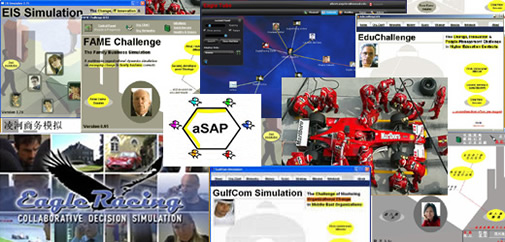
The Serious Games & Web 2.0 portfolio that he is developing today includes:
- the now very popular EagleRacing Simulation
- the renowned EIS Simulation, along with its various cultural adaptations (LingHe, adapted to the Chinese setting; and GulfCom, targeting the Arabic speaking world); its theme-based adaptations (FAME, a family-based version); and finally, its industry specific adaptations (e.g., the healthcare sector)
- Inno-Tube, the new web 2.0 online community platform offering enhanced collaboration possibilities, and the various other versions, such as: : TENCompetence-Tube, ChangeMasters-Tube, GMP-Tube, and Eagle-Tube
- while still others are emerging as prototypes, such as: aSAP, PitStop, among others
All of these new learning innovations are fully illustrated via left-hand side-bar links on the Professor's INSEAD personal page.
Any further information?
For further reading on the subject within the context of France, see a recent article/interview (in French) of French Minister Nathalie Kosciusko-Morizet, speaking on the French Government's launching of a 30 million Euro research grant : "Serious games", web 2.0 : le Gouvernement accélère la mutation de l'économie française. From the June 2009 web 2.0 summit , Tim O'Reilly's video presentation of the new web squared and related white paper How companies are benefiting from Web 2.0: McKinsey Global Survey Results (September 2009) See also Professor Angehrn's newly launched Inter-Organizational Learning and Collaboration 2.0.
-
EagleRacing
-
EagleRacing
 Downloads:
- FAQs
- EagleRacing flyer (pdf)
- INSEAD information sheet
- Journal article on EagleRacing, Innovate, Aug/Sept 2009
- CNN(International).com, Executive Education, "Tackling business problems with online games" (June 5, 2009), featuring the EagleRacing Simulation
- Deployment in INSEAD's IEP (video by Professor Angehrn and video by IEP participant)
- 2008 overview presentation of EagleRacing
- Isvor Learning Lab, December 2007 event posted on the Isvor FIAT corporate learning web site (pdf)
- Video of EC Project Launch Event in Copenhagen (Dec 2007) and flyer invitation (pdf)
- Information about the new EagleTube online platform
- L4S EagleRacing Simulation Follow Up Project

FAQs
What is EagleRacing?
EagleRacing is a video-based collaborative decision-making simulation.
What is the scenario?
Imagine that you are part of a team of high-level decision-makers at a racing car company, faced with the dilemma of making a number of decisions affecting your company’s financial future. You are confronted with different options, types of information, and an array of conflicting opinions, all of which you have to quickly analyze and manage properly in order to make the best decision.
What management challenges does EagleRacing set out to address?
- Management decision-making
- Cross-sector collaboration
- Ethical, culture-specific and value-related factors in collaboration contexts
- Collaboration traps and barriers
- The opportunities and limitations of collaboration technologies
Who is EagleRacing for?
Companies that aim at making their people/managers collaborate better and more efficiently will find this an excellent opportunity to address this issue in a playful, but very effective way.
How is it played?
EagleRacing can be played on-site during a workshop or on-line over 4-8 weeks in one of 3 possible formats (“Beyond the classroom”):
- Engage participants actively before the workshop starts on campus - helping them to get to know each other better through a collaboration experience which is then debriefed at the beginning of the program (BEFORE)
- Engage participants actively during a module break (DURING)
- Engage participants actively after the end of a workshop – giving them a context (and “pretext”) to remain in touch afterwards, extending their management learning experience as well as their networking and collaboration patterns (AFTER)
How is it taught?
It's an on-line teaching process:
- All teaching material (videos, additional data) available on the web
- Weekly (or bi-weekly) episodes develop over time as a function of previous decisions
- Teams must reach agreement via email exchanges (recorded)
- Face-to-face debriefing/reflection session after the game (½ day)
What are people saying about EagleRacing at INSEAD?
- Michael Pich, INSEAD IEP 2008 Program Director:
“Having seen this from the standpoint of a Program Director, I would say that this was seen by the participants as very innovative and engaging. We sprung this on them at the last minute without any warning, but they became immediately engaged once they saw the “story” being developed in the video. Having seen many of the email exchanges, I can tell you that they were passionate about their positions and about the effect of the group decisions on the over development of the story… the value-add from this is high, especially in terms of innovation and “new” technologies for communication, team building and on-line communities: all hot topics for this group. I highly recommend it.”
- INSEAD participants' Validation of EagleRacing:
“It was indeed very nice to keep in touch with each other during the 4 week break from INSEAD, working together on this project, over 3 continents and 11 hours time difference.”
“As a new participant who did not participate in IEP Module 1, this was an excellent way to be integrated to the participant group. Perhaps this type of forum could be used as a way of bringing in new people in a collaborative manner.”
“It was an interesting experience and the manner in which the simulation was facilitated served to keep all team members very engaged in the process (i.e., multi-media, weekly decisions, global interaction amongst team members).”
“This is indeed an emerging area of research and the exercise confirmed complications in dealing across countries, time zones, attitudes through new forms of communication. The technique you used during the 4 weeks and your close involvement in the process was very well received.”
What are people saying about EagleRacing outside of INSEAD?
- EagleRacing and Organizational Culture at the National Defense University, NDU (The Information Resources Management College of the National Defense University in Washington, D.C. currently offers an Organizational Culture course in which EagleRacing is a core component. Students are career government and Department of Defense executives preparing for positions of strategic leadership).
Course director, LTC Nate Allen, PhD provides the following insights:
”EagleRacing is an essential learning activity for our students in which they have the opportunity to experiment with, and test, course concepts in a safe and collaborative environment. In this experience significant learnings are garnered from the simulation itself as well as the team process and dialogue that is fosters. Upon completion of the simulation, students express a strong desire to go back and test out what might have happened had they made different decisions—a testament to the level of engagement engendered by the experience!”
 EagleTube
Eagle Tube is an on-line video-based system developed at INSEAD by Professor Angehrn and his team of researchers. It is aimed at supporting and stimulating experience exchange and innovation-oriented collaboration among educators deploying the EagleRacing simulation.
EagleTube stands alongside Inno-Tube and its other emerging versions that are now being built into Professor Angehrn's INSEAD portfolio.
It allows for exploration via a top navigation bar that grants access to each one of the "spaces," i.e.:
- a Channels Space comprised of a four-panel screen where members can very easily view, search, comment, tag, rate and submit videos in a similar way to YouTube (www.youtube.com). But, specifically in EagleTube, there are three categories or video channels to browse : EagleRacing Experiences, EagleRacing Ideas and EagleRacing Projects. Any combination of web links and documents (such as slides sets, presentations or articles) can be easily attached to the videos to share material and stimulate online discussions.
- a Networks Space with a CALT-Tube specific Network Visualization and Navigation Tool (NVNT) that allows members to visualize and browse through a navigable network of relationships connecting people, experiences, ideas, projects and tags.
- a Profiles Space, where members are encouraged to provide information about themselves and access information about other members.
- a Connection Space, for online chats.
- and finally, a Games Space (along with more options), particularly featuring a matching game which connects members to each other and videos in an entertaining way.
-
PitStop
-
PitStop
 download the ChangeMasters Ferrari PitStop video
See the second PitStop event at FIAT

FAQs
What is PitStop?
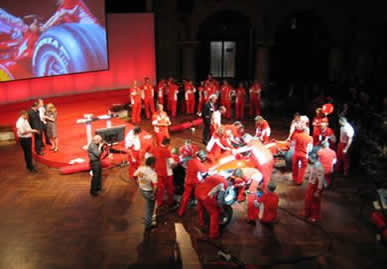
PitStop is an intensive, unique, "luxury" learning experience during which participants (particularly top managers and decision-makers) engage in collaborative team practices.
What is the PitStop scenario ?
Imagine being a member of a high performing pit-stop team which must execute a highly coordinated, interdependent group activity.
Through a hands-on experience involving a real racing car (as Ferrari) , you will be immersed in the dynamics of team collaboration and the challenges of group work under time and competitive pressure.
How long does it take to do?
The time needed for the workshop is one day.
What are the pedagogical objectives of PitStop?
The aims of the workshop are to help participants to increase their awareness of key ingredients needed for high team performance, and at the same time help them pinpoint typical team breakdown patterns that may emerge, if certain conditions are not in place.
-
EIS
-
EIS
 download EIS videos on YouTube (all related to the INSEAD/EU ChangeMasters project):
- EIS in a large organization, IKEA (Pontus Gäbel of IKEA speaking) ;
- Introduction to EIS;
- Why Try the EIS?;
- Benefits of the EIS in the public sector;
- EIS Scottish Govt commentaries
INSEAD EIS information sheet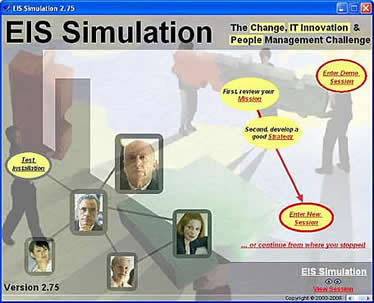
FAQs
What is EIS?
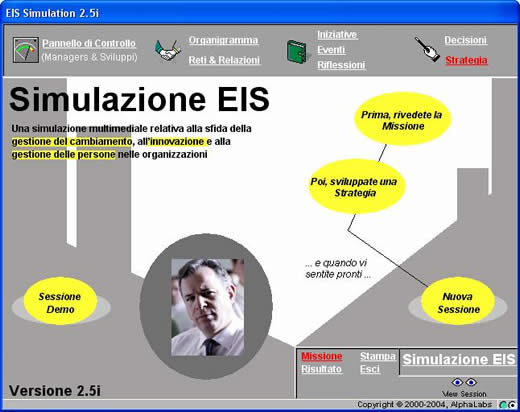
EIS is an advanced multimedia learning tool used for the implementation of organizational change and leadership.
What are its key components?
- A realistic scenario
- A challenging management mission
- A set of believable managerial actions
- A realistic set of dynamics
What is the game-like setting of EIS ?
The EIS Simulation provides participants with a rich, realistic experience of managing change in the subsidiary of a large company, as it helps them to become aware of their own beliefs, and limitations, concerning change and leadership. EIS is about changing how we address change, as it seeks to develop participants' individual change competencies and organizational change readiness.
How is it played?
Participants, working in small groups, are allotted a maximum of 6 months of (simulated) time to convince as many members as possible of a division's management team to adopt a new Executive Information System, the EIS.
How is it run, and how long does it take to do an EIS workshop?
EIS can be run online or off-line, and the time needed for an EIS workshop is from one half to one day, depending on learning objectives.
Is EIS a so-called 'serious game'?
The EIS simulation may effectively be described as serious play, that is: making the leap from traditional to simulation-based experiential learning. For more information on the subject, see Albert Angehrn's recent interview published in the Swiss review, Bilan.
Is EIS only done in English?
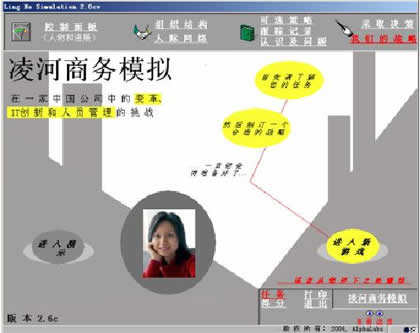
No. EIS has been translated into French, Spanish, Italian and Greek (this latter version is forthcoming), and also Chinese, with the LingHe simulation. See here below the various EIS foreign language user manuals:
French 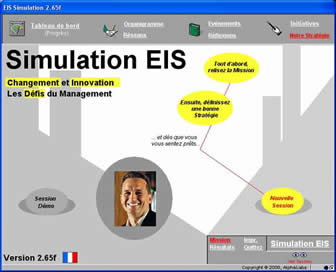 Spanish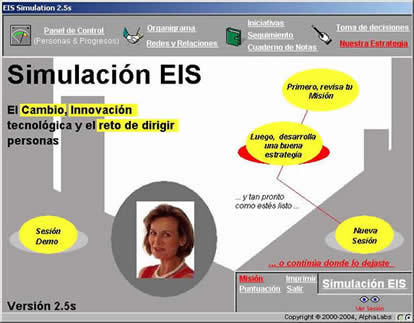
Are there customized versions of EIS?
Yes. EIS may also be taylor-made, to be taught in company specific programs. Also, customized versions exist for health care and higher education.
See also the EDU Challenge which is a version of EIS, that targets higher education.
Are there cultural adaptations of EIS, accompanied by translations?
Yes. There is the LingHe Simulation, which has already been adapted to the Chinese context, and is available in both English and Chinese (cited also here above).
There is still another such cultural adaptation (but this time without the accompanying translation, i.e., done in English only). It stands as output of the INSEAD research project entitled ChangeMasters Middle East and is a version of EIS that targets the the Middle East cultural specifics.
Its name is the GulfCom simulation.
What evidence is there of the impact of EIS in the management world?
The EIS simulation has been thoroughly tested in terms of its learning effectiveness in different organizational contexts and deployment modes – as documented in the recently completed INSEAD-CALT / EC ChangeMasters Project.
It has become a standing offering at INSEAD (see INSEAD EIS information sheet), and is indeed used today in corporate settings all around the world.
 BigSimulationBrother (BSB)
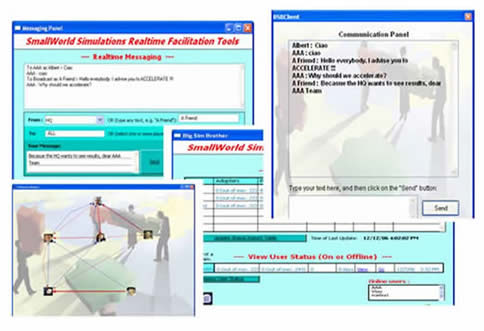
EIS now includes BigSimulationBrother (BSB), which is a real-time intervention tool for facilitators enabling them to both observe the activities of the teams as they play simultaneously on-line, and to intervene in the process and interact with the participants.

-
LingHe
-
LingHe
INSEAD Knowledge article, December 2008, "Effecting Change Management: a reality with the LingHe Simulation?" (now also on INSEAD Knowledge China portal, article in Chinese)LingHe overview presentation video INSEAD LingHe information sheet Two related articles: The Chinese Economy (2008) and INSEAD Quarterly (2005) 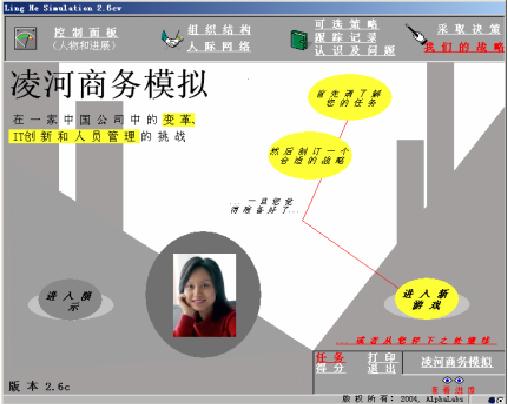
FAQs
What is LingHe?
LingHe is an adaptation of the EIS Simulation where the characters, their behavior and all dynamics (networks, cultural factors, etc.) simulate a realistic Chinese context.
What does a LingHe workshop set out to achieve?
The LingHe Simulation provides a rich, interactive learning experience, intended to help individuals understand how change and transformation take place in Chinese organizations.
How is it run, and how long does it take to do?
As with the EIS simulation, LingHe can be run online or off-line, and the time needed for a LingHe workshop is from one half to one day, depending on learning objectives.
Is it done in English only?
No. LingHe is available in both English and Chinese.
How was the Chinese context designed?
A fictitious business enterprise called the LingHe Company, located in Changsha, the capital of Hunan province, was invented for the purposes of the simulation.
The name and context of the LingHe Company were loosely based on the existing case of a state-owned textile company facing restructuring.
The particular Chinese context was thus defined in such a way as to convey a realistic case for change, that is to say:
- a traditional company becoming a joint-stock company (LingHe)
- operating under local managers who are unconvinced of any need to change the way they have always operated
- but who are nonetheless forced to undergo and execute the change
-
GulfCom
-
GulfCom
 download Invitation to participate in a pilot session of the GulfCom SimulationGulfCom flyer (pdf)INSEAD GulfCom information sheet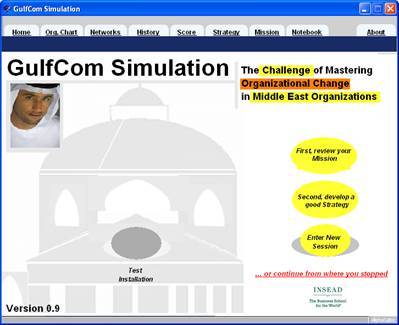
FAQs
What can be said about the new and upcoming GulfCom Simulation?
First of all, it's an example of a Small World Simulation based on the renowned EIS Simulation research, as it has been developed over the years at INSEAD by Professor Angehrn.
But, the immediate context for the creation of GulfCom has been the Change Masters Middle East Project -- an INSEAD research and development project led by Professor Albert A. Angehrn, Professor of Information Technology, at INSEAD, Fontainebleau campus, and Dr. Florian Schloderer, who assisted Professor Angehrn from the INSEAD Abu Dhabi Centre for Executive Education and Research.
In sum, the objective of this project has been to explore the specific challenges of leading change in Middle Eastern organizations and then to develop a version of a change management simulation which addresses the specific training needs in the region.
The end-result output: the GulfCom Simulation.
What's the game scenario?
Imagine yourself at GulfCom.
GulfCom is a local telecommunications company with a majority shareholder named Al Saqr Investments, and it's the Al Saqr group that has sent you to GulfCom.
Your mission:
To convince the 24 members of the GulfCom Management Team to effectively commence implementation of the group-wide Performance Management System (PMS)
As you enter the GulfCom simulation, you'll see that the new PMS has already been firmly set in place throughout the entire Al Saqr group, with the sole exception now being that of GulfCom; you'll also see that GulfCom has been very adept, at least until now, at finding convenient ways or "nice excuses" to avoid using the group-wide PMS, benefiting as it has from the overall success of the GulfCom operations.
In what specific context is the GulfCom now presented?
The GulfCom Simulation is currently the key component of 1-day learning experience workshops designed for facilitated groups of managers and decision makers who are interested in extending their understanding of the dynamics of change and transformation in Middle East contexts.
It is expected that GulfCom will quickly be fully integrated into the INSEAD curriculum.
Whom should I contact to learn more about the GulfCom Simulation?
For more information please contact:

Prof. Dr. Albert A. Angehrn
INSEAD,
Europe campus
- Dr. Florian Schloderer
INSEAD,
Abu Dhabi campus

-
FAME
-
FAME
 download the FAME User Manual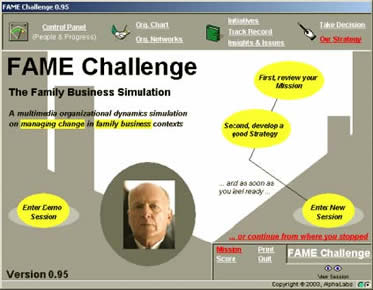
FAQs
What is FAME?
FAME, or the Family Business Challenge, is a multimedia organizational dynamics simulation on managing change in family business contexts. Its model is the EIS simulation.
And what is the specific game scenario of FAME?
In the FAME Challenge, you will be challenged to introduce an innovation in a family business, Peters Ltd.
Your mission, as formulated in the simulation, is to spend the next 6 months trying to convince the top management team of Peters Ltd. (which includes a number of members from the Peters family) to start engaging in management and ownership succession planning.
As is displayed in the unfolding screens of the simulation, you will be able to choose among many different initiatives in order to meet your goal.
In some cases, you may gather information on the managers (for example who drinks coffee with whom, etc...). In other cases, you may take direct action so as to try to convince the managers, and thus influence them so that they will adopt the proposed innovation.
Each time you implement an initiative, you will receive feedback about the impact of your decision immediately. The objective is to get as many adopters as possible in the shortest time.
In what languages is the FAME simulation available?
So far, in English only.
-
EDU Challenge
-
EDU Challenge
A related article : "EduChallenge Learning Scenarios: Designing and Evaluating Learning Scenarios with a Team-Based Simulation on Change Management in Higher Education" (with I. Schönwald, E. Dieter and S. Seufert), SCIL-Universität St Gallen, SCIL Report 8, January 2006.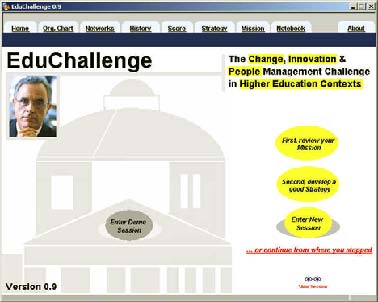
FAQs
What is the EDU Challenge?
It's a customized version of Professor Angehrn's renowned EIS simulation that is taylor-made for the higher education environment.
Who is using the EDU Challenge?
Numerous universities throughout Europe and the US are now using it.
-
aSAP
-
aSAP

FAQs
 aSAP
aSAP What is it?
The aSAP simulation is a new learning innovation developed by Professor Angehrn and his team of researchers at INSEAD.
It focuses on communication, collaboration and knowledge management.
How long does it take to do a workshop featuring aSAP?
One day.
What do participants do?
The participants, gathered into teams representing different stakeholders, try to come to an agreement about which innovative IT trends their company should implement.
What do they learn with aSAP?
The pedagogical message here is about helping participants learn about collaboration strategies as well as web trends and their potential business applications.
-
Inno-Tube
-
Inno-Tube

 For an introduction to Inno-Tube, see the brief video done by Professor Angehrn
 download Inno-Tube flyer and Inno-Tube First-time Users ManualInno-Tube journal article, Interactive Learning Environments, September 2009 See description of Inno-Tube in the INSEAD-CALT/EC project: Laboranova Further reading on the conceptual framework used:
- “Enhancing Social Interaction in Competence Development Networks: A Conceptual Framework”
- “TENTube: A Video-based Connection Tool Supporting Competence Development”
- “Designing Collaborative Learning and Innovation Systems for Education Professionals"
FAQs
What is Inno-Tube?
Inno-Tube is a new online collaborative community platform integrating the latest web trends, and which can be applied to any number of contexts.
Its ultimate goal is to foster innovation, including new product development.
It has emerged as output of Professor Angehrn's INSEAD-CALT/EC project named "Laboranova" and is listed in the professor's overall INSEAD portfolio.
How does it work?
It's Video-based networking.
Inno-Tube consists of coordinated knowledge exchange environments, namely:
- 3 Video Channels
- a Network Visualization and Navigation Tool
- Various Connection Agents & Games
Inno-Tube contains embedded connection agents which gather information about a user’s profile and system use, select the most appropriate videos and users to connect with, and stimulate users to watch and submit videos.
How does Inno-Tube add value?
Inno-Tube provides members with an attractive, interactive platform for extending their learning and networking beyond traditional management learning experiences.
What are the Inno-Tube applications?
Inno-Tube may easily be adapted to extend the collaborative learning and knowledge exchange experience of groups of distributed managers.
Has Inno-Tube been validated by tests? Any success stories in the corporate world?
Yes, indeed.
Our success story in a corporate setting is FIAT, in Italy, where Inno-Tube has been tested with success -- and continues to be very popular. For more details on this, see the new Inno-Tube journal article that gives a full report.
Inno-Tube has now also entered the INSEAD curriculum.
Also, it may be noted there is a similar platform now currently being deployed in the recently inaugurated CEDEP Pilot, with the introduction of the new GMP-Tube 1 and 11.
How do I access the Inno-Tube platform?
Inno-Tube is a prototype that is currently being tested at INSEAD. An access code and registration should first be requested of Professor Angehrn at INSEAD.
Here below is the link to the Inno-Tube online platform:
- Inno-Tube (also developed within the framework of the INSEAD-CALT/EC Laboranova project)
Are there other similar platforms?
Yes.
Other similar platforms may also be directly accessed, again upon online registration:
(done within the INSEAD-CALT/EC TENCompetence project)
(done within the INSEAD-CALT/EC ChangeMasters project)
stands alongside the Eagle Racing simulation)
(done within the CEDEP General Management Programme (GMP) and Professor Angehrn's CEDEP research pilot)
What else might be said about the new Inno-Tube? Its distinguishing features? It's key tools?
Inno-Tube combines a number of Web 2.0 technologies in view of building a virtual learning, collaboration and innovation environment.
A distinguishing feature of Inno-Tube is that the primary form of knowledge representation is not in writing, but through videos. Every member of the platform can view, record, comment and rate videos, or attach additional information to the videos, such as links or documents.
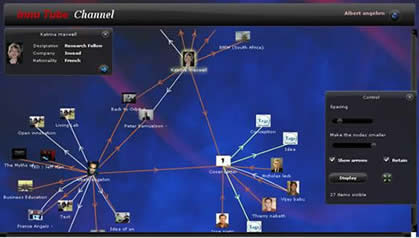
One of the key tools is the Network Visualization and Navigation Tool (NVNT). It allows for the visualization of different forms of connections between people, knowledge resources (videos), and tags.
Inno-Tube's NVNT is tool is especially useful to:
- create transparency about the distributed resources (knowledge and ideas) in the virtual learning, collaboration and innovation space;
- identify collaboration, learning and innovation opportunities;
- initiate learning, collaboration and innovation in a sustainable - and playful way (Serious Games).
Any further comments of any sort?
 See page 207 of the Inno-Tube journal article, which serves as an introductory statement:
"Our hypothesis is that Web 2.0 concepts and tools can have a positive impact on innovation in general, and in particular on new product development. To test this hypothesis, we have developed a video-based connection tool, Inno-Tube, which is based on the latest web trends and which makes extensive use of video, profiling, game dynamics, agents and network visualizations to capture the attention and involvement of community members by generating three different types of value: connection value, actionable learning value, as well as entertainment and instant gratification value. An important key concept underlying the design of Inno-Tube is that it also generates data allowing researchers to assess platform usage and evaluate system benefits along the three user value dimensions, as well as allowing individual users, and the organization, to monitor the innovation process."
See also pages 210-215 of the Inno-Tube journal article, for a detailed description of Inno-Tube in terms of McAfee's SLATES paradigm
Contact
Professor Albert A. Angehrn
INSEAD
Boulevard de Constance
77305 Fontainebleau, France
Email: [email protected]
Contact information on the INSEAD Europe Campus:
- Office PMLS 0.22, telephone extension 4361
- Assistant to Professor Angehrn: Estelle Demanze
