

ALM-ALCO Challenge
Asset & Liability Management includes the set of financial techniques to control value creation and risk in banks. ALM ensures that decision making, risk-taking and performance measurement are consistent with the corporate objectives set by senior management. It includes a valuation model of banks, the pricing of deposits and loans, capital management, credit risk provisioning, the control of risks (credit, market and non-financial), and risk-adjusted performance evaluation.
Bank Valuation and Value-based Management. Deposit and Loan Pricing, Performance Evaluation and Risk Management, McGraw-Hill, New York, 2nd edition, 2015 (with translation in Chinese and Portuguese-Brazil).
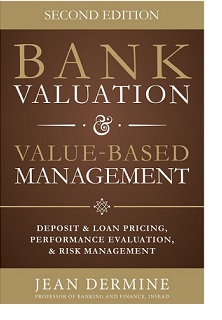 Unlike bank textbooks that emphasize institutional arrangements in the banking world, a first purpose of the book is to propose a sound valuation model for banks. Surprisingly, very few publications are available on the subject. Anchored in the fields of economics and finance, it provides not only useful tools to value banks, but also an integrated value-based management framework to discuss managerial issues such as: fund transfer pricing, risk-adjusted performance evaluation, deposit pricing, capital management, loan pricing and provisioning, securitisation, and the measurement of interest rate risk. To create value in banking, one needs to understand first the drivers of value. A sound and explicit bank valuation model is, as shown in the book, a very powerful tool to evaluate decisions that enhance shareholder value. In short, the book provides rigorous foundations to discuss Asset & Liability Management, the control of value creation and risks in banks.
Asset Liability Management, The Banker’s Guide to Value Creation and Risk Control, by Jean Dermine and Joe Bissada, FT-Prentice Hall (second edition, 2007. With translation in Chinese, Spanish, and Portuguese).
Available online from INSEAD bookshop Footnote
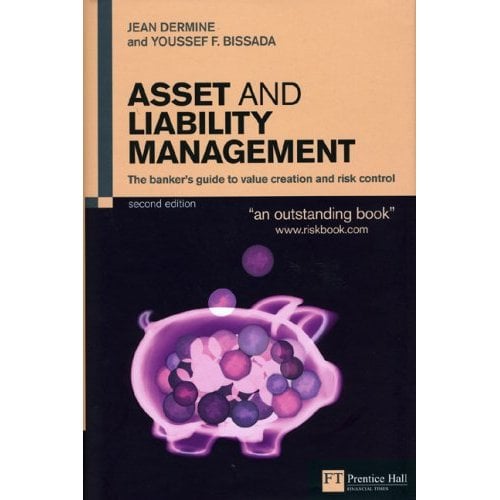 The book grows out of twenty-five years of research and training of bankers and MBAs in Europe, the Americas, Africa, Austral-asian and Asia. As deregulation and competition are reducing margins around the world, the need for knowledge of Asset & Liability Management, the Control of Bank’s Profit and Risks, becomes an absolute necessity for any banker in charge of a profit center, central bankers in charge of bank supervision and banks’auditors, consultants or lawyers. Two self-contained vehicles with exercises are provided : a book and a software. The paper-based version offers a more in-depth explanations of the concepts, while the computer version relies more on visual intuition.
Please, note that a paragraph is missing on page 30. To recover it, please click here
ALM in Banking, in Handbook of Asset and Liability Management, Volume 2:
Applications and Case Studies, North Holland Handbooks in Finance, eds. S.A. Zenios and W.T. Ziemba, Elsevier Science B.V. , 2007.
The main purpose of the chapter is to discuss Asset & Liability Management, the control of value creation and risks in a bank. This chapter is innovative in two ways. First, unlike the usual practice of restricting ALM to the control of interest rate and liquidity risks, we propose a framework to analyze both value creation and the control of risks. Second, rather than discuss the ALM issues one by one in an independent manner, the chapter provides a microeconomic-based valuation model of a bank. This allows an integrated discussion of fund transfer pricing, deposit pricing (fixed and undefined maturities), loan pricing, the evaluation of credit risk provisions, the measurement of interest rate risk for fixed and undefined maturities, the diversification of risks, and the allocation of economic capital.
Besides a comprehensive summary of the literature on ALM in Banking, the chapter makes six contributions related to transfer pricing, risk-adjusted pricing of loans, provisioning of credit risk, the relevant maturity to price and hedge deposits with uncertain maturities, the after-tax valuation of equity, and the hedging of economic profit.
Please, click here
ALCO Challenge
It is an educational computer package created by INSEAD Professors Joe Bissada and Jean Dermine to meet the training needs of bank branch managers, corporate bankers, treasurers and strategic planners. Participants are grouped into teams, each of which represents the Asset-Liability Committee (ALCO) of one bank. They take various decisions related to pricing, balance sheet management, and off-balance sheet control. A unique feature of ALCO Challenge is that it includes advanced control tools that help participants to understand the sources of profitability and risks. ALCO Challenge is compliant with the Basel III capital and liquidity regulations. The educational objectives of ALCO Challenge are fivefold:
Value creation in financial services. ALCO presents an integrated view of the links between product profitability, risk factors, capital adequacy, taxation and stock market value of banks.
Strategic pricing. The competitive environment in which the simulation takes place leads to an in-depth analysis of market prospects, other teams' strategies and competitive positioning of the bank.
Risk Management. Modern risk management techniques will cover both credit and market risks.
Negotiation. The pricing of Interest Rate Swaps and the Sale of Loans to other banks help develop the negotiation skills of participants.
Team work. The functioning of an Asset-Liability Committee (ALCO) involves the delegation of tasks, consensus, decision making, and negotiation with other teams.
To access the list of Jean Dermine's publications on ALM , please click here
Contact
Jean Dermine
Professor of Banking and Finance
INSEAD Europe Campus
Boulevard de Constance
77305 Fontainebleau
Tel: +33 (01) 60 72 41 33
Email: [email protected]
Assistant: Dagmara Boryszczyk
Tel: +33 (0)1 60 72 93 36
Email: [email protected]
